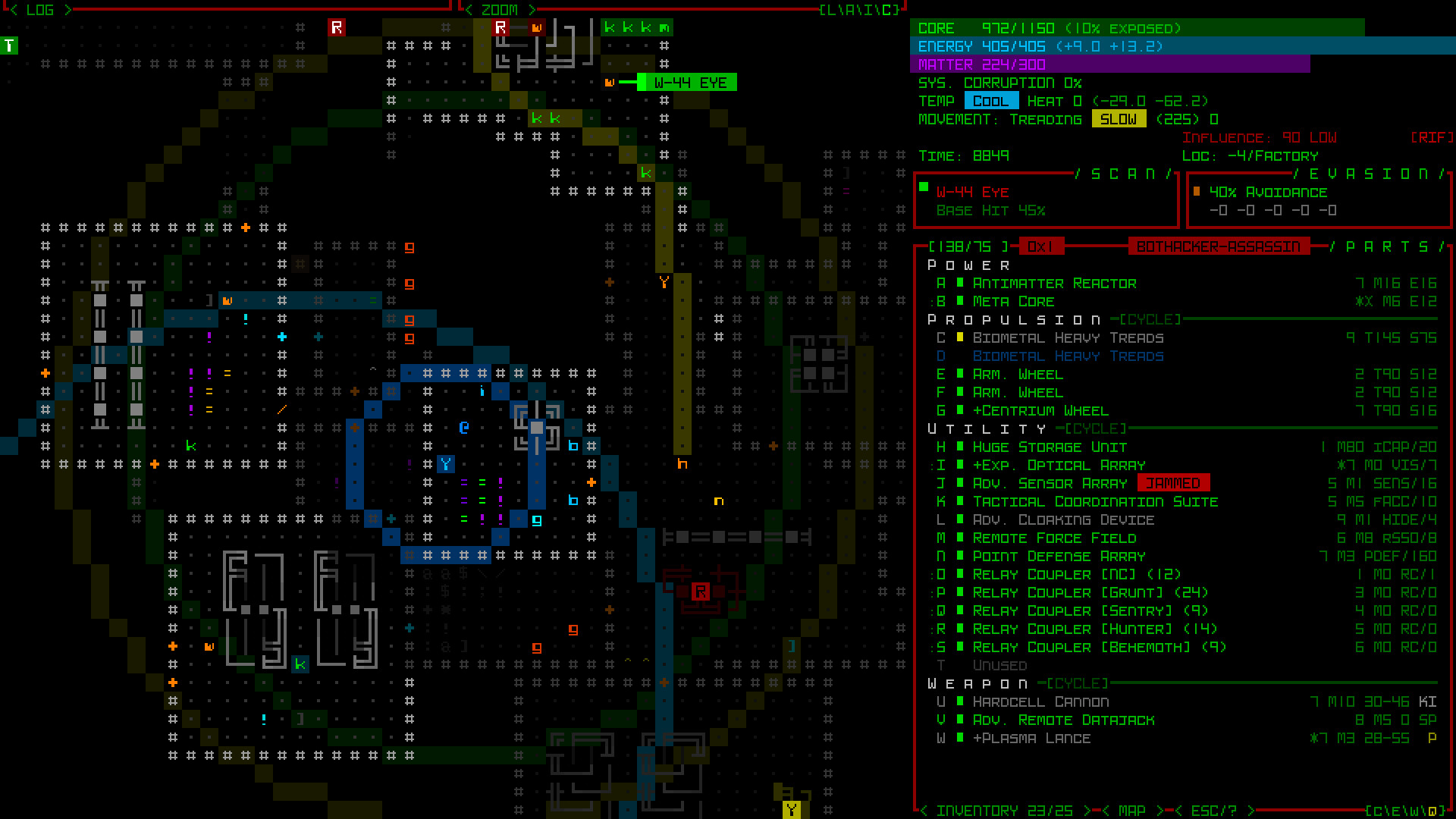
Why hacking is Cogmind's most distinctive path
Most ways through Cogmind's Complex involve dealing with the world as it is — fighting the robots in your way or evading them. Hacking is different: it lets you reach into the Complex's systems and bend them to your purposes. Rather than just surviving the environment, you read it, reroute it, and at its best command it. This is the playstyle with the highest ceiling and the most control in the game, and it is unlike anything a pure combat or evasion build can do. It is also the most demanding, because it rewards knowledge — knowing what to hack, what it can give you, and how to invest in the hackware that makes it possible. For players willing to learn, it transforms the Complex from a gauntlet into a system you manipulate.
The core idea is leverage. A combat build spends parts to win fights; a hacking build spends knowledge and hackware to avoid needing to, gaining information, safe routes and even allies that do the fighting for it. Understanding how that leverage works is the key to the path.
Hacking in Cogmind is a path you grow into. It rewards understanding the systems and some setup, so most players learn survival with an evasion build first, then layer hacking on top once they can read the Complex confidently.
Hackware: the foundation
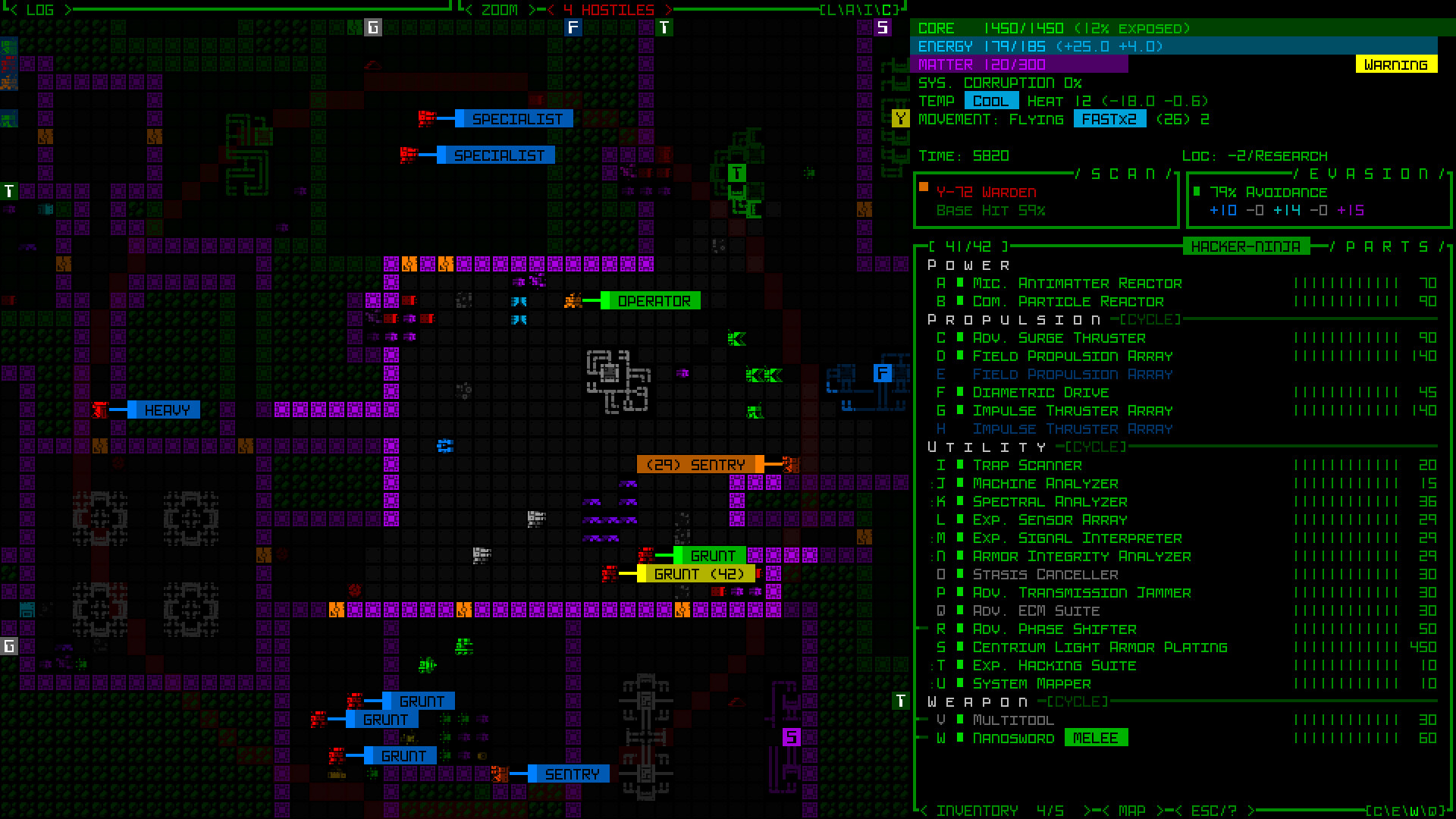
Everything about the hacking path starts with hackware — the utilities you equip to interact with the Complex's systems. Just as weapons enable combat and propulsion enables evasion, hackware enables manipulation, and investing in it determines how capable a hacker you are. With hackware equipped, you can attempt operations against terminals, machines and robots, and your success depends on the quality of your hackware against the difficulty of the target. This means a hacking build, like any Cogmind build, is something you assemble from salvage and improve over a run — the more and better hackware you carry, the more of the Complex opens up to you. Prioritising hackware utilities, and protecting them, is the practical heart of the approach.
Because hackware competes for the same limited slots as weapons and defenses, a hacking build is a deliberate choice about what your robot is for. The payoff is access to a layer of the game that brute force never touches.
What hacking wins you
The reason to invest in hacking is the breadth of what it grants. At the most basic level, it wins you information — intel about the floor, map data, and awareness of threats and routes that let you move safely. Beyond that, hacking can open and reveal routes, turning a dangerous floor into a navigable one, and retrieve schematics and resources that improve your build. Its most powerful uses involve the Complex's machines and robots directly: manipulating machines to your advantage, and recruiting or seizing control of robots as allies that fight on your behalf. An allied force is a transformative advantage, absorbing the risk that would otherwise fall on your own fragile parts.
Put together, hacking lets you read and reshape the Complex. Where a combat build reacts to the world and an evasion build avoids it, a hacking build increasingly controls it — and that control compounds as you gather intel, routes and allies across a run.
| Hacking target | What it can grant | Why it matters |
|---|---|---|
| Terminals | Intel, map data, routes, schematics | Lets you read and navigate the Complex safely |
| Machines | Manipulation and control of systems | Reshapes the environment in your favour |
| Robots | Recruit or seize allies | Allies fight for you and absorb risk |
Building and playing a hacker
A hacking-focused run is about leverage over firepower. You invest in hackware, keep enough propulsion to stay mobile and evasive (since a hacker is often still avoiding direct fights), and use your hacking to gather intel and acquire allies that handle threats for you. The playstyle pairs naturally with evasion — you avoid unnecessary combat while manipulating the Complex to clear your path — and it scales as you accumulate knowledge of what to target and build toward control. The trade-off, again, is that it asks more of you: you need to understand the systems to use them well, which is why it rewards experienced players and is a path most grow into rather than start with.
The mindset is that of an operator rather than a brawler. You are not trying to overpower the Complex; you are trying to outsmart and commandeer it, turning its own machines and information against it.
Pair hacking with an evasive, mobile core rather than a heavy combat one — a hacker thrives by avoiding fights and letting allies and information do the work. For the survival fundamentals to build on, see our Cogmind beginner guide; for how hacking ranks against other styles, the builds tier list; and for the times you must fight, the combat guide.