Your crew is your build
In Cyber Knights: Flashpoint, the mercenaries you recruit and develop are the closest thing the game has to a character build, and how you grow them matters as much as how you play a mission. Each merc belongs to a class with its own talent tree, and the talents you choose, the cybernetics you install and the weapons you mod together decide what that mercenary can actually do on a heist. A thoughtfully built crew of focused specialists will carry you through a long campaign, while a haphazard team of half-developed generalists stalls as missions get harder. This guide is about building the former: sharp, specialised mercs who each do one job extremely well and combine into a crew that can handle anything.
The throughline is focus. Every training point, every implant and every mod should serve a clear idea of what a mercenary is for. Build with that intention and your crew becomes far more than the sum of its members.
You develop your mercs between missions — spending training points on talents, installing cybernetics, and modding weapons and gear. These persistent choices compound across the campaign, so investing in coherent, focused builds early pays off for dozens of missions.
Talents and training points
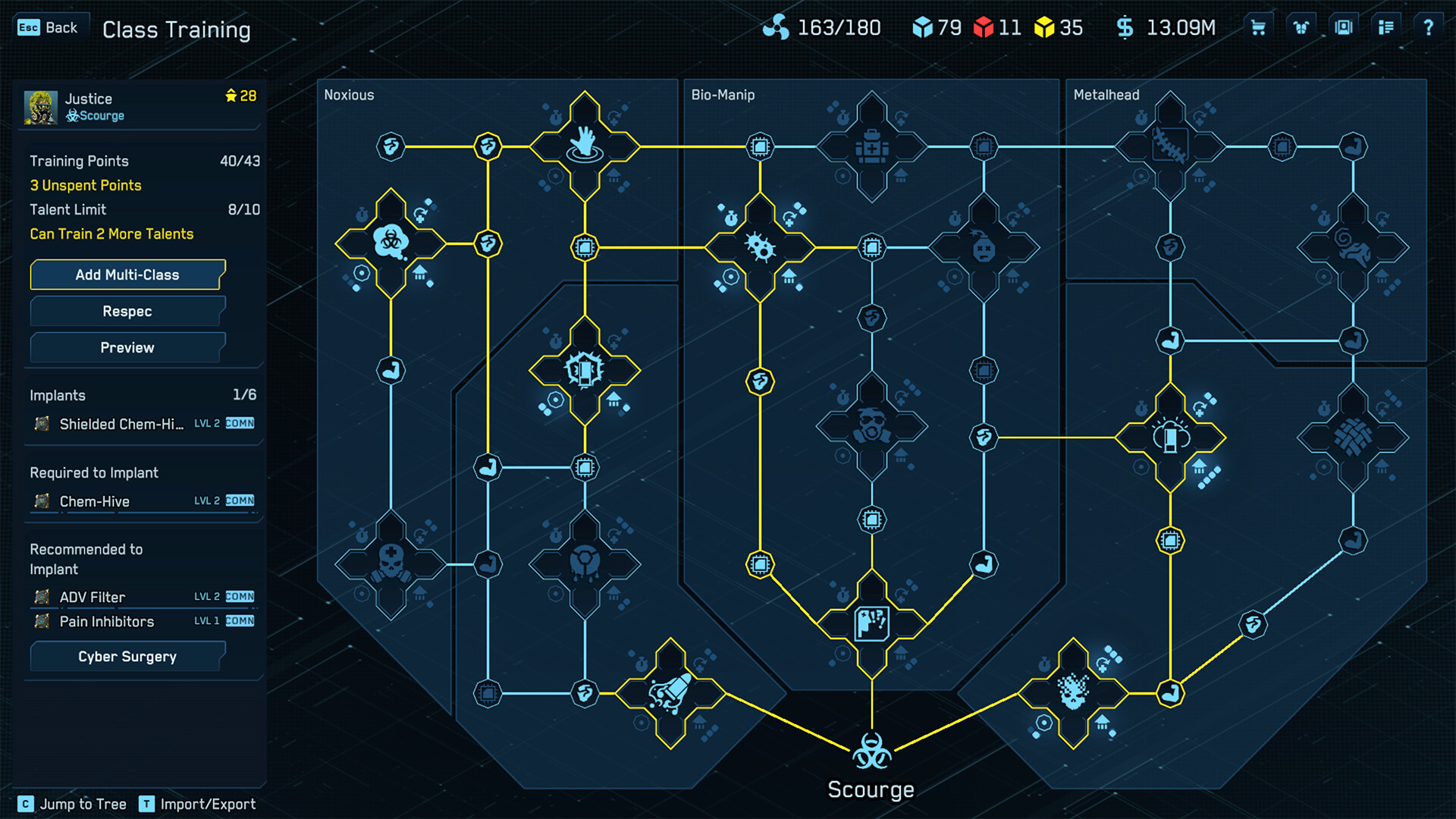
The core of any build is the talent tree. Each class has a bespoke tree of roughly fifteen to twenty talents, and you unlock and upgrade them with training points earned by leveling up, beginning with the first few and branching out along connected nodes as you progress. The crucial constraint is that training points are limited by your level, so you cannot take everything — building a merc means deciding which talents define its role. The strongest builds are focused: pour points into the talents that make a class excel at its job — a Hacker's intrusion abilities, a Soldier's firepower and Overwatch, a stealth class's infiltration tools — before spending on niche or situational picks. A merc that masters its specialty is far more useful than one that dabbles across its whole tree.
Plan a build with the merc's role in mind from the start, and spend each level's points toward that goal. Reaching the talents that define a class is what unlocks its real power, so prioritise the path there rather than scattering points along the way.
Decide what each merc is for before you spend a training point. A Hacker built for the Matrix, a Soldier built to anchor a firefight, a stealth operator built to move unseen — a clear plan turns limited points into a sharp, effective specialist.
Cybernetics and weapon mods
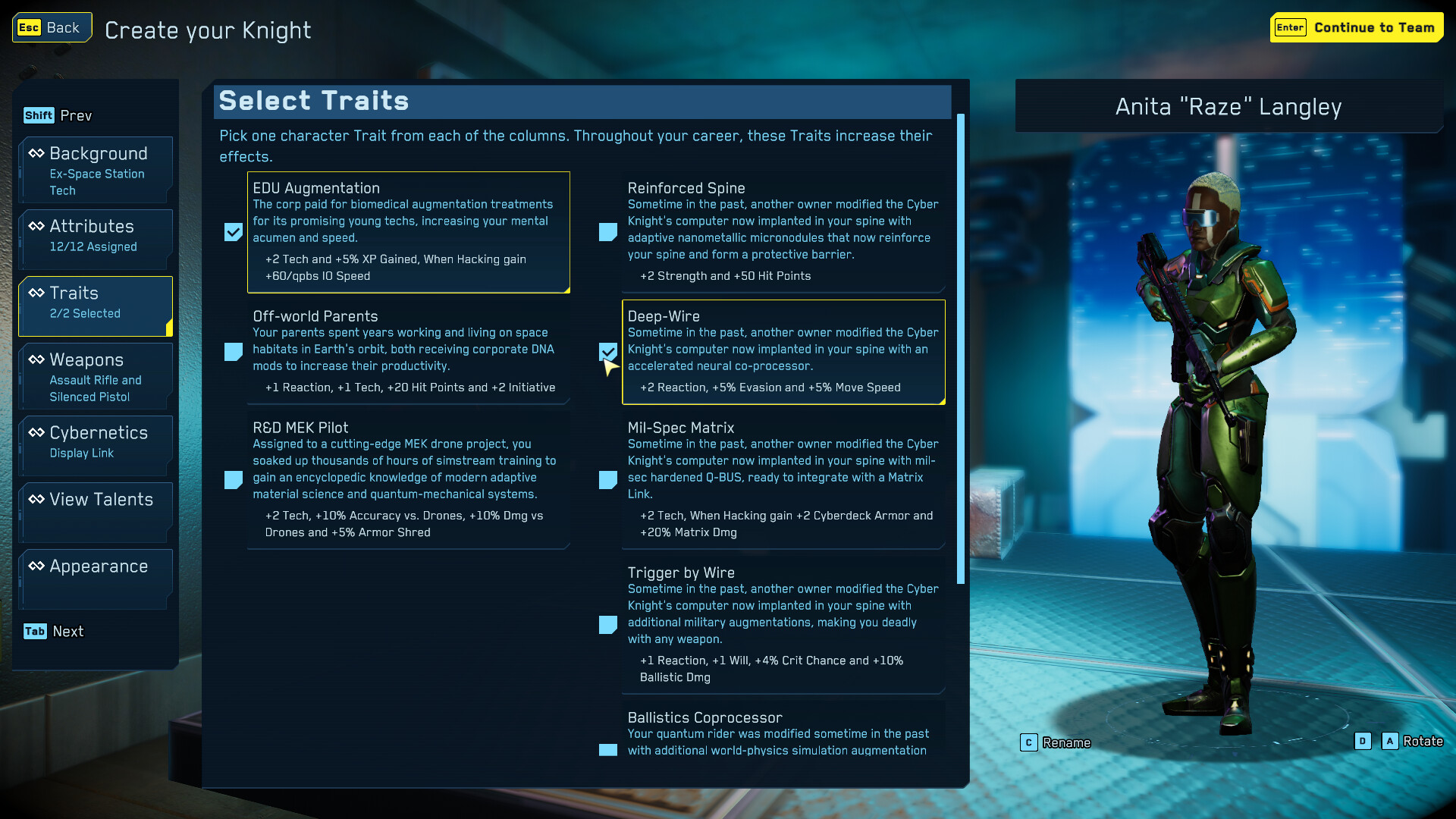
Talents are only part of a build; cybernetics and weapon mods are how you sharpen it further. Cybernetics are implants you install between missions to enhance your mercs, and the best approach mirrors talents: choose implants that amplify what a merc already does, reinforcing a combat class's lethality or a stealth class's ability to move unseen, rather than spreading generic upgrades thinly. A well-chosen implant can elevate a specialist from good to exceptional at its role.
Weapon mods follow the same logic. You can modify your weapons to tune their performance, and the best results come from matching the weapon to both its role and its user — quiet, controllable weapons for a stealth operator who must not be heard, raw firepower for a combat class meant to win a fight. Modding each weapon to fit how its wielder actually plays, rather than chasing generic stats, is what turns a decent loadout into a purpose-built one. Together, focused talents, role-matched cybernetics and tuned weapons make a mercenary genuinely formidable at its job.
| System | What it does | How to use it |
|---|---|---|
| Talents | Class abilities via a talent tree | Focus training points on the role-defining ones |
| Training points | Earned by leveling, spent on talents | Spend deliberately; you cannot take everything |
| Cybernetics | Implants that enhance a merc | Pick implants that amplify the merc's role |
| Weapon mods | Tune a weapon's performance | Match the weapon to its role and user |
Building a balanced crew
Individual builds only matter if they combine well, so assemble your crew with balance in mind. Pair focused specialists across the roles a heist demands: a Hacker built for the Matrix and security, stealth operators built for clean infiltration, a Face built to boost your whole operation, and a combat class built to anchor a firefight when a plan goes loud. Build your Cyber Knight protagonist to fill whatever gap your crew has. Because each class has its own talent tree and its own ideal cybernetics and weapons, a crew of well-built specialists covers far more situations than a team of interchangeable generalists, and it gives every mission multiple ways to succeed.
Develop them deliberately over the campaign — focused talents, role-matched implants, tuned weapons — and your crew scales smoothly with the difficulty. To put these builds to work, see our stealth and hacking guide and the classes tier list; if you are still finding your feet, the beginner guide lays the groundwork.
Do not scatter a merc's training points across its whole tree. A focused specialist who excels at one job beats a generalist who is mediocre at several, and a crew of sharp specialists is what carries the late campaign.