Stealth is the game
Cyber Knights: Flashpoint is a heist game first, and stealth is not an optional playstyle but the core of how it is meant to be played. A mission where you slip in, complete your objectives and slip out without ever being seen is the game at its best — tense, clever and hugely satisfying in a way a shootout never is. Everything in this guide serves that goal: reading the security, managing your movement, hacking the level, and keeping combat in reserve for when a plan breaks. Master these and the game opens up; ignore them and you will fight the entire map every mission. The mindset to hold is simple: you are planning a robbery, not a battle, so the win condition is to never be noticed.
Once that clicks, each level becomes a puzzle of sight lines, patrols and locked systems to solve quietly. The tools below are how you solve it.
Scouting is free and detection is expensive. Before committing any move, look at what the cameras, plates, lasers and guards around you can see. A few seconds of observation prevents the single mistake that turns a silent heist into a firefight.
Reading security and sight lines
The foundation of stealth is understanding what can detect you. Levels are layered with security: cameras watch fixed cones, pressure plates and laser grids trigger if you cross them, and human guards patrol with their own moving sight lines. Each has an area of awareness, and your job is to stay out of all of them. That starts with scouting — before you move a mercenary, study the security around your path and identify the safe lanes between watched areas. Then move from cover to cover along those lanes, never stepping into a sight line you have not checked. The most common cause of detection is not a clever enemy but a player who rushed into an area they could have seen was watched.
Guards add a timing element on top of fixed security. Because they move, a route that is dangerous one moment is safe the next, so watch their patterns and advance when they are turned away or walking off. Treat the whole level as a moving puzzle of awareness, and solve it one careful step at a time.
Plan your route to your objective before you take the first step, not as you go. Knowing where the safe lanes and choke points are turns a mission from a nervous improvisation into a deliberate, repeatable infiltration.
Action points keep you hidden
Stealth and the action-point system are deeply connected. Because every move costs action points and you can act in any order while points last, you control exactly how far and how carefully your crew advances each turn. The key discipline is to move in measured steps and always end your turn in cover and out of sight lines — never spend your last point dashing into the open. Leaving yourself positioned safely, with awareness of what is around you, means you are never caught exposed at the start of the enemy's turn. Plan each turn as a short, safe advance rather than a sprint, and use your AP to set up the next move as much as to make the current one.
This measured approach is also what lets you react. A crew that ends its turns in cover with options open can adapt when a guard shifts or a plan changes; one that overextends has no room to recover. Patience, expressed through careful AP spending, is the engine of good stealth.
| Threat | How it detects you | How to beat it |
|---|---|---|
| Camera | Watches a fixed area | Avoid its cone or hack it off |
| Pressure plate / laser | Triggers if crossed | Route around it or disable it |
| Guard | Patrols with a sight line | Time movement, use cover, distract |
| Matrix security | Defends digital systems | Hack it with offensive programs |
Hacking the Matrix and going loud wisely
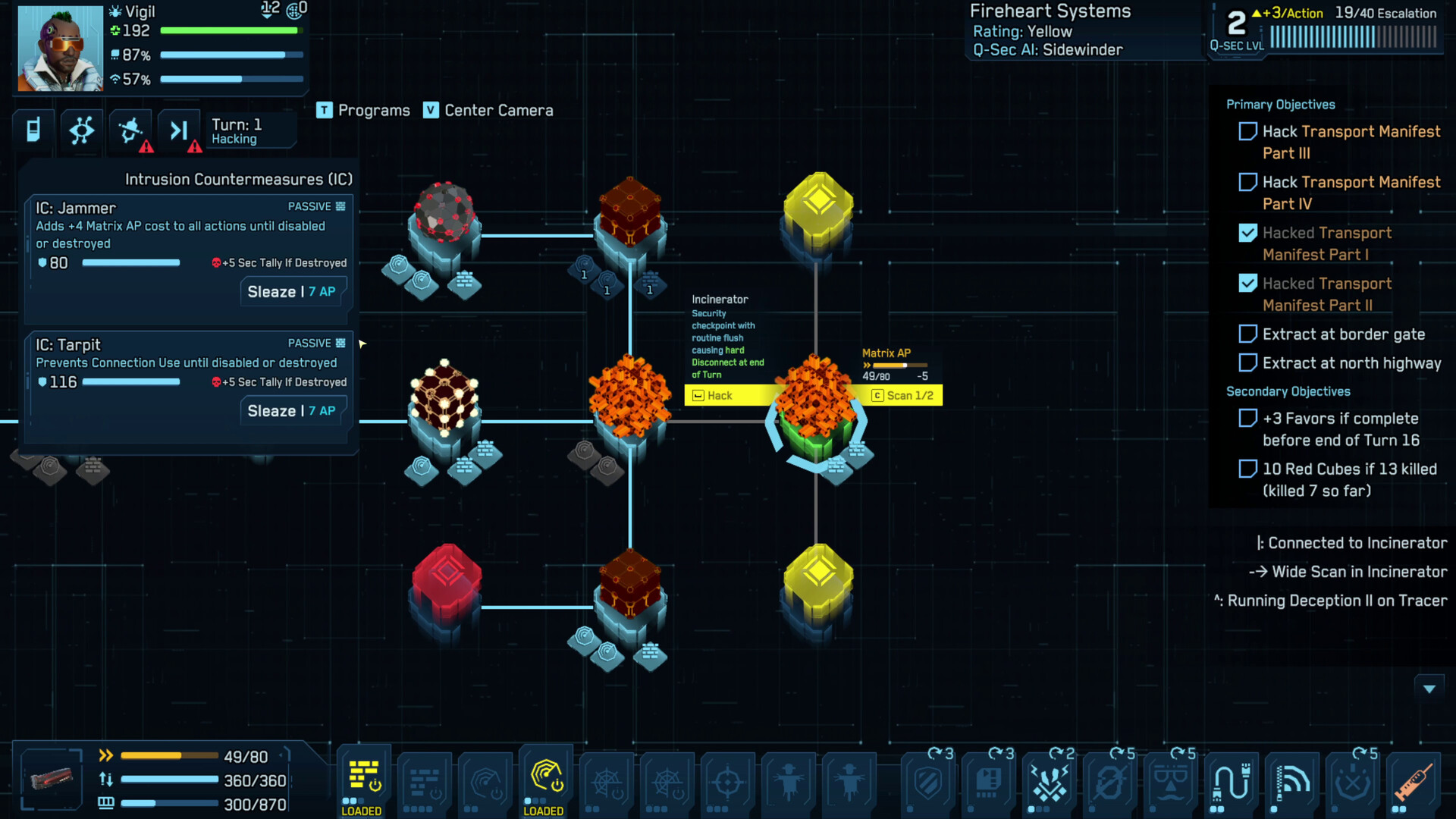
Hacking is your most powerful stealth tool. A Hacker plugs into the Matrix and faces a level's digital security — running offensive programs against the intrusion countermeasures that defend it — and winning lets you seize control of cameras, doors and alarms, disabling them or turning them to your advantage. A good hack can clear an entire route, opening locked paths and blinding the security so your crew walks through unopposed, and some objectives require hacking outright. Treat the Matrix as a second battlefield you win by control rather than force, and use it to dismantle the obstacles between you and your objective before your crew ever reaches them.
Even with perfect planning, some heists break, and that is when combat becomes your fallback. The turn-based fighting is strong, but going loud should be a deliberate choice, not a panic: fall back on a prepared position, use a combat class's firepower and Overwatch, and fight in control rather than scrambling. The crews that survive a blown heist are the ones that planned for the possibility. To build a team that can both sneak and fight, see our classes tier list and builds guide; if you are still learning, the beginner guide covers the basics.
Do not treat going loud as a reset button. Charging into a firefight without a plan, a combat class or good positioning is how crews get wiped. If a heist breaks, fall back, set up, and fight on your terms — or, when possible, disengage and slip away.