
A fortress runs on organisation
Once your dwarves are fed, watered and sheltered, Dwarf Fortress becomes a game of organisation, and how well you manage your fortress determines whether it thrives or grinds to a confused halt. The core challenge is that you have many dwarves, many jobs and a sprawling, vertical space, and keeping all of it working smoothly takes deliberate planning. Three things matter most: assigning labours so the right work gets done, arranging workshops and stockpiles so production is efficient, and organising your fortress across its z-levels into a coherent layout. Get these right and your fortress hums along, producing what it needs and supporting a growing, content population. Get them wrong and you get idle dwarves, stalled jobs and a colony that feels perpetually behind.
This guide is about that organisation — the difference between a fortress that works and one that merely survives. The food and drink economy underpins all of it, so we will cover that too.
Remember that you manage tasks and assignments, not individual dwarves. Good fortress management is really good systems management: set up labours, workshops and stockpiles well, and your dwarves will run the fortress themselves.
Labours: getting the right work done
Labours are the heart of fortress management. Each dwarf can be assigned which labours they are allowed to perform — mining, woodcutting, carpentry, masonry, brewing, cooking, farming, and many more — and the game creates jobs from your designations and your fortress's needs, which dwarves then pick up if the labour matches. Managing this well is a balancing act. You want your skilled dwarves doing the work they are good at, since skill affects quality and speed, but you also need every essential labour covered so nothing critical stalls. Early on, dwarves often wear many hats; as your fortress grows, you can specialise, dedicating dwarves to particular trades.
The common failure is mismanaged labours: too many dwarves enabled for everything, so they grab random low-priority jobs while important work waits, or too few enabled for a vital task, so it never gets done. Periodically review who is doing what, make sure key jobs — brewing, farming, hauling, masonry — are well covered, and adjust as your needs change. A fortress with thoughtful labour assignments simply gets more done.
Give your most skilled dwarves the labours that match their skills and limit them to those, so they are not pulled onto unrelated chores. A dedicated brewer, mason or farmer who focuses on one trade produces better goods faster than a jack-of-all-trades.
Workshops, stockpiles and z-levels
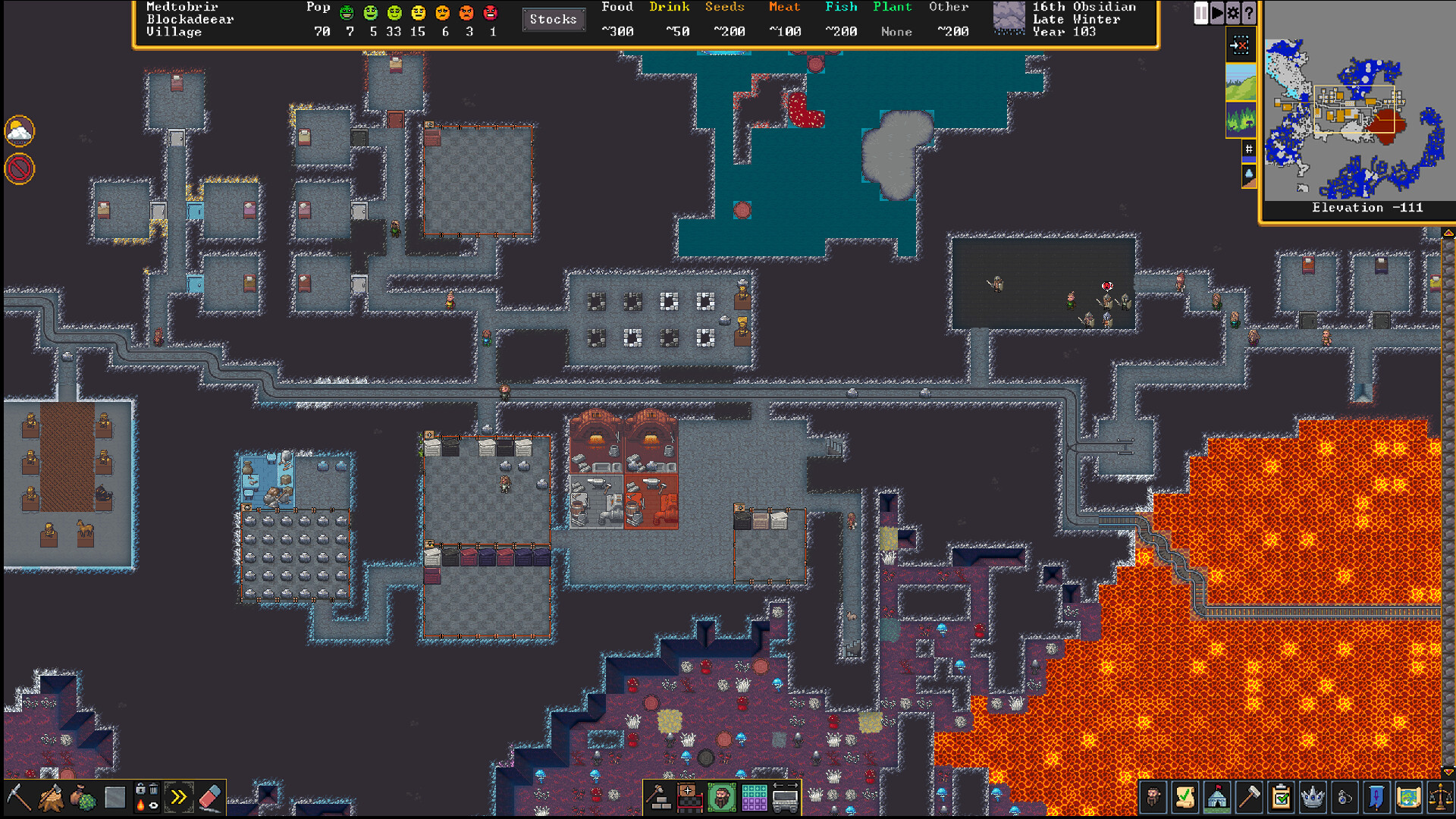
The physical layout of your fortress matters as much as your labour assignments, because dwarves spend an enormous amount of time hauling materials, and every wasted step slows production. The single biggest principle is to place workshops near the stockpiles they draw from and feed. Your still should sit beside the stockpiles of plants it brews and the drinks it produces; your kitchen near the food; your mason near the stone; your carpenter near the wood. Grouping related production and storage cuts hauling dramatically, and it is one of the easiest ways to make a fortress feel faster and more efficient.
Layered on top of this is the vertical dimension. Your fortress spans z-levels, and thinking vertically lets you build compact, organised and defensible. Rather than sprawling across one level, you might stack related areas — food production on one, workshops on another, bedrooms on a third — connected by central stairways, so everything is close and travel is short. A tight vertical layout keeps hauling distances down, makes your fortress easier to defend, and keeps your dwarves moving efficiently between the areas they use.
| Element | Principle | Payoff |
|---|---|---|
| Labours | Assign by skill, cover essentials | Important work gets done well |
| Workshops | Place near their stockpiles | Less hauling, faster production |
| Stockpiles | Group near related workshops | Materials and goods stay close |
| Z-levels | Stack related areas, connect by stairs | Compact, efficient, defensible |
The food and drink economy
Beneath all your management sits the food and drink economy, which never stops mattering. Drink is the constant priority — dwarves dehydrate in days — so a still kept supplied with plants to brew, and a healthy drink stockpile, are non-negotiable foundations. Food follows: a reliable farm growing crops, supplemented by fishing, hunting and gathering, and a kitchen to cook varied meals, keeps your dwarves fed and, because variety improves their mood, happier. As your fortress grows, scale this economy up so production keeps pace with your population, and keep an eye on your stockpiles so a shortage never catches you off guard.
A well-run food and drink economy is what frees the rest of your fortress to flourish. With drink and food handled, your dwarves can mine, craft, build and defend without the constant threat of dropping from thirst or hunger. Keep this backbone strong, organise your labours and layout around it, and your fortress becomes a smooth, self-sustaining machine. To protect everything you have built, see our military guide, and to keep your dwarves content as the fortress grows, the happiness guide. If you are still finding your feet, the beginner guide covers the basics.
Do not let your fortress outgrow its food and drink supply. A booming population that outpaces your brewery and farm will start to go thirsty and hungry, and hungry, unhappy dwarves are how a thriving fortress tips into a tantrum spiral. Scale production with your numbers.