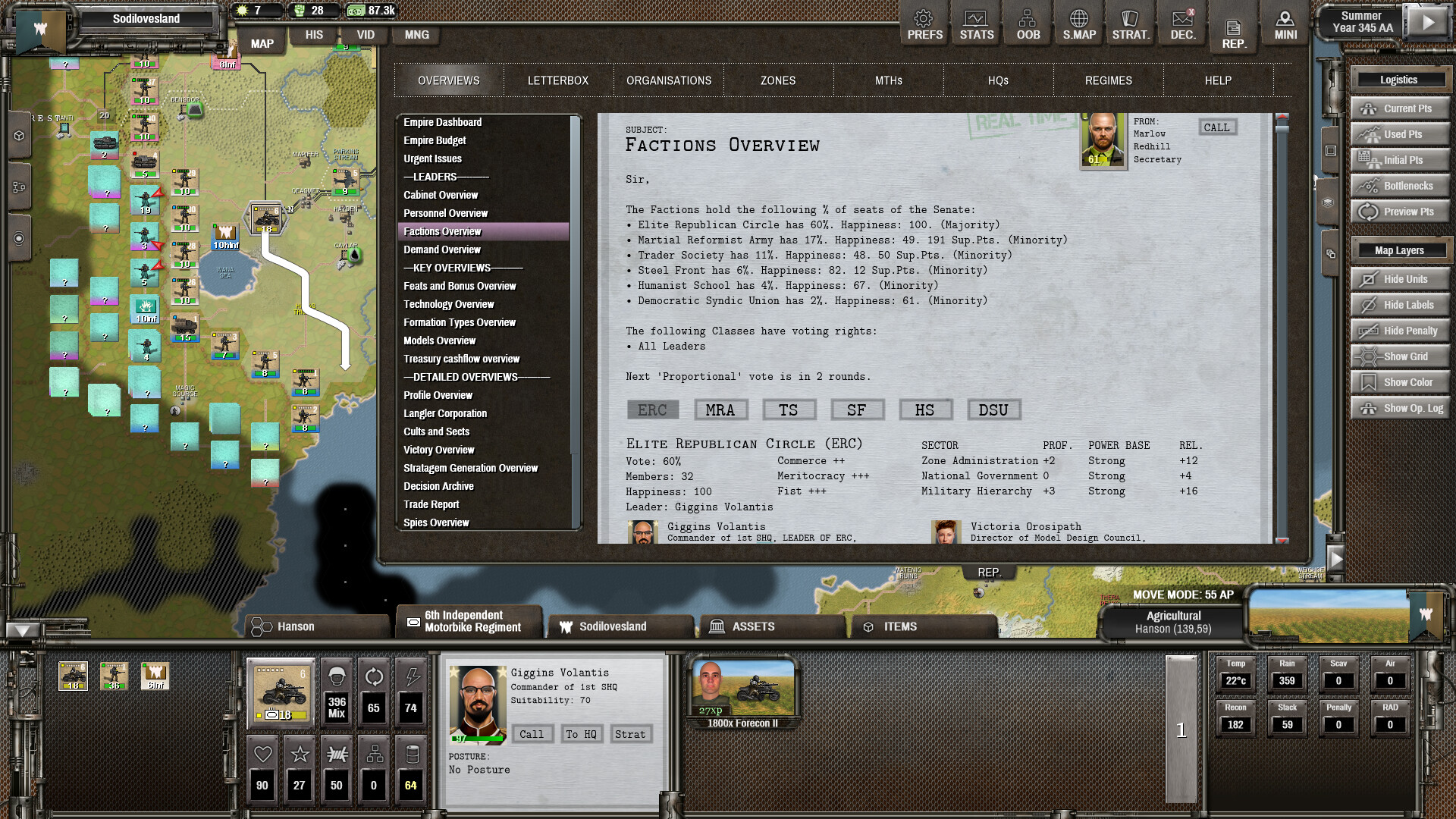
Your nation is a living political machine
It is tempting to think of Shadow Empire as a wargame with some administration bolted on, but the truth is the reverse: the war rests on a deep, living political and economic machine, and learning to run it is half the game. You do not control your empire directly so much as govern it through councils and leaders, spend political power to act, play stratagems to steer, and fund everything through an economy you balance against your people's patience. Get this layer right and your armies are supplied, your tech advances and your nation holds together; get it wrong and you collapse from within long before an enemy reaches you. This guide explains how the governing machine works and how to keep it running in your favour.
The mindset to hold is that people and power, not just resources, run your empire. A nation of loyal, capable leaders with political power to spare is far stronger than a rich one that cannot govern itself.
Almost everything you do with your leaders and government costs political power, and many of your most important actions are stratagems. Think of political power as the fuel of your governance and stratagems as the levers — you need both flowing to steer your nation.
Councils and leaders: the people who run things
Your empire is administered through councils — interior, military, economic and more — and each is headed by a director you appoint from your leaders. This is the human core of the game. Leaders have their own skills, ambitions and loyalties, so a capable, well-matched director turns a council into a genuine asset, while a weak or ill-suited one squanders its potential. Recruiting good leaders and slotting them into the councils that fit their talents is therefore one of your highest-value activities, especially early, when a few strong directors can transform how your nation functions. Open councils you can actually staff well rather than spreading thin talent across too many.
Just as important is keeping those leaders managed. Ambitious or neglected leaders can become liabilities — sources of unrest or even coups — so part of governing is tending relationships, watching loyalties, and using your power to keep your leadership working with you rather than against you. The same people who run your empire can unmake it if ignored.
Match councils to the leaders you have, not the other way around. A council led by a director whose skills fit it will far outperform one staffed by whoever was available, so let your talent pool shape which parts of government you prioritise.
Political power and stratagems: steering the nation
Political power is the master resource of governance. You spend it to appoint and dismiss directors, create new posts, respond to the events that constantly arise, and play stratagems, which means a nation short of political power simply cannot act — it freezes while problems pile up. Generating a healthy, steady supply of it, especially early, is what keeps your regime responsive and in control. Treat it as a priority resource, not an afterthought.
Stratagems are the levers you pull with that power. Drawn from your councils and leaders, they are playable actions that shape your empire across economic, military, diplomatic and political lines — adjusting your economy, launching operations, managing diplomacy, and steering through crises. The skill is in choosing the right ones and timing them well: the stratagem that defuses unrest, funds an expansion, or seizes a military opportunity at the right moment can change the course of a game. Together, political power and stratagems are how you actively govern rather than merely react.
| Element | What it is | How to use it |
|---|---|---|
| Councils | Departments run by directors | Staff with capable, well-matched leaders |
| Leaders | People with skills and loyalties | Recruit, place and keep them loyal |
| Political power | The resource for governing actions | Generate steadily; spend on priorities |
| Stratagems | Playable actions across domains | Time them to steer and resolve crises |
Economy, stability and holding it together
Underpinning all of it is the economy, which funds your government, military and expansion. Your nation runs on resources — metal, rare metals, energy, food and more — alongside production and credits, and you raise revenue largely through taxes, setting income and sales rates to balance income against your population's tolerance. Push taxes too high and unrest rises; too low and you cannot afford your ambitions. Managing your resources, covering shortfalls through development or trade, and keeping production flowing are constant tasks that determine what your empire can actually do.
Stability ties everything together. A regime that taxes sensibly, keeps its leaders loyal and its people tolerably content, and uses political power and stratagems to address problems early will hold firm; one that neglects any of these can fall apart from within. So govern with an eye on the whole machine — economy, leadership and stability at once — and your nation becomes the stable foundation your armies and logistics need. To put that foundation to work, see our military guide and logistics guide; if you are just starting, the beginner guide covers the early priorities.
Do not let governance slide while you focus on war. Most Shadow Empire defeats begin at home — an empty political power pool, a disloyal leader, or an angry population — long before the front collapses. Tend your nation as carefully as your armies.