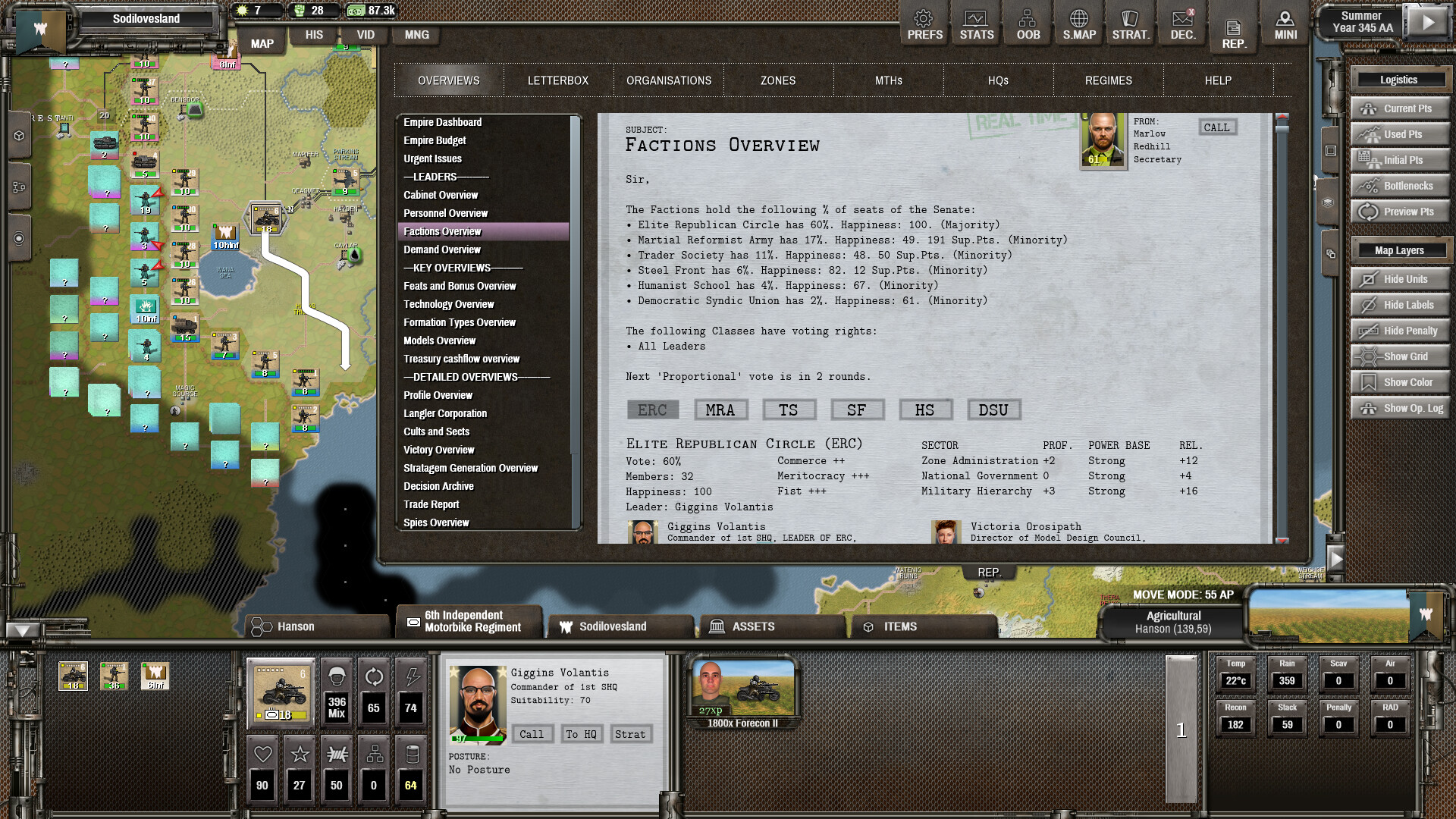
War is built, not bought
Shadow Empire does not hand you a fixed roster of units; it hands you a design system and asks you to build your own military. That freedom is powerful but daunting, and it is why a new player's army can feel like a confusing mess while a veteran's is a precise instrument. The path from one to the other runs through four things: designing units that fit your situation, organising them into formations and an order of battle, spending operational points wisely, and fighting in a way that exploits morale, readiness and entrenchment. Underneath all of it sits the logistics that keep your forces fed — covered in our logistics guide — because even a perfect army starves out of supply. This guide walks through turning your forces into a war-winning machine.
The mindset that matters: your military is an extension of your economy, tech and logistics. Build it to fit what you can research, afford and supply, not to chase the biggest units on paper.
Combat in Shadow Empire rewards condition over size. A rested, supplied, entrenched force can beat a larger one that is exhausted or out of supply, so the state your units are in when they fight is often the deciding factor.
Designing units that fit your situation
The foundation of your military is unit design. You build units by combining components — chassis, weapons, armour and more — within the limits of your researched technology and your resources, which lets you tailor each unit to a role and a budget. Cheap infantry to hold ground, heavier armoured units to break lines, artillery to support an assault: each is a balance of capability against the cost in resources and production to field it. Because you design them, your army reflects your tech path and your economy, and as your research advances you unlock better components and can redesign units to keep them competitive.
The practical advice is to design for purpose and affordability rather than maxing every stat. A force of well-judged, sustainable units you can actually supply and replace will serve you far better than a handful of expensive showpieces you cannot maintain. Let your research and resources guide what you build.
Revisit your unit designs as your technology improves. Outdated units fall behind, and a quick redesign with newer components — better weapons or armour — keeps your formations effective without rebuilding your whole army from scratch.
Formations and the order of battle
Individual units win nothing if you cannot command them coherently, which is where formations come in. You organise your units into formations — larger, commandable groups — structured within your order of battle, and this organisation is what makes war at scale manageable. A clear structure lets you assign roles: a front-line formation to hold or break a sector, a mobile reserve to exploit or plug gaps, garrisons to hold cities and supply points. Grouping units this way keeps your army cohesive and turns a sprawling collection of units into a force you can actually direct.
Investing in a sensible order of battle pays off the moment a war gets complex. When you can think in terms of formations with clear jobs rather than dozens of individual units, you make better decisions faster, and your army responds as a coordinated whole rather than a crowd.
Operational points and winning battles
Commanding formations costs operational points, the resource you spend to move and attack. They effectively cap what a formation can do in a turn, so good play means planning each formation's actions around what its operational points allow — prioritising the decisive moves and not trying to do everything at once. Treat operational points as a budget for action, and spend them on what matters most: the attack that breaks a line, the move that secures a position, the redeployment that saves a front.
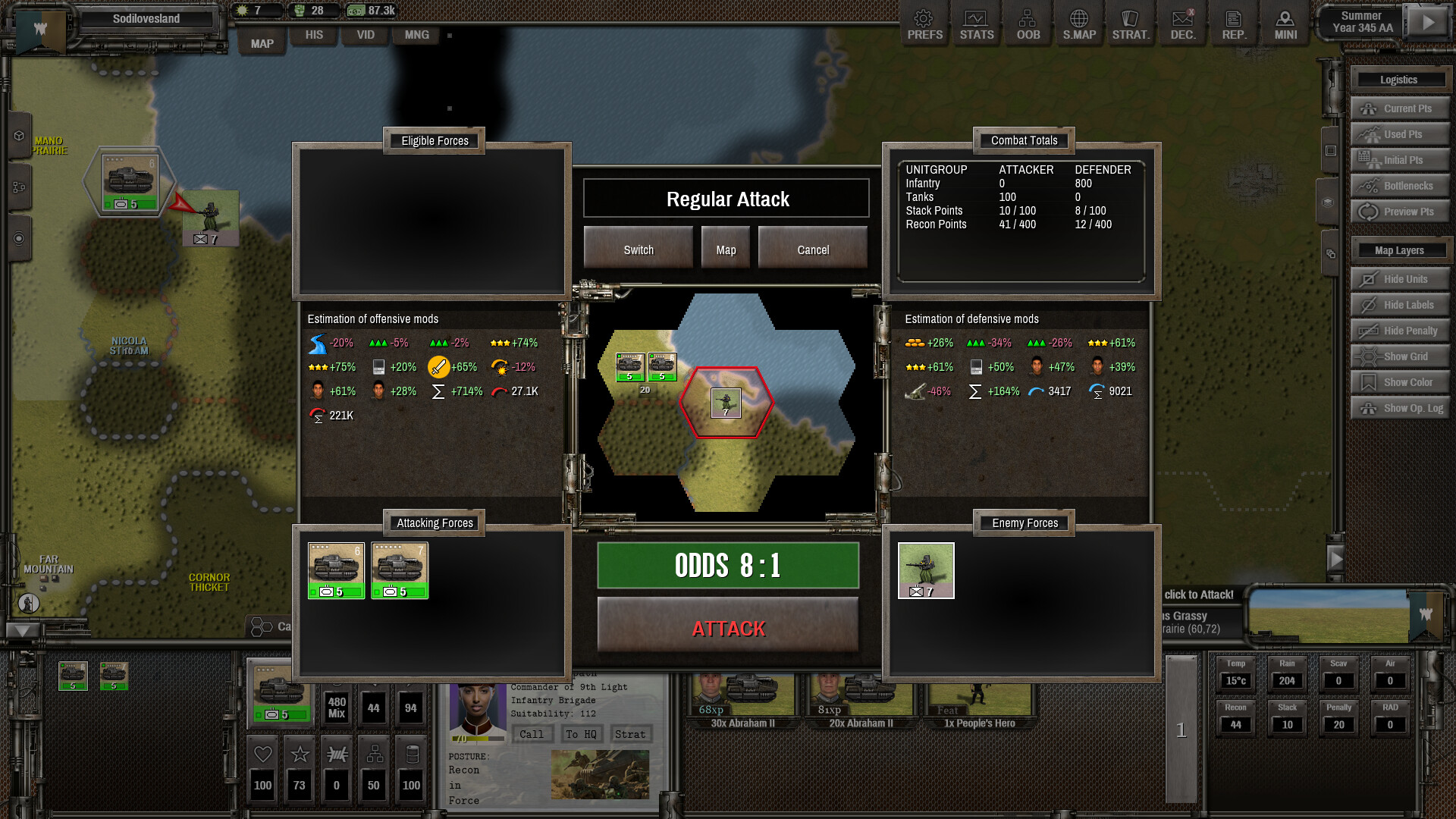
Winning the actual battles then comes down to state as much as strength. Combat is turn-based on a hex grid, and morale, readiness and entrenchment heavily shape outcomes: a dug-in, rested, supplied defender can repel a larger but worn-down attacker, while an exhausted force flung forward will underperform its numbers. So fight on good terms — rested and supplied, entrenched when defending, concentrated when attacking — and let condition do half the work. All of it rests on keeping your forces supplied, which loops back to logistics, and is funded by the economy in our stratagems and governance guide. If you are still learning the basics, start with the beginner guide.
Do not throw worn-down units into attacks to force a breakthrough. Low morale and readiness can turn a numerically winning fight into a costly failure. Rest, resupply and entrench your forces, then commit them in good condition.