Your army is starving — what to check, in order
Supply failures in Shadow Empire nearly always come from the same short list, and the order matters because the cheap fixes are also the most common causes.
| Order | Check this | Why it is this high | The fix |
|---|---|---|---|
| 1 | **Is there a road?** | Supply range depends on the terrain it crosses. Open terrain is expensive, hard terrain worse, and dirt and especially paved roads are far cheaper — so roads extend your reach further than extra trucks do. | Build road toward the front before building more trucks. |
| 2 | **Is the army past the last truck station's range?** | Where the range ends, your supply ends. An army beyond it starts to starve no matter how healthy your economy is. | Push a new truck station forward and relay supply to it. |
| 3 | **Does every city have a truck stop?** | Public truck stops are cheap and they are what keeps your territory attached to the network at all. A city without one is a hole in the relay. | One public truck stop per city, as a standing habit. |
| 4 | **Are the right stations upgraded?** | Upgrades move more supply, but only where volume is the constraint. | Upgrade the stations near your SHQ and any sharing a hex with a train station first. |
Why logistics is the heart of Shadow Empire
Most strategy games treat supply as an afterthought; Shadow Empire makes it the centrepiece. Here, getting resources and supplies from where they are produced to where your armies actually fight is a real, physical network you build and manage, and it is the single system that most determines whether your wars succeed. An army can have the best units in the world and still grind to a halt if it has outrun its supply. Learning how supply flows — from your SHQ, through truck stations, across terrain and roads, to the front — is therefore not optional; it is the core skill of the game. This guide walks through that chain so you can keep your empire and your armies fed.
The mindset to adopt is that logistics comes before conquest. You do not push your forces forward and then worry about supply; you build your network forward and let your forces follow it.
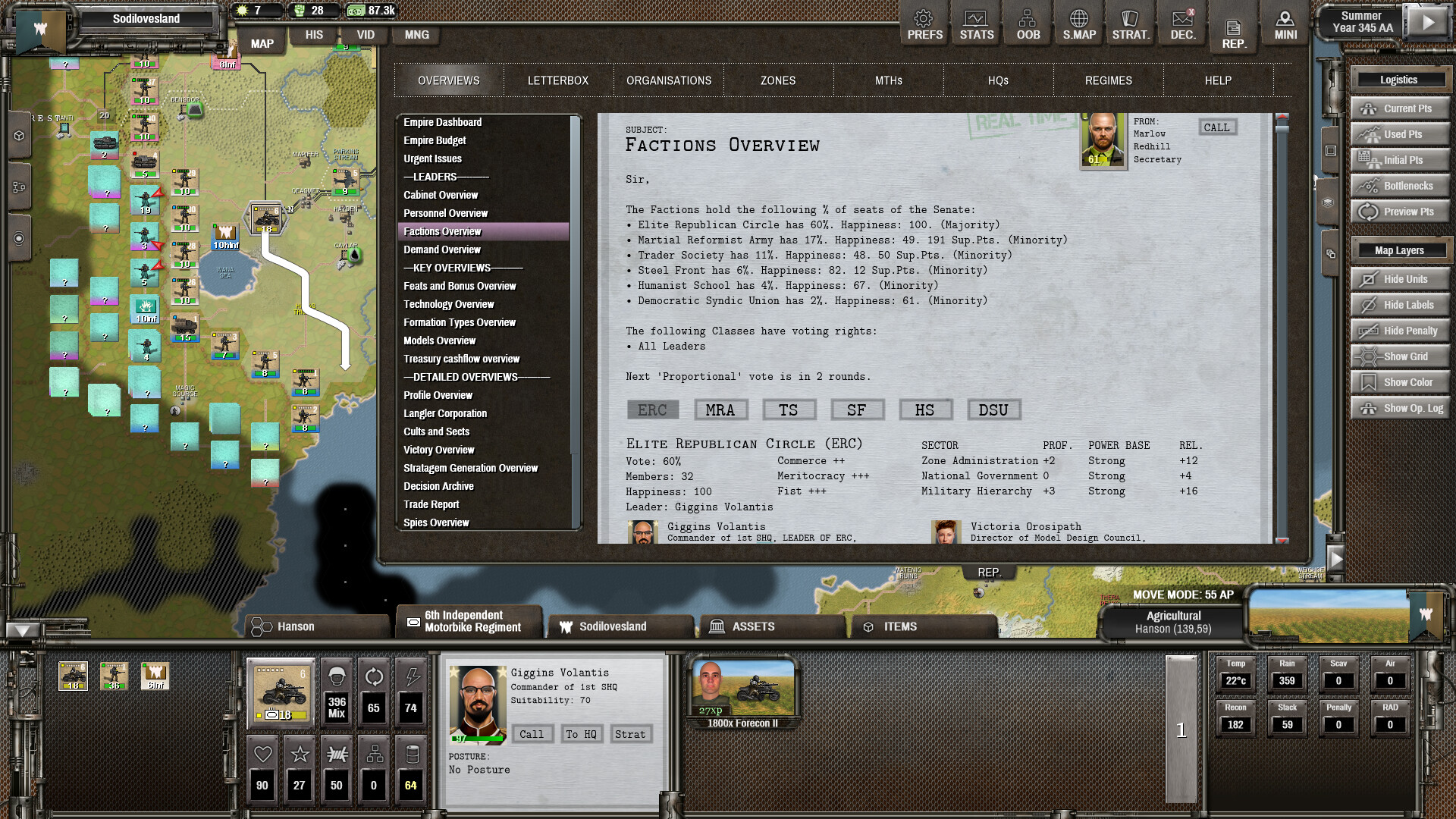
Turn on the operational logistics display to see your supply ranges drawn on the map. Visualising where supply reaches — and where it runs out — is the fastest way to understand the system and avoid pushing armies into a supply gap.
The supply chain: SHQ, truck stations and range
At the top of the chain is your SHQ, the Strategic HQ that collects your resources and supplies. From there, truck stations carry that supply across the map to your cities and your armies. The crucial concept is range: a truck station can only push supply so far, and how far depends on the terrain it must cross. Open terrain is expensive to move supply through, hard terrain more so, while dirt roads and especially paved roads are far cheaper — meaning supply travels much further along roads than across open ground. The practical consequence is that your network's reach is shaped as much by your roads and the map as by the number of trucks you have.
Think of it as a series of relays. Supply is collected at the source, carried by truck stations within their range, and handed forward. Where that range ends, your supply ends — and any army beyond it will start to starve. Building and upgrading truck stations, and connecting them with roads, is how you extend that reach toward where you need it.
A simple, reliable habit is to build one public truck stop in each city. They are cheap, and they keep your territory connected to your supply network. Upgrade the ones that matter most — those near your SHQ or sharing a hex with a train station — to move more supply where it counts.
Roads, rail and depots: extending your reach
Once you understand range, extending it becomes your main logistical lever, and you have three big tools. Roads are the first: laying dirt and then paved roads toward your front slashes the cost of moving supply and stretches your network much further than open terrain allows. Rail is the second: train stations act as hubs that move large volumes of supply efficiently over distance, and a truck station sharing a hex with a train station becomes a powerful forward collection point. Supply depots are the third: they provide a one-time extension to truck range, letting you push supply a little further forward than a truck station could reach alone — useful for supporting an advance into new territory.
Used together, these let you project supply deep into contested ground. The art is in sequencing them: roads and rail to build the backbone, truck stations as the relays, and depots to reach the last stretch to the front. An empire that invests in this infrastructure can sustain offensives that a purely military build never could.
| Tool | What it does | Best use |
|---|---|---|
| Truck station | Carries supply within a range | One per city; upgrade key hubs |
| Roads | Cut logistics cost over terrain | Extend reach toward the front |
| Rail / train station | Bulk supply hub over distance | Backbone of a long supply line |
| Supply depot | One-time truck range extension | Pushing supply into new ground |
Supplying your armies and offensives
All of this comes together when you go to war. Armies pull supply only from nearby, and in the wilderness that range is short, so the cardinal rule is never to let your forces outrun your network. Before an offensive, extend your logistics toward the front — build truck stations forward, lay roads, use rail to move supply in bulk, and place depots to reach the last hexes. Then advance in steps that stay inside your supply range, consolidating and extending the network as you go, rather than racing ahead and stalling when your units run dry. A slower advance that stays supplied will outperform a fast one that starves every time.
The reward for mastering this is enormous: your logistics become a weapon. You can starve an enemy by cutting their supply, sustain a grinding front your opponent cannot, and project force exactly where your network reaches. To turn that supplied force into victories, see our military guide on building and using armies, and the stratagems and governance guide for the economy that funds it all. If you are still finding your feet, the beginner guide covers the early priorities.
Never launch an offensive your logistics cannot follow. The most common way strong armies fail in Shadow Empire is by advancing out of supply and stalling, leaving them weak and exposed. Build the network first, then send the troops.