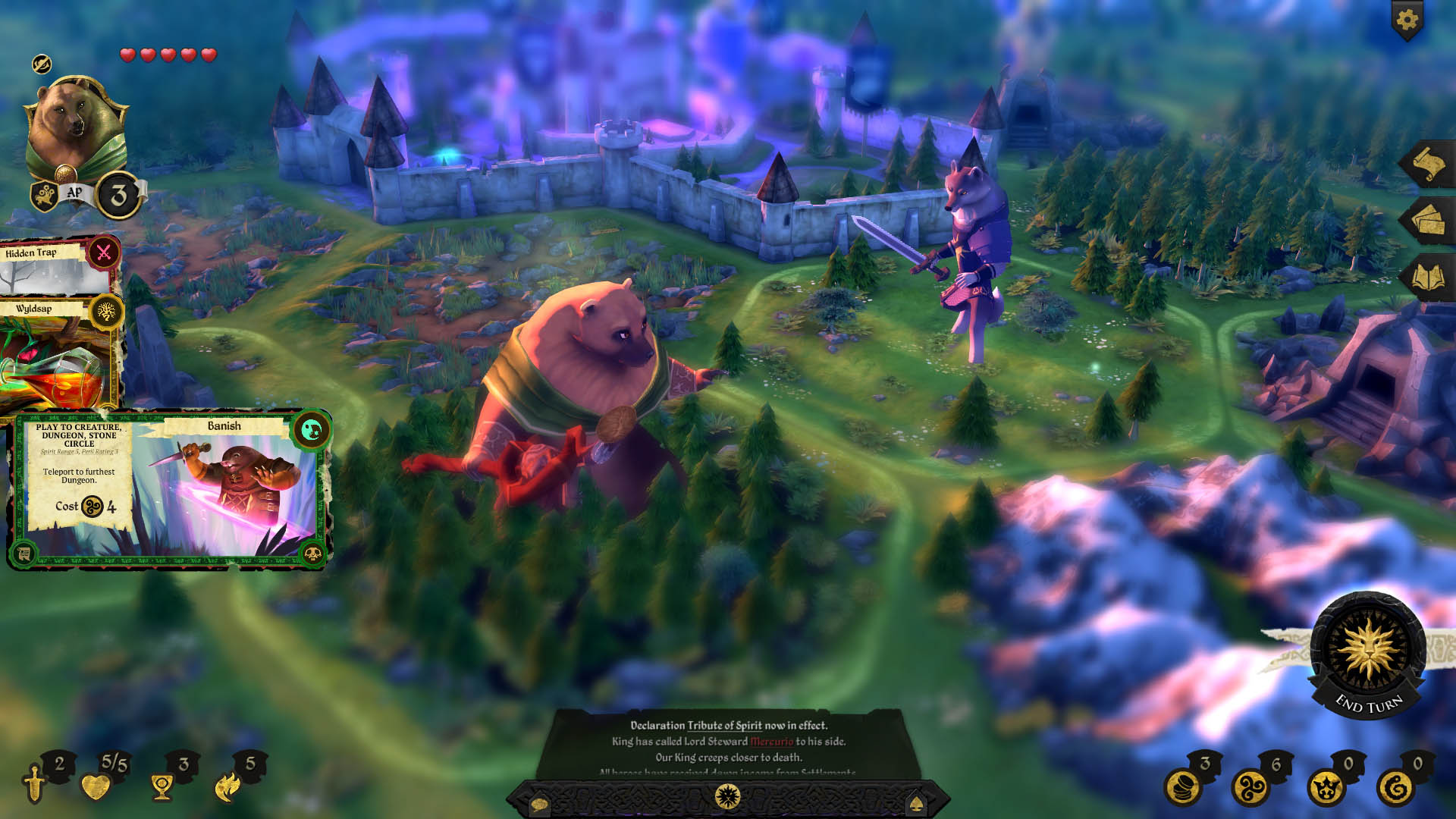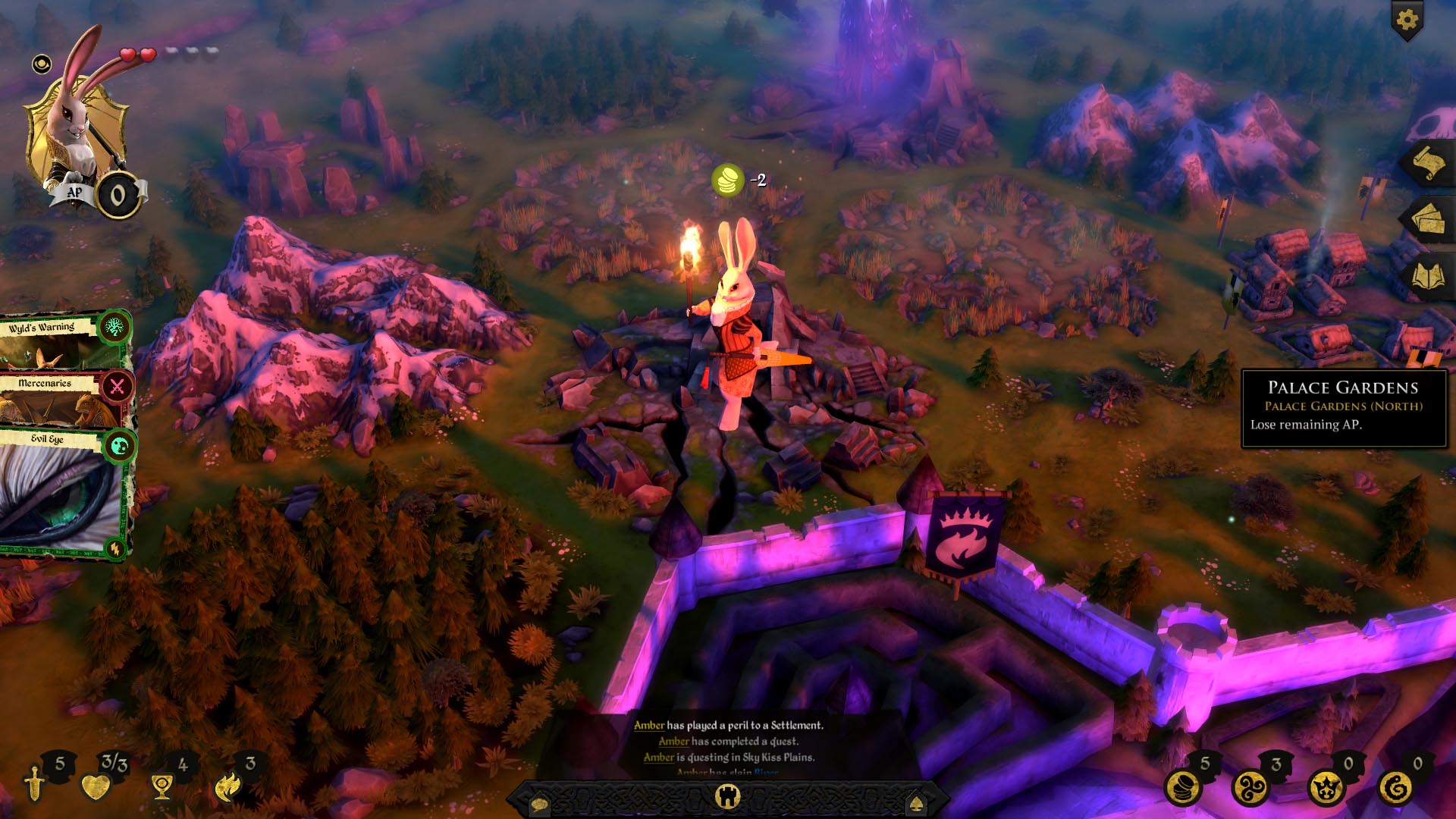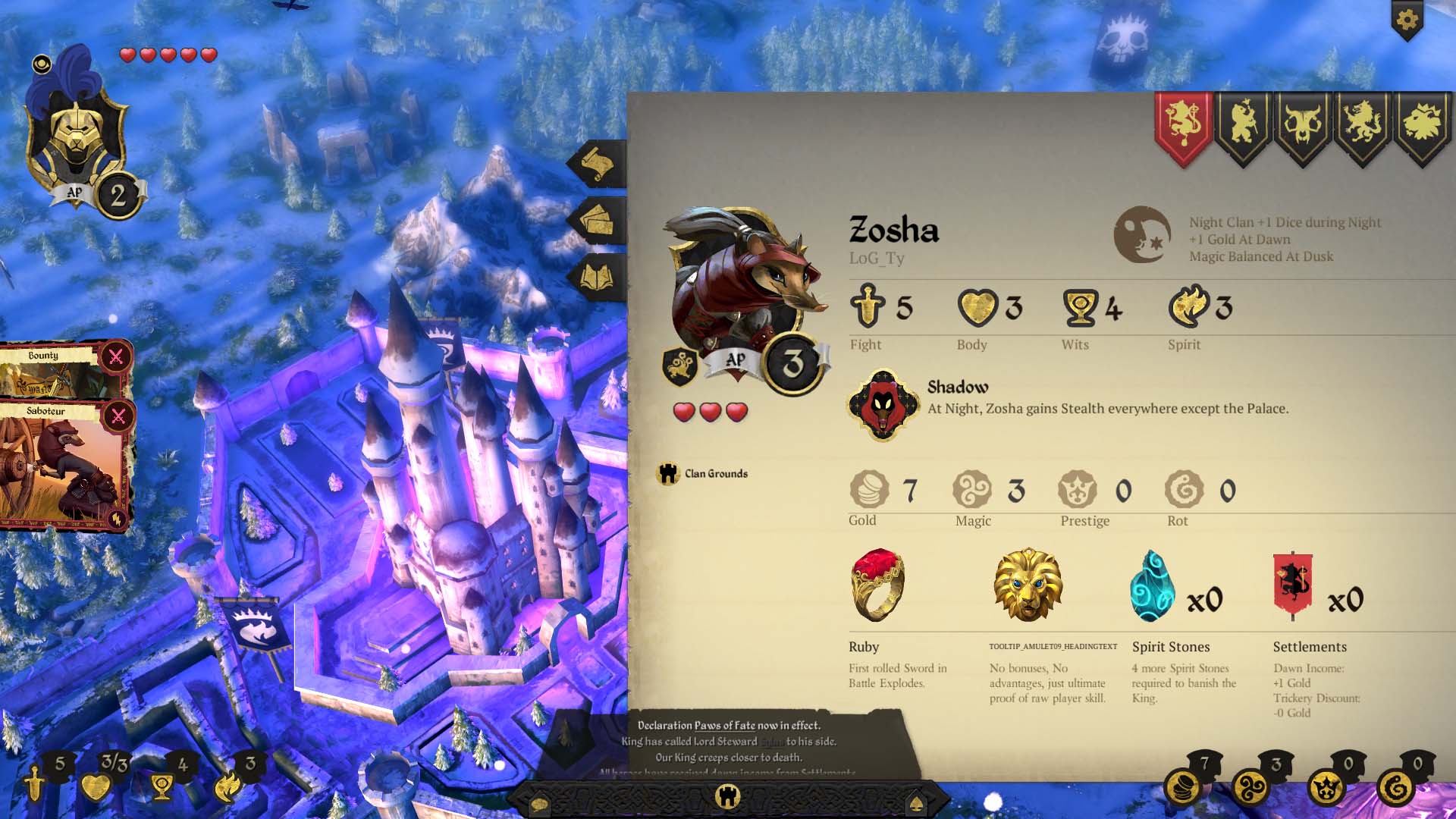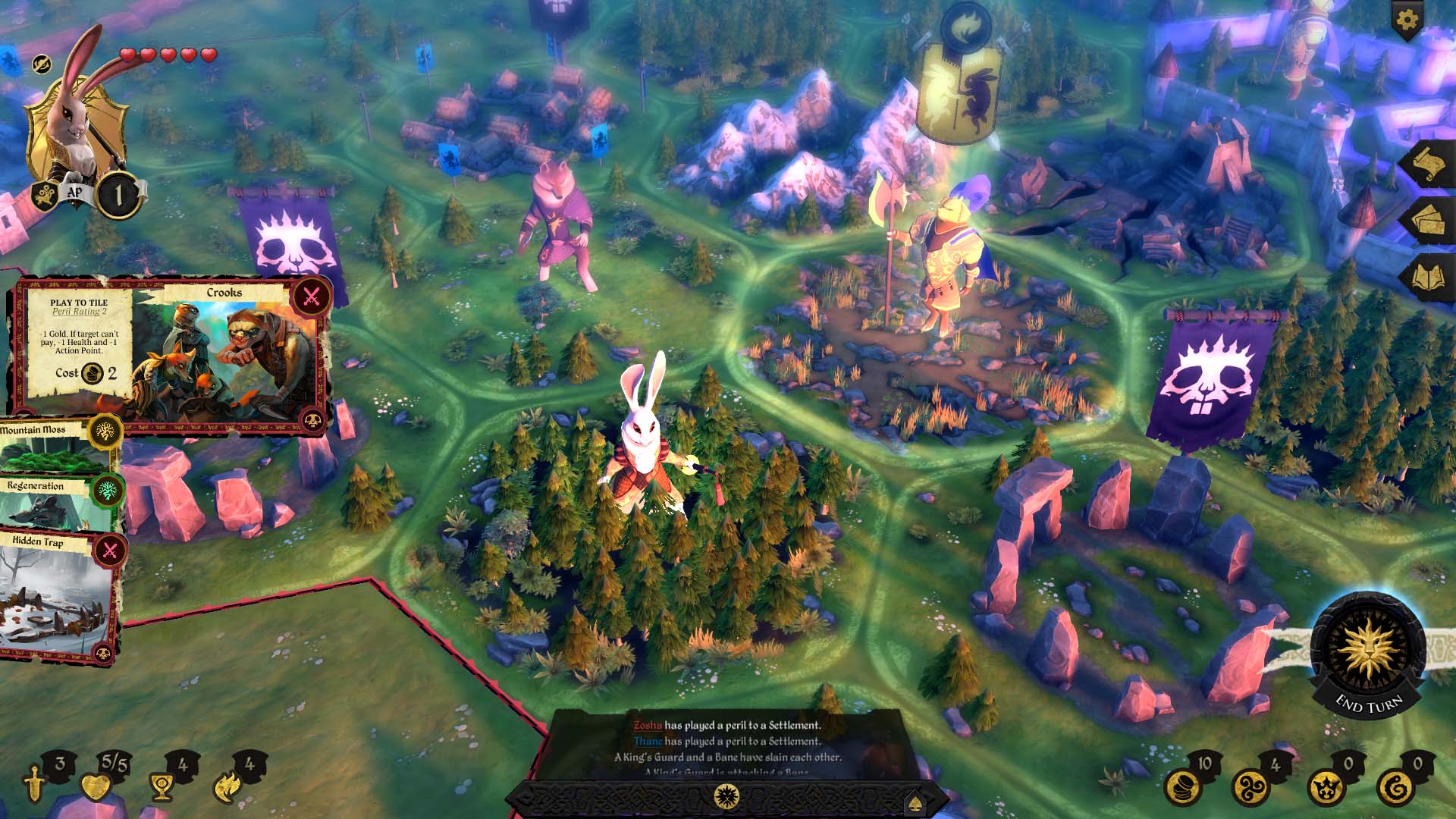
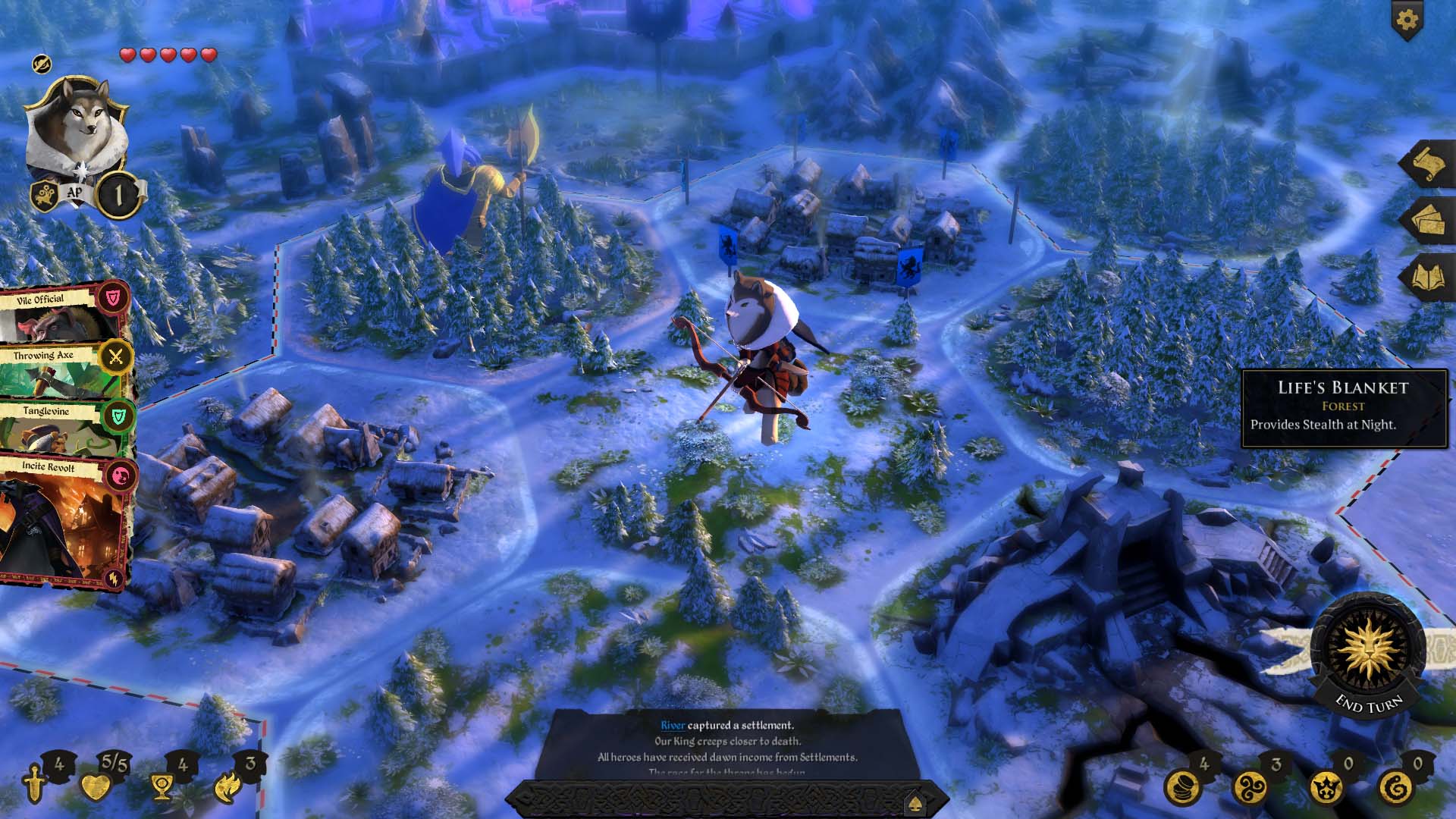
Armello hands you a hero, a hex map, a deck of cards and a dying king, and tells you there are four ways to take the throne. First games almost always break in the same two places: you charge the palace, and you lose fights your stat line said you should win.
Both are fixed once you know two rules the game does not emphasise.
What to do first, in order
| Priority | Do this | Why it ranks here | Common mistake |
|---|---|---|---|
| 1 | Build Prestige and stay away from the King | Prestige collects when the King dies of the Rot **and** when a rival kills him but dies too. It is the only route that needs nothing from you but position | Heading for the palace because killing the King looks like the goal |
| 2 | Keep cards in hand | Fights are decided in the burn phase, where each card locks a die. Fight only sets the dice count | Spending your hand on map effects, then attacking with nothing to burn |
| 3 | Fight in your own hours | Suns hit by day, Moons by night, and affinity grants a bonus die in your own half | Attacking whenever the opportunity appears, with half your pool dead |
| 4 | Take quests and settlements | Both feed Prestige and Gold, and Gold becomes cards | Treating the map as travel rather than as income |
| 5 | Watch who can afford to attack the King | Whoever is behind on Prestige loses nothing by trying | Assuming the hero nearest the palace is the threat |
If you remember one line, it is the first. Attacking the King strips almost all of your Prestige, which makes it the most expensive action available to you.
The two rules that decide first games
| Rule | What it means | What to do about it |
|---|---|---|
| **Attacking the King costs your Prestige** | The aggressive route spends the claim you already held on two of the four endings | Only take the shot when you are behind, or when you can definitely survive it |
| **Burning cards locks dice** | Any number of cards, each forcing one die to a chosen symbol | Attack players who just spent their hand. Never attack into a fresh one |
If you kill the King and die in the same battle, you do not win — the Prestige leader does. This one interaction explains most of what experienced players do. They hover, they build, and they wait for somebody else to spend everything on the palace.
How a fight is actually resolved
-
1
Dice are counted from Fight
Modified by time of day, items, effects and Rot. If you are Evading rather than attacking, your Wits stat sets the number instead.
-
2
Automatic effects apply
Some equipment grants flat bonus swords or shields, and fighting while standing on mountain terrain grants one free shield. These sit outside the dice entirely.
-
3
Both sides burn cards
Each card burned forces one die to show that card's top-right symbol, and there is no limit. This is where the fight is decided. Ambushed heroes cannot burn at all.
-
4
The rest is rolled and resolved
Swords always hit, shields each cancel one incoming hit, Suns hit only by day and Moons only by night. Worms always miss and Wyld symbols explode into a hit plus a bonus die — unless you are corrupted, in which case those two swap.
The four routes, briefly
| Victory | How it works | For a first game |
|---|---|---|
| **Prestige** | Be the Prestige leader when the King dies of the Rot, or when a rival kills him and falls | **Default to this.** It needs no journey and no risk |
| **Kingslayer** | Kill the King in battle and survive | Only when you are behind, since it strips your Prestige |
| **Spirit Stone** | Collect 4 stones, banish the King with no battle | Clean when it lands, but four stones dies to one Rot card |
| **Rot** | Slay the King with your Rot higher than his | Narrowest route. Commit early or not at all |
Heroes are not a power ranking. Every hero distributes exactly sixteen points across Fight, Body, Wits and Spirit, so a high Fight is always paid for elsewhere. The real differences sit outside that budget — starting Gold runs from 3 to 8, and day or night affinity is fixed.
Five ways to lose a first game
- Charging the palace. It costs your Prestige before the dice are even rolled.
- Attacking with an empty hand. Your opponent locks dice and you roll.
- Fighting out of hours. Half your symbols are dead at the wrong time of day.
- Racing a stone collector. One Rot card on a four-stone hero kills them outright.
- Trading yourself for a rival. Mutual death leaves both sides' Prestige unchanged.
Once the basics land, why the four routes are not equals is in the victory conditions guide, the burn phase in full is in the combat guide, and who to actually pick is in the hero tier list. If you have not bought it yet, start with the honest review.