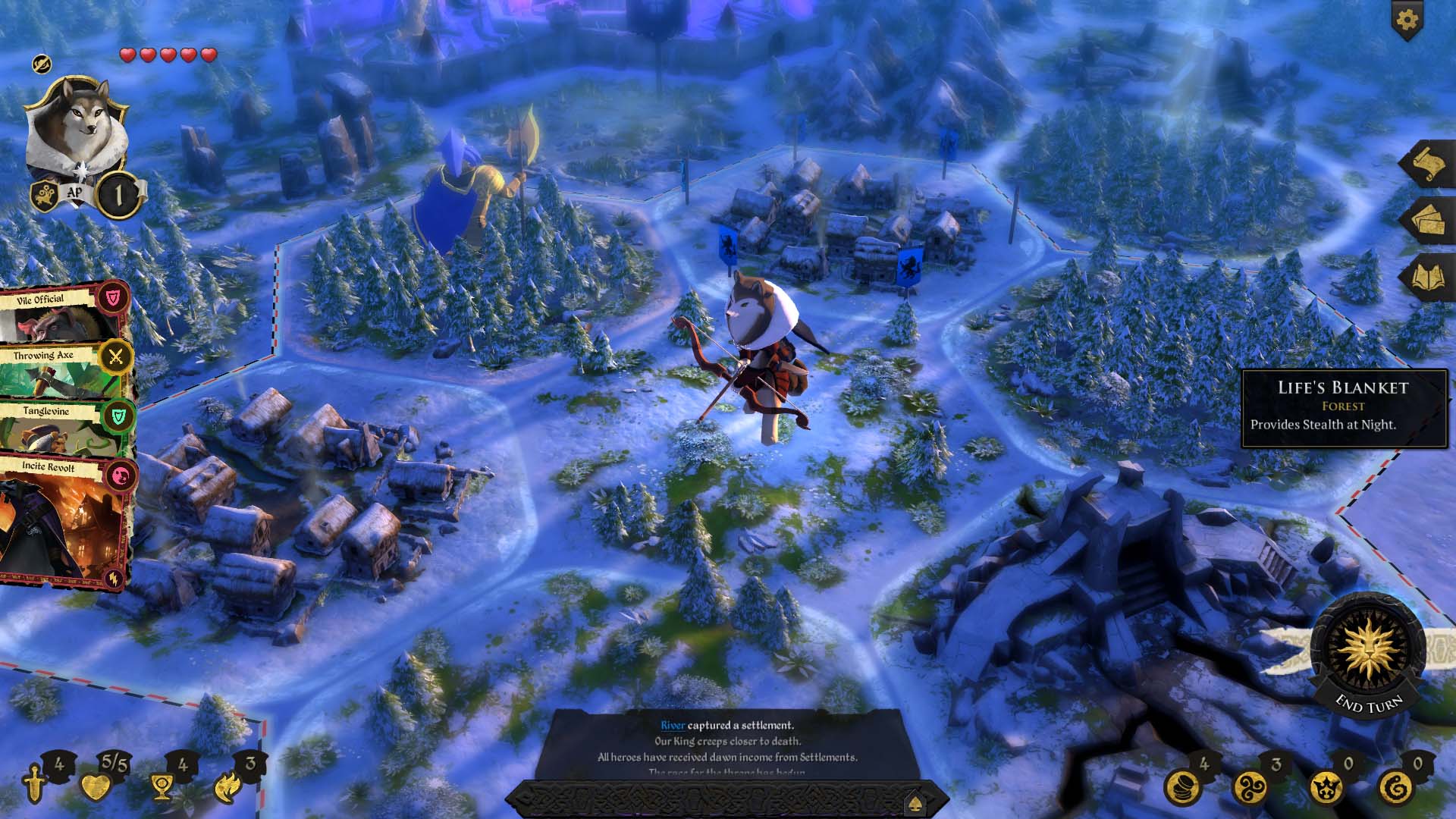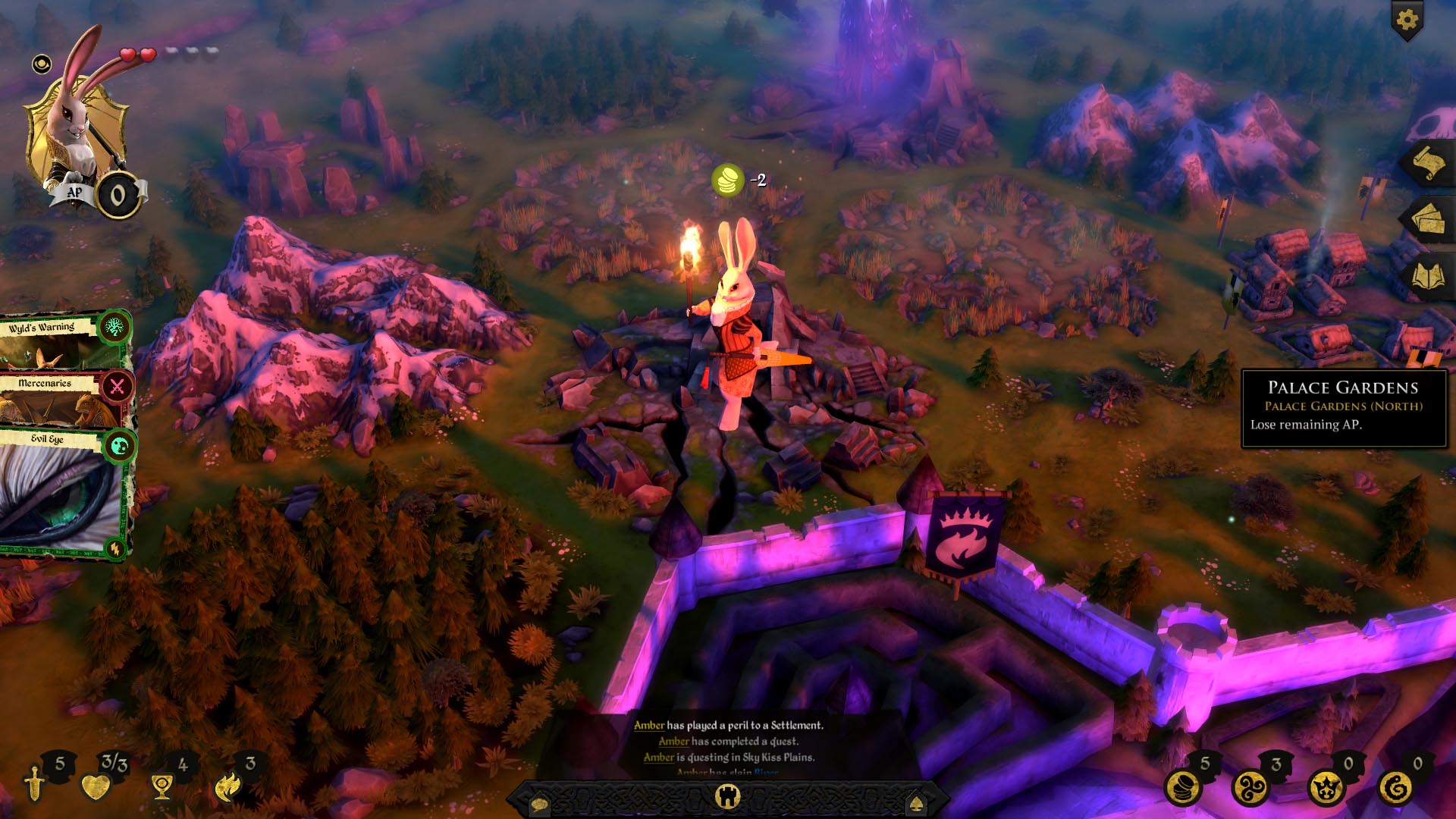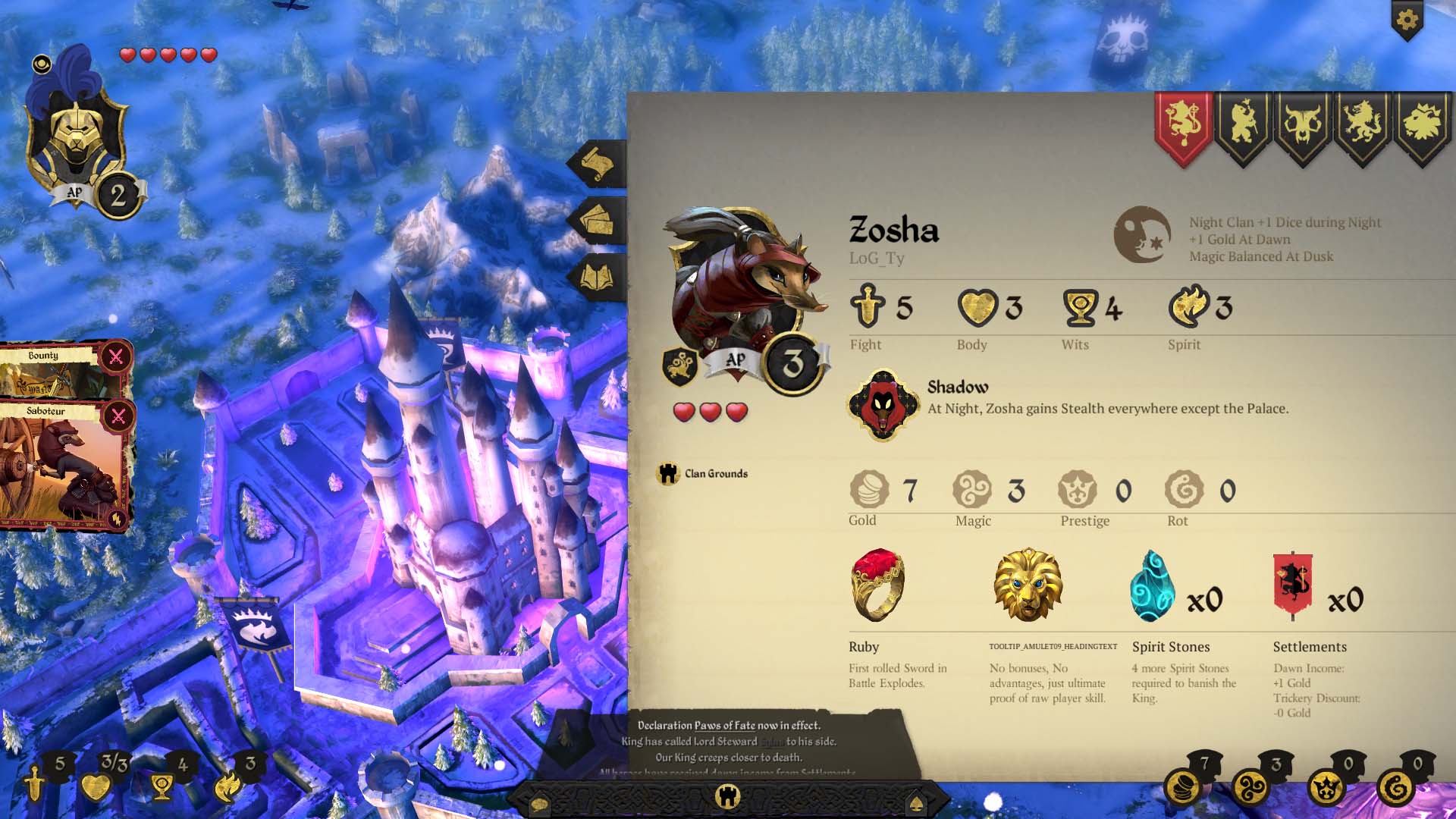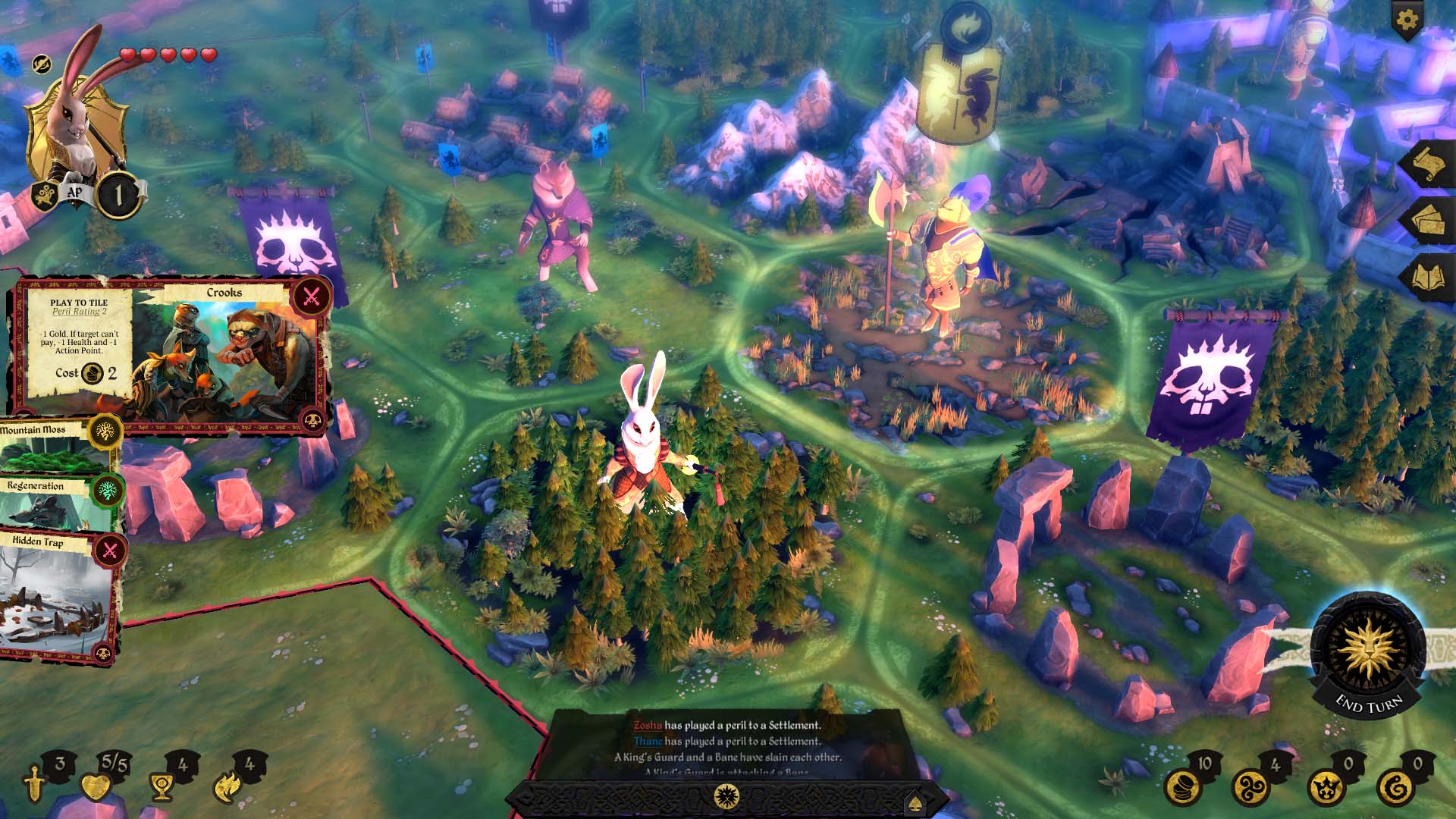
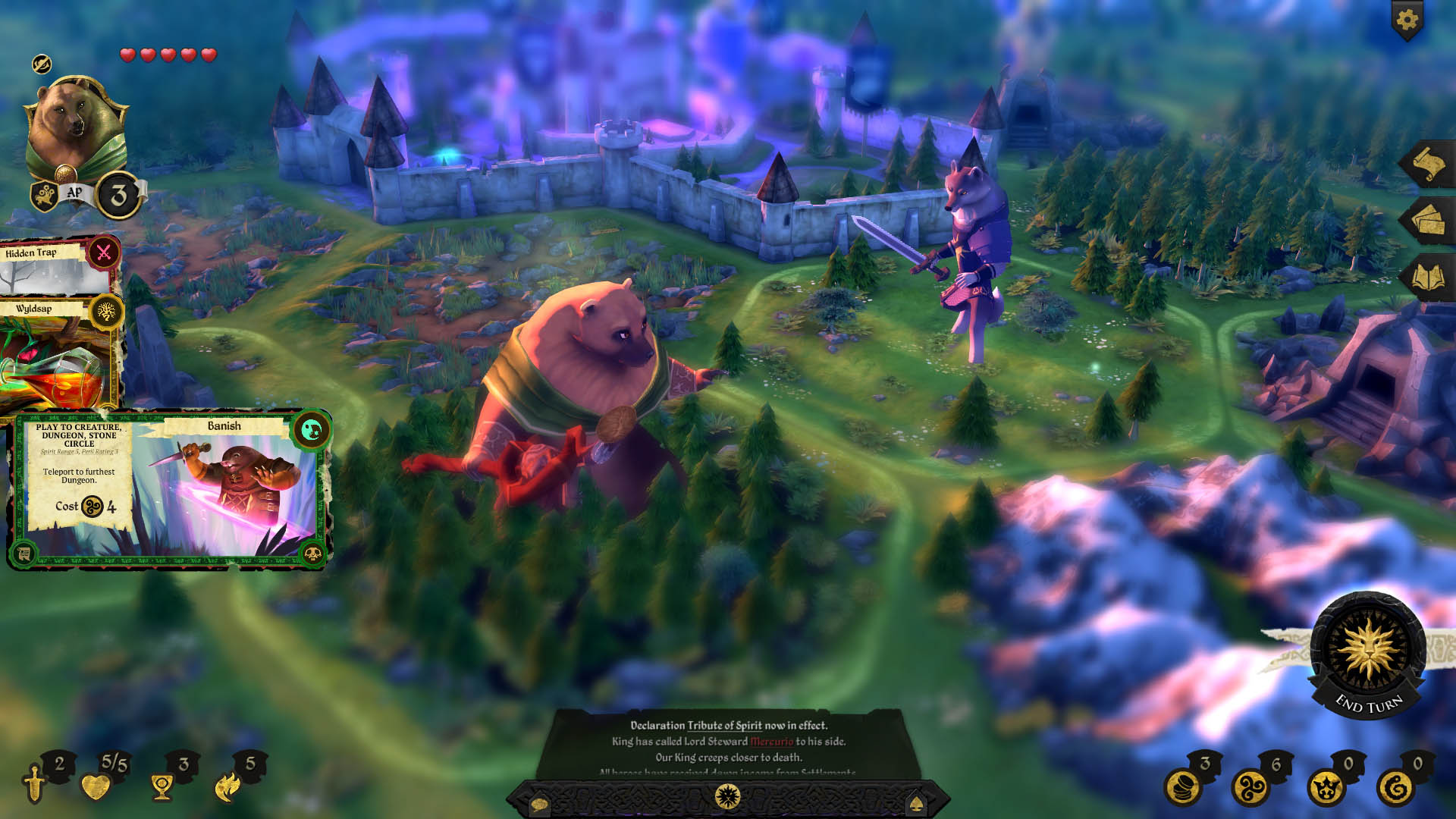
Armello presents combat as dice. Two animals face off, a handful of dice tumble out, somebody loses health. New players lose a fight, shrug, and blame the roll.
The roll is the last step, and by then the fight is usually over.
Before any dice are thrown you may burn as many cards from your hand as you like, and each burned card forces one die to show the symbol printed on it. There is no limit. A hero holding five cards can lock five dice; a hero holding none rolls and hopes.
The order of a fight
-
1
Dice are tallied
Your Fight stat sets the base number. Time of day, items, effects and Rot bonuses adjust it. If you are Evading instead of attacking, your Wits stat sets the number rather than Fight.
-
2
Automatic effects apply
Some cards grant bonus swords or shields outright, and standing on mountain terrain grants one bonus shield. These sit outside the dice entirely — they neither influence rolls nor are influenced by them.
-
3
The burn phase
Heroes burn as many cards as they want, each locking one die to that card's top-right symbol. This is the decision. Everything before it was setup and everything after it is resolution.
-
4
The roll
Whatever dice you did not lock are thrown.
-
5
Resolve
Each side's shields are subtracted from the other side's hits. If shields meet or exceed hits, that combatant walks away untouched.
Ambushed heroes may not burn cards. That is the whole reason ambush is feared. It does not increase damage — it removes your opponent's ability to convert their hand into certainty, and drops them back to raw probability while you keep your locks.
What the symbols do
| Symbol | Effect | Notes |
|---|---|---|
| Sword | Always a hit | The only unconditional offence |
| Shield | Prevents one incoming hit | Stacks against hits, not against dice |
| Sun | Hits in the **day**, misses at night | Half your dice are dead at the wrong hour |
| Moon | Hits at **night**, misses in the day | Same, inverted |
| Worm | **Always misses** | Dead result — unless you are corrupted |
| Wyld | **Always explodes** — hits and grants a bonus die | The best result — unless you are corrupted |
Corruption inverts two of the six
For a corrupted character, Worm and Wyld swap roles. The Worm explodes; the Wyld misses.
This is not a penalty, and reading it as one is a common mistake. A corrupted hero has exactly the same dice, with two faces trading places. What changes is everything you had learned about which results to hope for, and which cards are worth burning.
Because burning locks a specific symbol, corruption also changes which cards are worth burning. A card with a Wyld corner is your best burn when clean and a wasted one when corrupted, and a Worm corner is the reverse. Check your Rot before you decide what to feed the fire.
Practical rules
| Rule | Why | What to do |
|---|---|---|
| **Count their hand** | Cards are the real weapon | Attack the player who just spent their hand, not the one who just drew |
| **Never attack into a full hand** | They can lock more dice than you | Wait a turn, or force them to spend cards elsewhere first |
| **Fight sets dice, burns set faces** | Stats are the smaller half | A 4 Fight hero with cards beats a 5 Fight hero without |
| **Time of day is half your dice** | Suns and Moons are conditional | Fight in your own affinity's hours whenever you can choose |
| **Mountains give a free shield** | It sits outside the dice | Defend on high ground; it costs nothing and cannot be rolled away |
| **Evading uses Wits** | Not Fight | A high-Wits hero can survive fights they could never win |
Killing heroes pays
A hero who slays another hero or a Bane gains one point of Prestige. Given that two of the four victory conditions hand the game to the Prestige leader, combat is not only a way to remove obstacles — it is one of the steadier ways to climb.
Mutual death is the exception worth remembering: when both sides fall, Prestige stays exactly as it was for both. Trading yourself for a rival gains you nothing at all.
Common mistakes
- Blaming the dice. The dice were the last step and the smallest one.
- Attacking into a fresh hand. You are attacking their certainty, not their stats.
- Ignoring the hour. Suns and Moons make half your pool conditional.
- Burning Wyld cards while corrupted. The symbol you are locking now misses.
- Fighting off the mountain. A free shield is better than a die.
Which heroes turn these rules into a win is in the hero tier list, and why the fight you should usually avoid is the one with the King is in the victory conditions guide. New players should start with the beginner guide, and the honest review covers how well this holds up over many games.