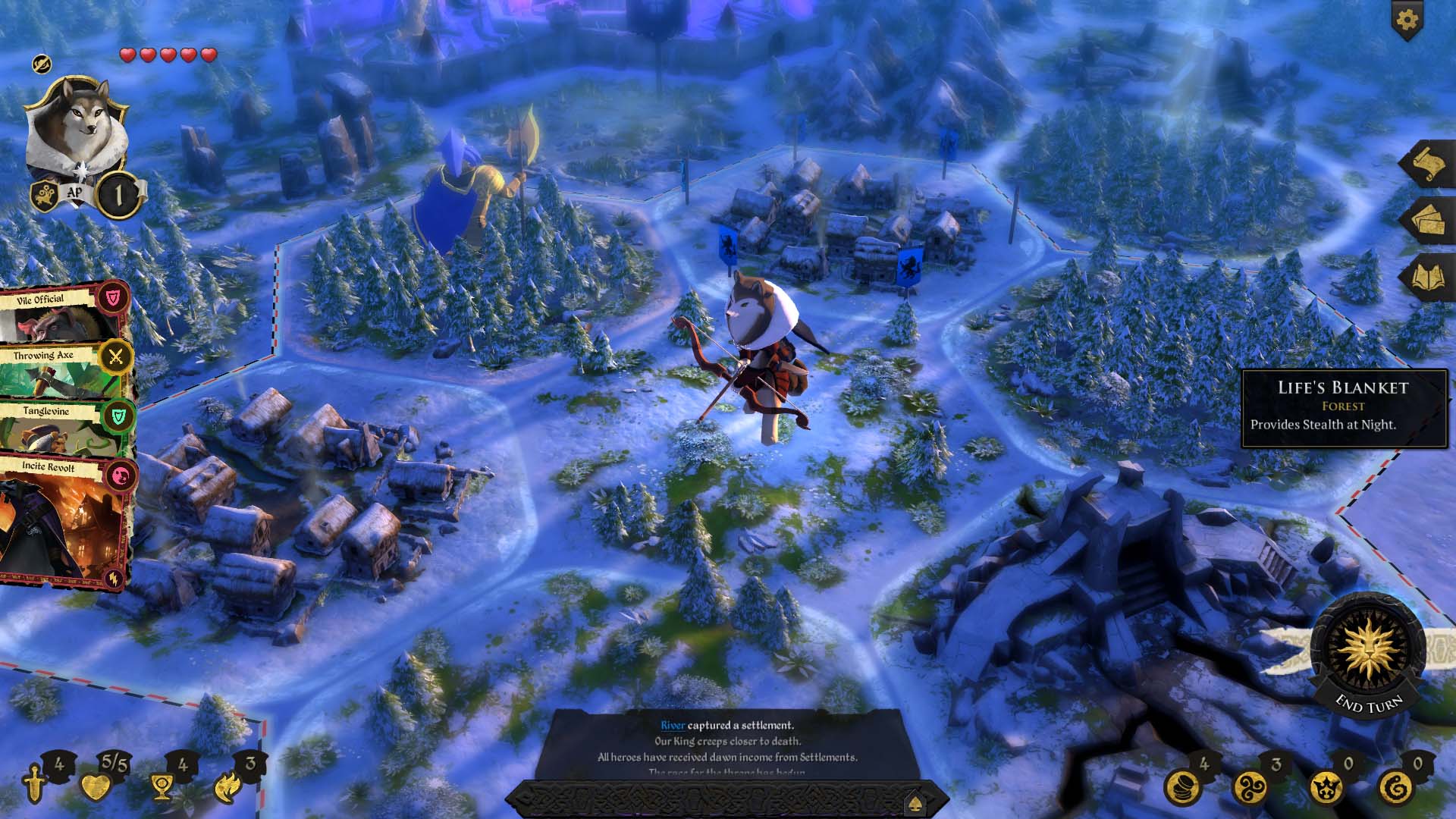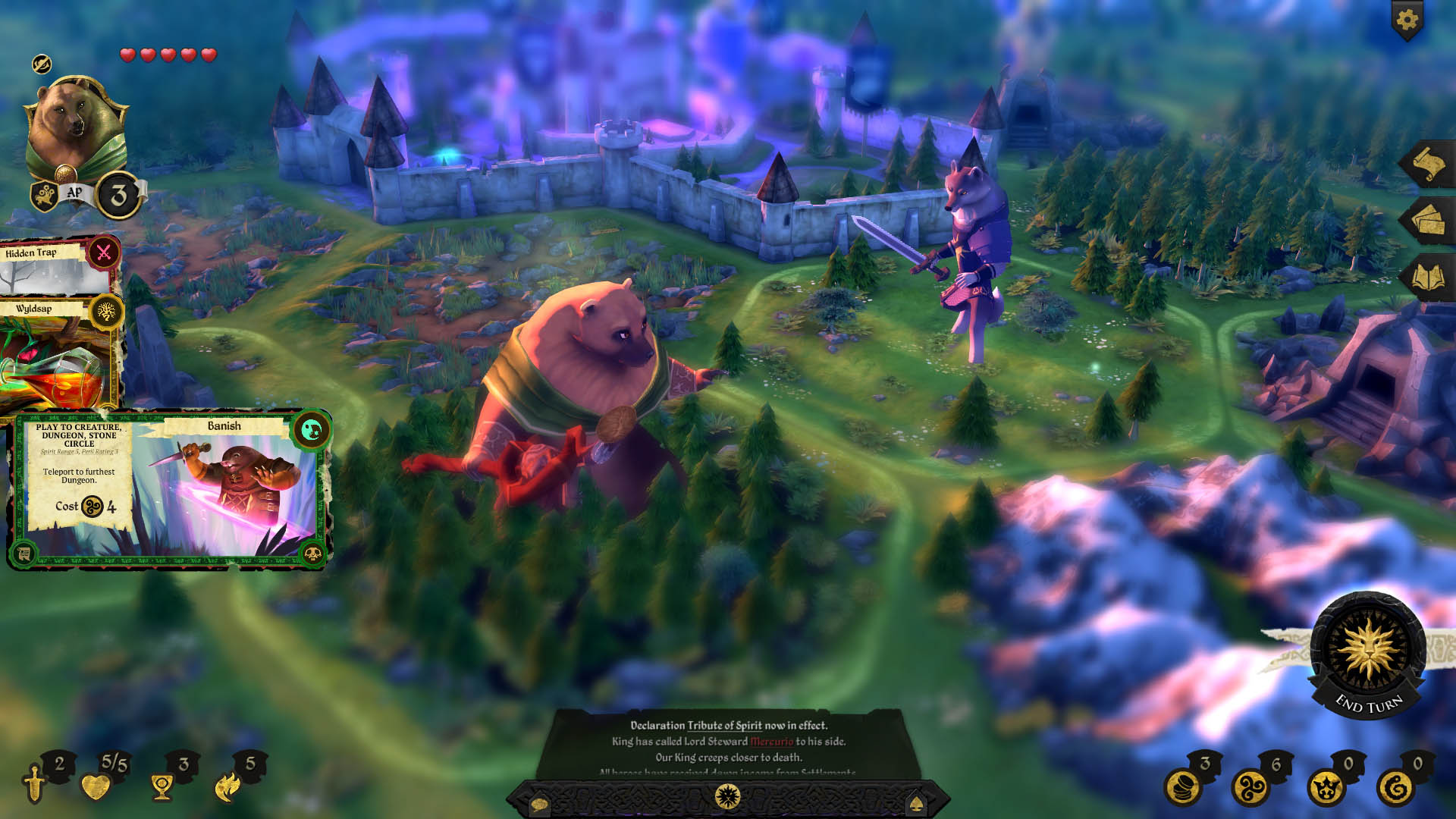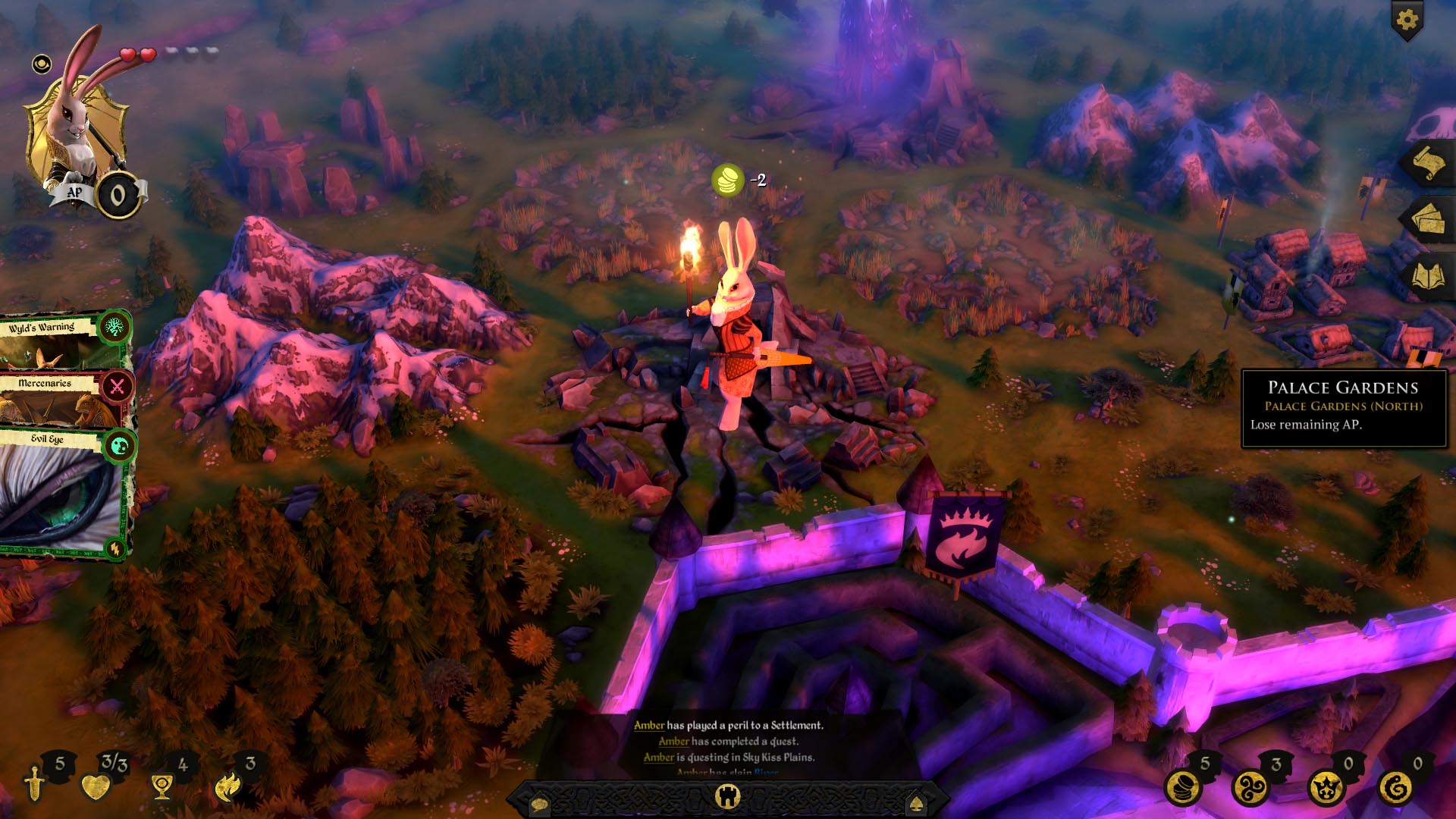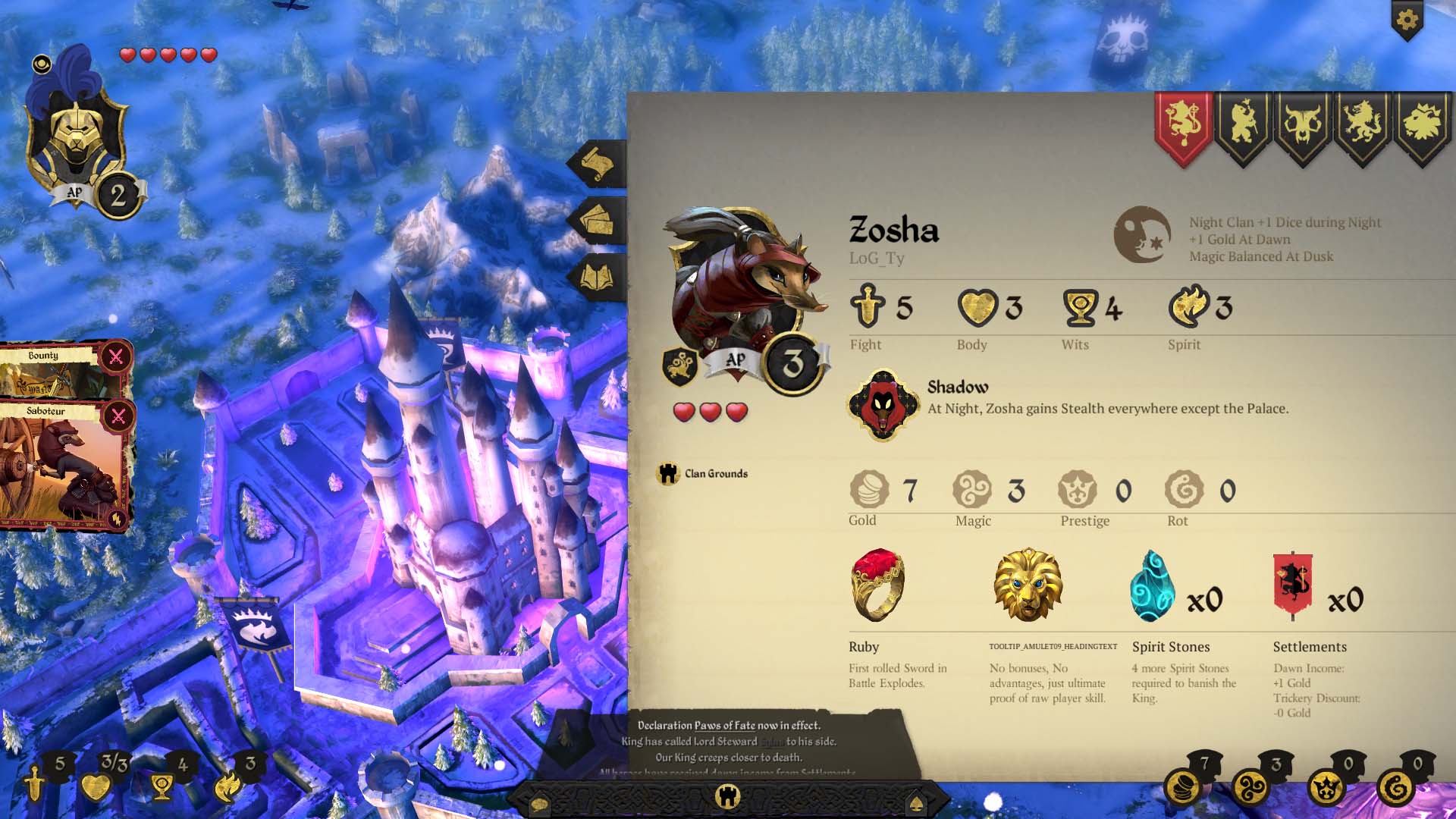
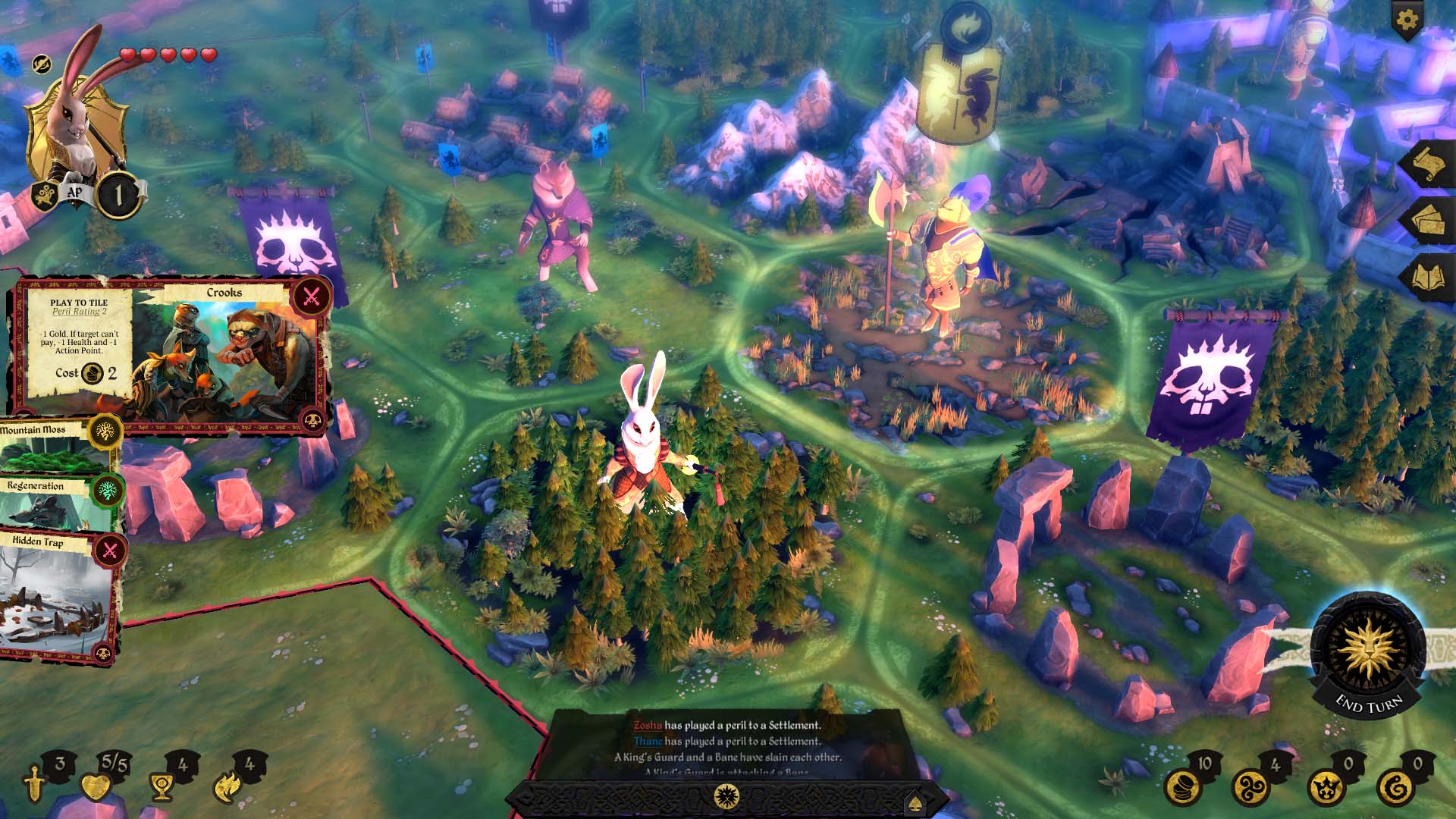
Four animals want a throne. The king who sits on it is dying of a plague called the Rot, and he will die on his own if nobody touches him. Everything interesting about Armello comes from that last clause.
Because the King is already dying, you do not have to kill him to win — and if you try, the game takes almost all of your Prestige for the attempt. Since the Prestige leader wins when the King finally succumbs, charging the palace means spending the claim you already held in exchange for one battle.
That is a genuinely sharp piece of design hiding inside a storybook.
What that rule buys
It makes patience competitive. In most games of this shape, aggression is the engine and caution is a failure state. Here the player doing nothing dramatic has a standing claim on two of the four endings, and the player visibly closing on the palace has already paid for their shot.
It also makes the table readable in a specific way. The question is never "who is closest to winning" but "who loses the least by attacking the King" — and that is usually not the hero nearest the palace. Learning to ask the right question is most of the skill curve.
The Rot deserves its own mention. Corrupting yourself opens a fourth victory route, and it does something more interesting than adding risk: for a corrupted character, Worm and Wyld dice symbols invert. Worms explode into hits and Wyld symbols miss. Your dice are not worse, they read backwards, which means corruption is a commitment rather than a dial.
Presentation carries the rest. League of Geeks built this as a digital board game rather than a board game ported, and it shows in the animation, the hand-drawn art and the way a fight resolves like a short film. Ten years on it still looks better than almost anything in its category.
Where it falls short
The design that makes it clever also makes it passive at a four-player table.
If the correct play is often to build quietly and let someone else overreach, then four players who all understand that produce a slow game where everyone circles. The tension is real but it is a tension of waiting, and not every group enjoys an evening of nobody committing. Games that go long tend to go long for structural reasons rather than because anything exciting is happening.
The second problem is that combat reads as dice and is actually cards, and the game does very little to teach that. You may burn any number of cards before rolling, each one locking a die to a chosen symbol, so a full hand converts a fight into arithmetic. Players who never internalise this spend years believing Armello is random — and from where they are sitting, it is.
The third is commercial. Eight heroes in the base game, sixteen more across four expansions. The base roster covers all four clans and is enough to learn on, but the complete game is a notably larger purchase than the store page first suggests.
Where it stands
| Item | State |
|---|---|
| Release | 1 September 2015 |
| Developer and publisher | League of Geeks, both roles |
| Steam rating | Around 82 percent positive |
| Structure | Digital board game. Hex map, card hands, dice, four heroes, four victory conditions |
| Roster | 8 base heroes, 24 with all expansions. Every hero distributes exactly 16 stat points |
| Localisation | Japanese, Russian, Simplified and Traditional Chinese, Korean, French, German, Spanish, Italian, Dutch, Polish, Brazilian Portuguese. Interface, full audio and subtitles |
Comparisons
| Compared with | How Armello differs | Who that suits |
|---|---|---|
| Tabletop board games | Enforces rules that would be fiddly in cardboard — inverted dice under corruption, burn phases, a day-night cycle | People who like board games but not bookkeeping |
| Into the Breach | Social rather than solvable. The other three players are the puzzle | Players who want to read people, not a board |
| Civilization | Tiny and finished in an evening, with one dying king instead of an era | Anyone who wants strategy without a weekend |
| Darkest Dungeon | Shares the gothic tone and the punishing streak, but plays as a race rather than an endurance test | Players who want atmosphere without attrition |
Who should buy and who should skip
| Buy it if | Skip it if |
|---|---|
| You want a board game that punishes the obvious move | You want aggression to be the reliable path |
| You have three friends to play it with | You will mostly play against AI |
| You enjoy reading a table rather than solving a board | You want your decisions to be independent of other players |
| You want full voice acting in Japanese, Russian, Chinese or Korean | You dislike buying a roster across four expansions |
Verdict
Armello is a better-designed game than its fairy-tale surface suggests, and the reason is one rule: the King is already dying, so killing him is optional and expensive. Everything good here grows from that — the readable table, the value of patience, the question of who can afford to move.
What it cannot escape is the pace that creates, and a combat layer that hides its own decision behind dice. Neither is fatal. Both are worth knowing before you sit down with three friends and discover that the winning move is frequently to wait.
Buy it for the rule that makes waiting interesting. Very few games manage that.
New players should start with the beginner guide, the asymmetry between the four routes is in the victory conditions guide, the burn phase that decides fights is in the combat guide, and who to pick is in the hero tier list.