
Start in a way that lets you learn
Field of Glory: Empires is a deep, dense grand strategy game, and the fastest way to bounce off it is to pick a fragile nation and try to absorb every system at once. So the best thing a new player can do is start in a forgiving position and focus. For your nation, choose a strong, well-placed power — Rome is the classic beginner choice, beginning in a solid position with room to grow and recover from mistakes, and teaching the game's systems in relative safety. Carthage or one of the Hellenistic successor kingdoms also make capable starts. Steer clear of small, exposed nations and tribes for your first game, since they punish inexperience harshly; learn the ropes with a major power, then take on a harder position once you understand how everything works.
With a strong nation chosen, resist the urge to learn everything immediately. For your first game, concentrate on a few core ideas — what legacy is, how regions and buildings work, and how your economy grows — and let the deeper systems like decadence and complex diplomacy come once those basics feel natural. A focused start turns an intimidating game into an approachable one.
Lean on the tooltips. Field of Glory: Empires presents a lot of information, but hovering over its many icons and numbers explains what they mean, and getting into the habit of reading tooltips is the fastest way to learn the dense AGEOD interface.
Understand legacy and build your regions
The single most important thing to understand in Field of Glory: Empires is that you win on legacy, not on the size of your empire. Legacy points represent the lasting impact of your civilization, and they are earned in many ways — through buildings, culture, prosperity and great deeds, not just conquest — and, crucially, they stay earned even if your empire later declines. This changes how you should play compared with a typical 4X: your goal is not to paint the map your colour but to build a civilization that leaves a lasting mark. A smaller, well-developed, cultured nation can out-score a sprawling conqueror, so think about building legacy steadily rather than grabbing every region in sight.
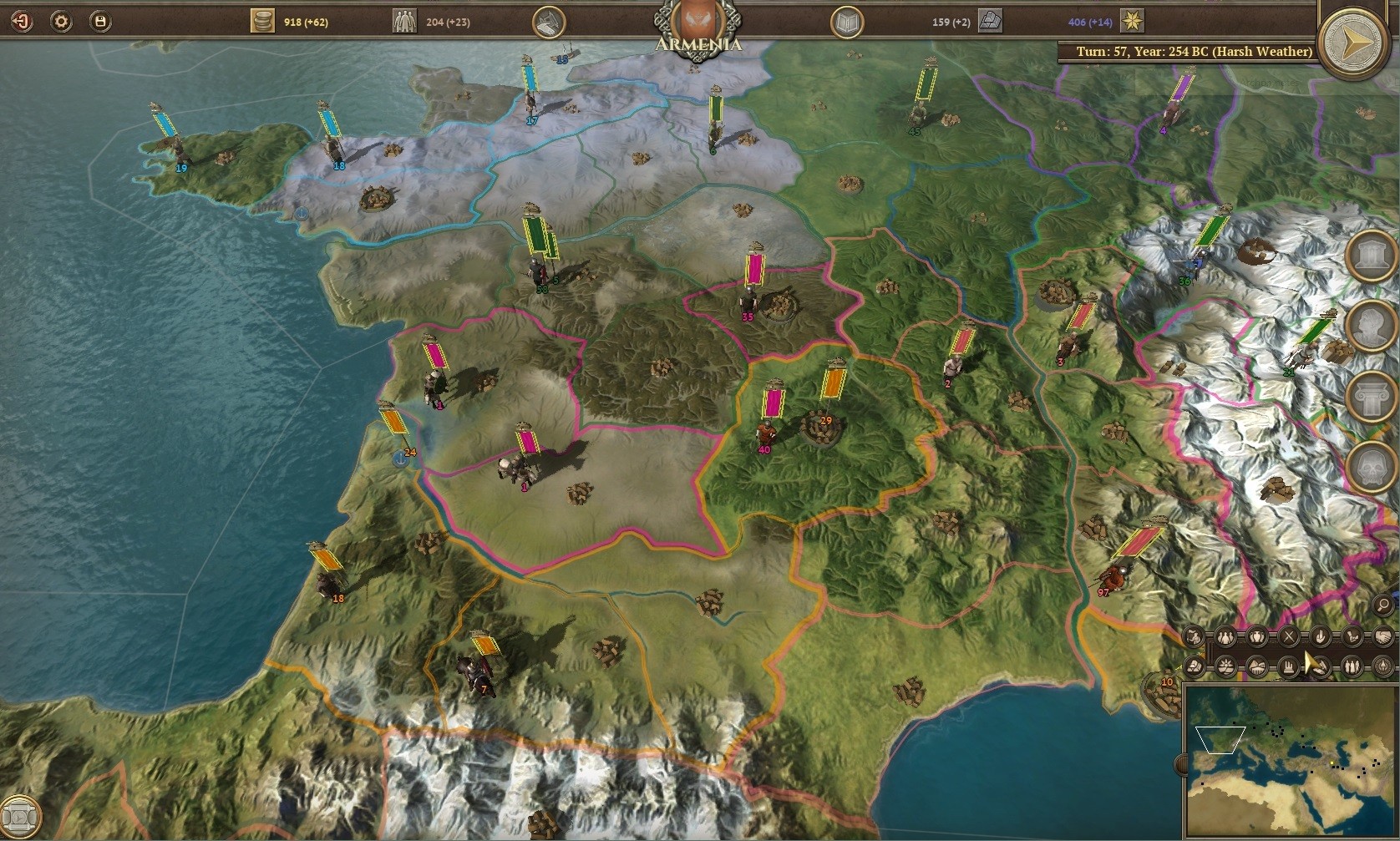
The foundation of that legacy is your regions and their development. Your empire is made up of regions, each of which you improve with buildings that grow its economy, population, culture and other output, and a strong empire comes from developing your regions well rather than simply holding a lot of them. As a beginner, focus on constructing the right buildings to build up production, food, money and culture in the regions you control, since well-developed core regions are worth far more than a scattered, neglected sprawl. Steady regional development is how you build both a healthy economy and a growing legacy.
Develop what you hold before grabbing more. A compact, well-built empire generates more economy, culture and legacy — and less decadence and instability — than a large one you have not developed. Quality of regions beats quantity, especially while you are learning.
Expand carefully and watch decadence
As your empire grows, the game introduces its signature tension: decadence. Decadence represents the way large, wealthy empires tend to decline, and it rises as you expand and prosper, threatening unrest and decay if left unchecked. This is the mechanic that makes Empires different from a grow-without-limit 4X, and for a beginner the key lesson is to expand at a sustainable pace. Rather than conquering as fast as you can, grow at a rate you can stabilise and develop, and use the buildings, decisions and policies that help offset decadence as it rises. Think of decadence not as a punishment but as a reminder that sustainable, well-managed growth beats explosive expansion you cannot control — exactly the lesson ancient history teaches.
Put it together and your first empire has a clear shape: pick a strong nation, understand that legacy wins, develop your regions and economy with good buildings, expand carefully, and keep decadence in check as you grow. You will make mistakes and wrestle with the dense interface, but a strong nation and a focus on the basics give you room to learn. The goal of your first game is not to dominate but to understand how the empire-building loop fits together — regions and buildings feeding your economy and culture, those feeding your legacy, and decadence keeping your growth honest.
| Priority | Do this | Why it matters |
|---|---|---|
| Nation | Pick a strong start like Rome | Forgiving while you learn |
| Legacy | Build a lasting civilization | Legacy, not size, wins the game |
| Regions | Develop with the right buildings | Core of economy, culture and legacy |
| Decadence | Expand at a sustainable pace | Unchecked growth breeds decline |
Grow your first empire
Survive and grow through your first game this way, and Field of Glory: Empires stops being an intimidating wall of systems and starts revealing its distinctive depth. Once you understand legacy, regions and decadence, the rest of the game — diplomacy, war, culture, the full sweep of building and managing an empire — opens up naturally, and you can specialise and take on tougher nations at your own pace. Remember that the game embraces the whole arc of a civilization, so even if your empire eventually peaks and declines, the legacy you built can still win you the game; that perspective makes the dense systems feel purposeful rather than punishing.
When you are ready for more, our empire guide goes deep on economy, regions, buildings and decadence, the nations tier list compares who is good to play, and the war guide covers armies, battles and the optional Field of Glory II integration. If you enjoy the tactical side, the battles can be fought in Field of Glory II itself.
Do not expand faster than you can manage. The most common new-player mistake is conquering aggressively while neglecting development and decadence, which leaves you with a large, unstable, decaying empire. Grow at a pace you can develop and stabilise — a sustainable empire builds far more legacy than a sprawling, decadent one.