
The verdict up front
Field of Glory: Empires is one of the most distinctive grand strategy games of the ancient world, built around an idea most 4X games never touch: that empires rise and fall, and that the mark you leave can outlast your power. Developed by AGEOD, the veteran historical-strategy studio, and published by Slitherine, it drops you into the Mediterranean around the rise of Rome and lets you guide one of dozens of nations — Rome and Carthage, the Greek city-states, the Hellenistic successor kingdoms, the tribes of Europe — through the building of an empire. What sets it apart is its victory condition. You do not win by painting the map your colour; you win by accumulating legacy, a measure of the lasting impact of your civilization, and because legacy stays earned even if your empire later collapses, you can play through a nation's rise, golden age and decline and fall, and still win. It holds a Very Positive rating on Steam, and it offers a strategy experience genuinely unlike most others.
So is it worth buying? If you love grand strategy, ancient history, and the theme of rise and fall, very much so — the empire-building is deep, the legacy victory is refreshing, and the decadence system gives it a character all its own. The honest caveats are real: the AGEOD interface is dense and takes effort to learn, and the decadence mechanic divides players, some of whom find it unintuitive or punishing. But for the right player, Empires offers something few strategy games do.
Field of Glory: Empires is a turn-based grand strategy game from AGEOD, published by Slitherine, set in the ancient Mediterranean (the base game spans roughly 310–190 BC). You build an empire through regions, buildings, economy, culture and war, winning on legacy. It has its own battle resolver and can optionally export land battles to the tactical Field of Glory II.
What you actually do
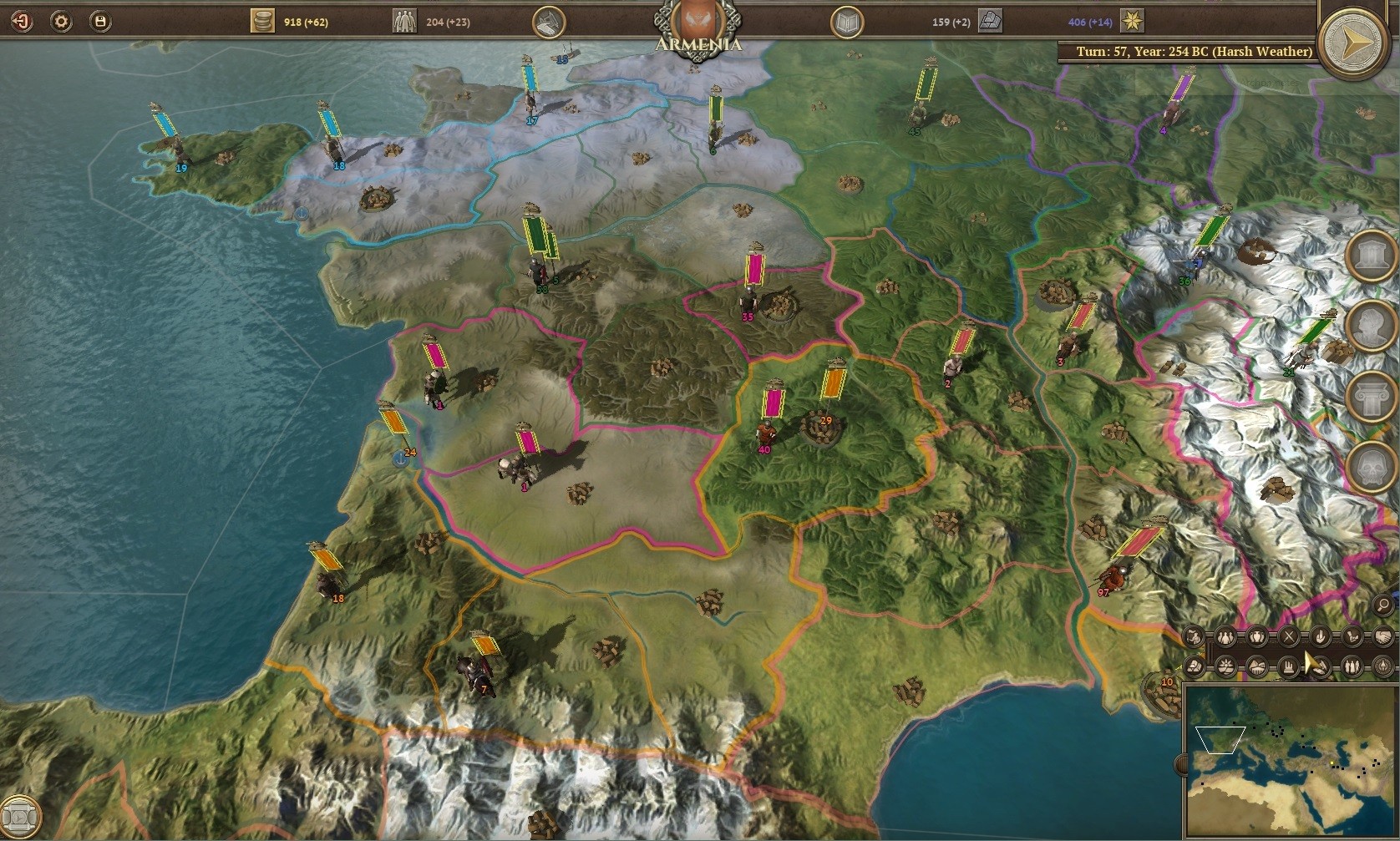
A game of Field of Glory: Empires casts you as the leader of an ancient nation, and your task is to build it into a civilization that leaves a lasting legacy. Turn by turn, you manage your regions and their buildings, grow your economy and population, advance your culture, conduct diplomacy with the living tapestry of rival nations and tribes, and wage war when you must. As your empire grows you accumulate legacy — the score that wins the game — but you also generate decadence, the pressure that drags great empires toward decline, and balancing the two is the heart of the experience. When armies clash, you can resolve battles with the game's own system or, if you own Field of Glory II, export them for full tactical engagements. The result is a complete arc of empire: the rise, the flourishing, and often the eventual fall, all of which can still add up to a winning legacy.
This focus on the whole life cycle of a civilization, rather than just relentless expansion, is what makes Empires feel different. You are not just conquering; you are authoring the story of a people across centuries, decline included.
New to the game? Start with a strong, straightforward nation like Rome and focus on understanding regions, buildings and legacy before worrying about decadence or war. Our Field of Glory: Empires beginner guide walks you through your first turns.
Why legacy and decadence carry it
The reason Field of Glory: Empires stands out is the pair of systems at its core: legacy and decadence. Legacy reframes what a strategy game is about. Instead of measuring success purely by the size of your empire at the end, the game measures the lasting impact your civilization accumulates over time, and that legacy is banked permanently. This single idea is liberating: a small, cultured nation can out-score a sprawling conqueror, and a once-great empire that overreaches and crumbles can still have won, because the legacy of its golden age remains. It encourages you to think like a historian, weighing the long arc of a civilization rather than just its peak square mileage.
Decadence is the counterweight, and it is what gives the game its rise-and-fall soul. As your empire grows large and rich, decadence builds, threatening instability and decline, so unchecked expansion carries a cost and prosperity must be managed. Together, legacy and decadence model something most strategy games ignore — that empires are not permanent, that growth breeds decay, and that the goal can be a glorious legacy rather than an immortal dominion. It is a genuinely thoughtful, thematic design, even if the decadence half of it is the game's most divisive feature. Our empire guide and nations tier list go deeper.
Pros
- +A distinctive legacy-driven victory that lets you win even in decline.
- +Deep ancient empire-building with dozens of nations and a living map.
- +A unique decadence system that captures the rise and fall of empires.
- +Optional Field of Glory II integration for full tactical battles.
Cons
- −A dense, unintuitive AGEOD interface with a learning curve.
- −The decadence mechanic is divisive and can feel punishing.
- −The built-in battle resolver is abstract without Field of Glory II.
- −English, French, German and Spanish only.
Battles and Field of Glory II integration
Empires is first and foremost a grand strategy game, but war matters, and how you fight is one of its more interesting features. The game has its own built-in battle resolver, which handles engagements abstractly and lets you play the entire game without anything else — perfectly serviceable, if not deep. The standout option, for owners of the tactical Field of Glory II, is integration: you can export a land battle from Empires to Field of Glory II, fight it as a full tactical engagement with all the depth that game offers, and then return to Empires with the outcome. For players who own both, this turns the abstract clashes of grand strategy into hand-fought tactical battles, a genuinely compelling combination. It comes with limits — naval battles, assaults and multiplayer are not exported, and some strategic factors like frontage are not carried across — and it is entirely optional, but it is a clever bridge between strategy and tactics that few series offer.
This makes Empires especially appealing alongside Field of Glory II: the strategy game provides the empire and the wars, and the tactical game provides the battles. Each is complete on its own, but together they form an unusually full ancient-warfare experience.
The honest weaknesses
Now the caveats. The most consistent is the interface: this is an AGEOD game, and like the studio's other deep historical titles, it presents a great deal of information through a dense, not always intuitive UI that takes real effort to learn. New players should expect a climb before the systems click. The other recurring criticism is decadence itself: while it is central to the game's identity, a portion of players find it unintuitive or punishing, feeling it works against the natural strategy-game urge to expand, and it is the mechanic most likely to divide opinion. The built-in battle resolver, finally, is functional but abstract, so the tactical side of the game is far richer only if you also own Field of Glory II. And it is English, French, German and Spanish only, with a lot of text, a barrier for players outside those languages.
None of this undermines a thoughtful, distinctive design, but it is honest to say Empires asks for patience and a tolerance for its quirks. It rewards players who engage with its unusual ideas and frustrates those wanting a slick, conventional 4X.
Buy Field of Glory: Empires for its legacy victory, decadence theme and deep ancient empire-building, not for a polished interface or a conquer-everything 4X. If you dislike systems that check expansion, or need a slick UI, weigh that carefully. If the rise and fall of empires excites you, it offers something genuinely different.
Who should buy it
If you love grand strategy and ancient history, and the idea of winning through legacy rather than conquest appeals to you, Field of Glory: Empires is well worth your time — a deep, distinctive empire-builder with a rise-and-fall soul that few games capture, and a natural strategic companion to the tactical Field of Glory II. Players who relish thoughtful systems, the sweep of classical history, and an unconventional victory condition will find a lot to love, and the optional tactical integration is a treat for owners of both games. To get started, read our beginner guide, then dig into the empire guide, nations tier list and war guide.
Who should pass? Anyone who wants a polished, accessible 4X, a conquest-only path to victory, or who would chafe at a system like decadence that deliberately works against unchecked growth. Be honest about that, because the game's identity is built on those ideas. For the players it suits — grand strategists drawn to the rise and fall of civilizations — Empires is a rewarding and unusual game, with the honest asterisks that it is dense, divisive in its decadence, and best paired with Field of Glory II for its battles.
The game those battles get handed to is Field of Glory II, which is worth reading about on its own terms if you plan to use the integration rather than auto-resolve. And if the medieval period appeals more than the ancient Mediterranean, Field of Glory II: Medieval is the same tactical system moved to roughly 1040–1270.