Loop Hero
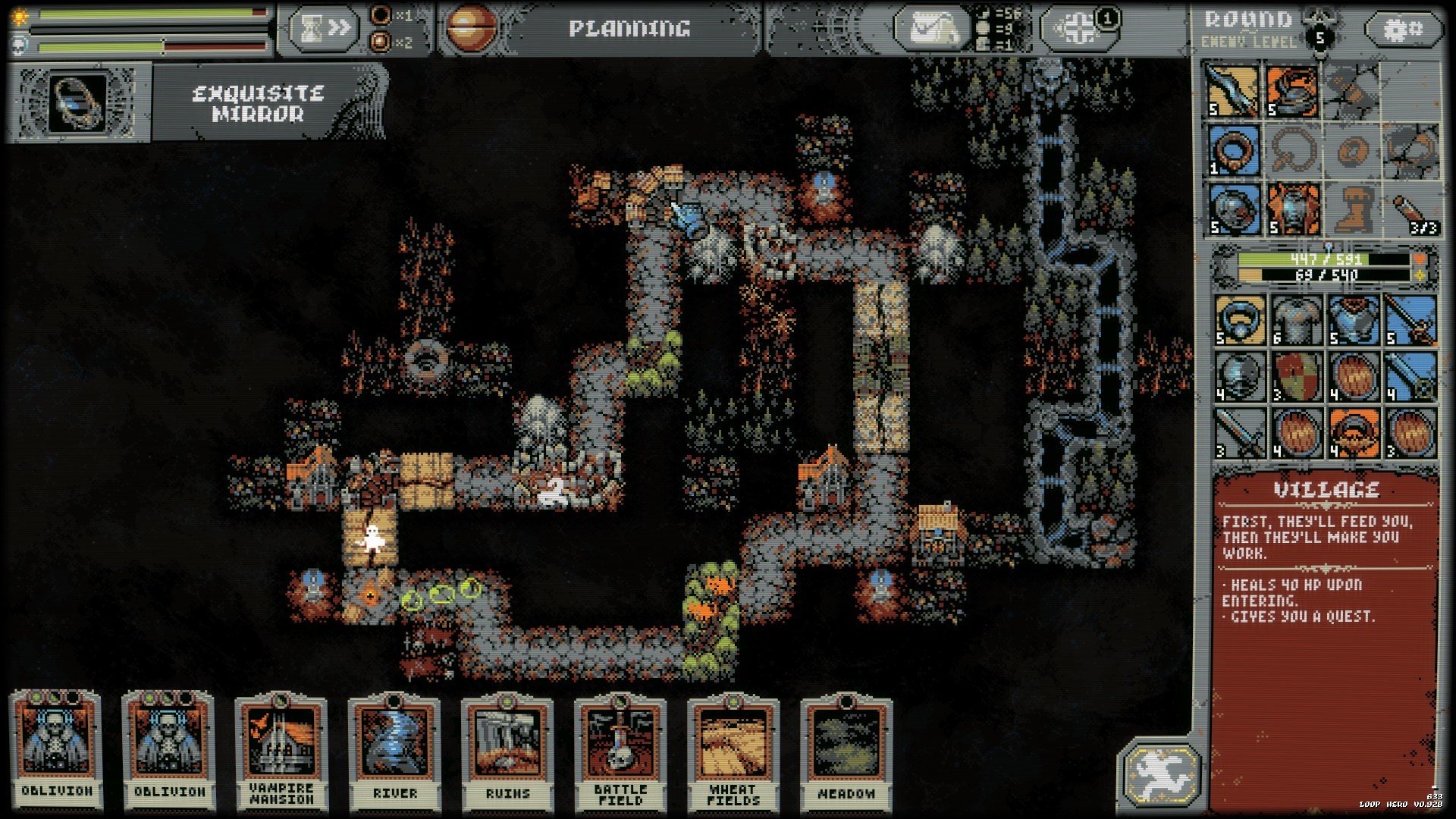
A deck-based auto-battler where you summon your own enemies. Every tile you place makes the loop more dangerous and more profitable at once, so difficulty is a dial you hold and loot is the payment for turning it.
Read the Honest Review
The good and the not-so-good — honest, with reasoning.
Guides
Guides
Loop Hero Beginner Guide — Retreat Before You Die
Loop Hero explains its controls and almost none of its economy. The thing new players get wrong is not card placement — it is that dying costs you most of what you collected, and retreating deliberately does not. This guide puts the opening hours in order: when to retreat, what to build first, how the loop actually escalates, and the placement habit that separates a run that scales from one that stalls.
guideLoop Hero Camp Build Order — What to Build First
The camp is Loop Hero's real progression, and its 23 buildings are not equal. Four of them gate almost everything else — traits, crafting, the Desert cards, golden cards in your deck — and the rest are improvements you can take whenever. This is the build order in priority sequence, with the adjacency rules that decide where each one can go and which one you are allowed to knock down afterwards.
guideLoop Hero Best Cards — Combos Ranked, and the Full List
Loop Hero cards are worth far more in combination than alone. Two Battlefields turn Wasteland into Blood Path, a Village next to a Vampire Mansion becomes a Count's Land, nine Rocks in a square become a Mountain Peak. So a deck should be built around the combinations you intend to trigger, not around the cards that read best. This ranks the combinations worth building for, then lists every one of them.
guideLoop Hero Best Class — All Three Ranked, and Why
Loop Hero has three classes, and picking between them is usually framed as a power question. It is not. Each class wants a different set of landscape cards, and two of those sets are direct opposites. That is why a deck that carried your Warrior can make a Necromancer run feel broken. This ranks all three, explains what each one demands from your deck, and says which to unlock and in what order.
Overview
What's the Game?
A deck-based auto-battler where you summon your own enemies. Every tile you place makes the loop more dangerous and more profitable at once, so difficulty is a dial you hold and loot is the payment for turning it.
You choose the difficulty
every tile placed strengthens what you face and increases what drops, so the risk dial is permanently in your hand.
Combination tiles carry the depth
a Vampire Mansion beside a Village permanently upgrades it, nine Rocks in a square become a Mountain Peak, a Meadow beside anything else upgrades itself for free.
Three classes, three opposite decks
Rock and Mountain carry the Warrior and actively hurt the Necromancer, so a deck is not portable between them.
The camp is the real progression
23 buildings, four of which gate almost everything, and everything you build survives a failed expedition.
Retreat beats death
the campfire is the only safe exit, and dying anywhere else costs most of your haul. The game never says so.
Honest caveats
the middle chapters ask for repeated farming runs, and a hero that fights by itself means a lot of that time is spent watching.
Trailer
Trailer
 Watch on Steam
Screenshots
Screenshots
Languages
Supported Languages
| Language | Interface | Audio | Subtitles |
|---|---|---|---|
| 日本語 ● | ✓ | — | ✓ |
| Deutsch | ✓ | — | ✓ |
| English | ✓ | — | ✓ |
| Español | ✓ | — | ✓ |
| Français | ✓ | — | ✓ |
| Italiano | ✓ | — | ✓ |
| 한국어 | ✓ | — | ✓ |
| Português (Brasil) | ✓ | — | ✓ |
| Русский | ✓ | — | ✓ |
| 简体中文 | ✓ | — | ✓ |
| 繁體中文 | ✓ | — | ✓ |
Spec
System Requirements
Windows
Minimum
Minimum: OS *: Windows 7, 8.1, 10 x64 Processor: Intel Core2 Duo E4500 (2 * 2200) or equivalent, AMD Athlon 64 X2 Dual Core 3600+ (2 * 1910) or equivalent Memory: 2 GB RAM Graphics: GeForce 7300 GT (512 MB), Radeon X1300 Pro (256 MB) Storage: 300 MB available space
Recommended
Recommended: OS *: Windows 7, 8.1, 10 x64 Processor: Intel Core2 Duo E6750 (2 * 2660) or equivalent, AMD Athlon 64 X2 Dual Core 5000+ (2 * 2600) or equivalent Memory: 2 GB RAM Graphics: GeForce 8600 GT (512 MB), Radeon HD 4650 (1024 MB) Storage: 300 MB available space
macOS
Minimum
Minimum: OS: Mac OS X 10.11 or higher Memory: 2 GB RAM Storage: 300 MB available space Additional Notes: Mac M1 officially not supported
Linux
Minimum
Minimum: OS: Ubuntu 18.04+ Processor: Intel Core2 Duo E4500 (2 * 2200) or equivalent, AMD Athlon 64 X2 Dual Core 3600+ (2 * 1910) or equivalent Memory: 2 GB RAM Graphics: GeForce 7300 GT (512 MB), Radeon X1300 Pro (256 MB) Storage: 300 MB available space
Recommended
Recommended: OS: Ubuntu 18.04+ Processor: Intel Core2 Duo E6750 (2 * 2660) or equivalent, AMD Athlon 64 X2 Dual Core 5000+ (2 * 2600) or equivalent Memory: 2 GB RAM Graphics: GeForce 8600 GT (512 MB), Radeon HD 4650 (1024 MB) Storage: 300 MB available space
Achievements
Achievement Highlights
 First blood
 First time?
 Go-getter
 Grandma says hello
 Groundhog day
 Lost count
 New beginning
 Practically a job
 Trickster
 Trophy collection
FAQ
FAQ
Data last updated: · Information based on store APIs
More Games