
Most games send enemies at you. Loop Hero makes you place them.
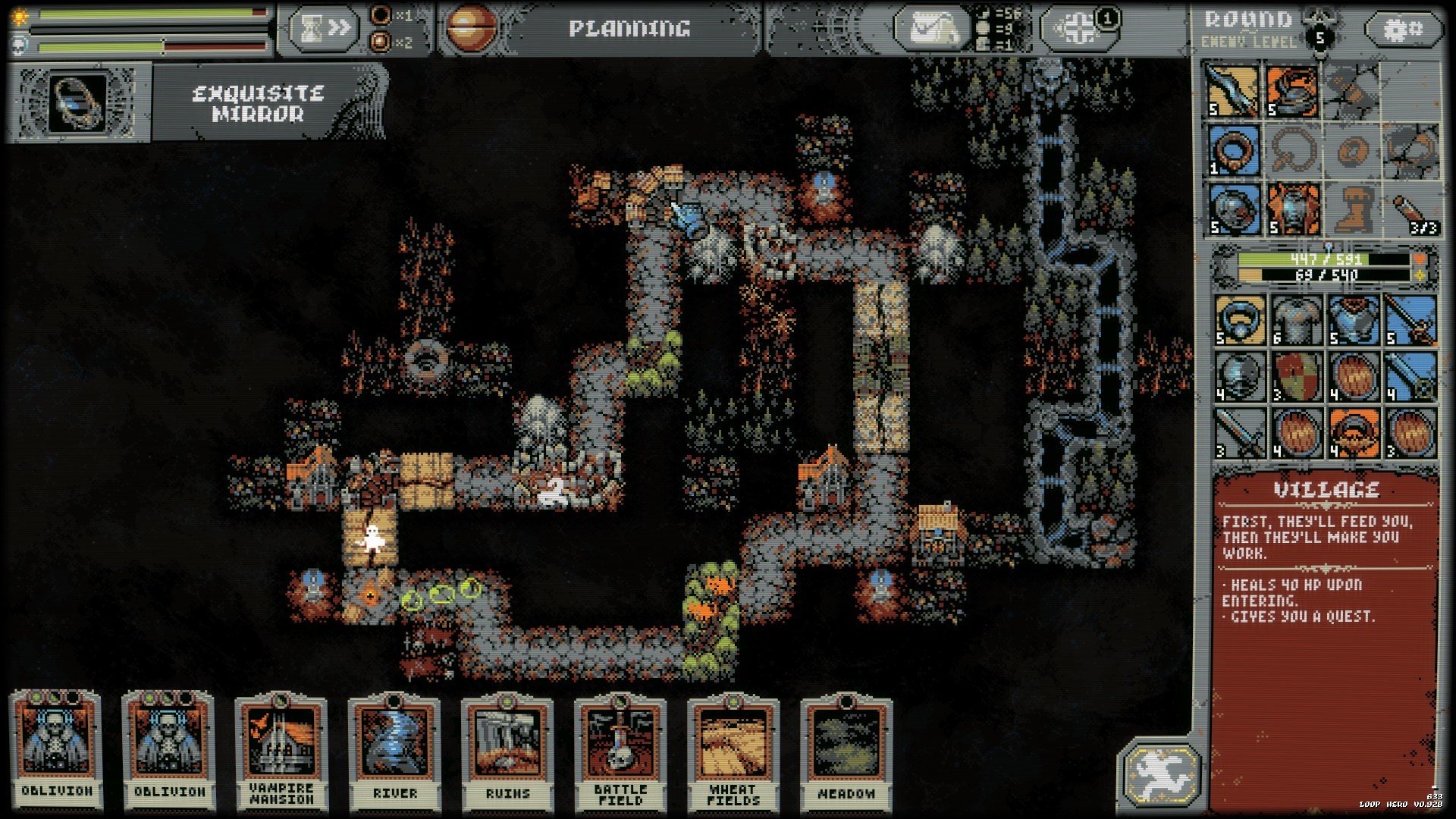
Your hero walks a fixed loop and fights on its own. Your only inputs are which cards go on the map and when to retreat. Every tile you add makes the loop more dangerous and more profitable at the same time, which means difficulty is a dial you are holding, and loot is what you get for turning it. That inversion is genuinely original, and it is the reason this game is remembered four years after release.
What the idea buys you
The first hour is close to perfect. You place a Rock because it gives HP, and discover that nine of them in a square become a Mountain Peak with a much larger bonus and a Harpy problem. You place a Vampire Mansion next to a Village and watch it get ransacked for three loops before permanently upgrading into something better than what you started with. You realise a Meadow is a bad card and a Meadow next to anything else is a good one.
None of that is explained. All of it is discoverable, and discovering it is the game.
The class design carries the same idea further than it needed to. The three classes do not merely have different stats — they want opposite landscape cards. Rock and Mountain raise maximum HP, which is the Warrior's whole identity and nearly useless to a Necromancer running on Magic HP. Desert cuts maximum HP, which ruins the Warrior and costs the Necromancer nothing. A deck is not portable between them.
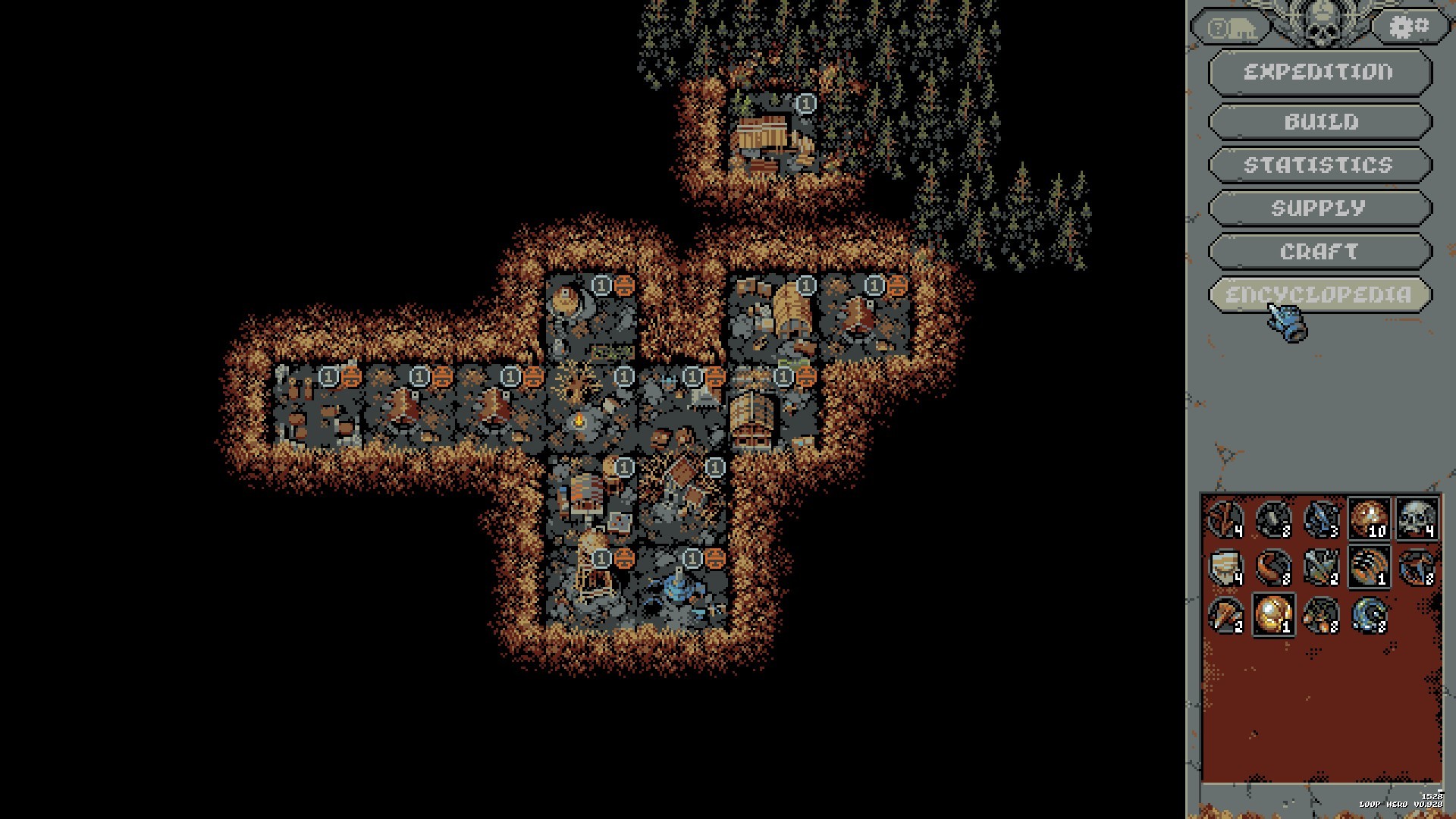
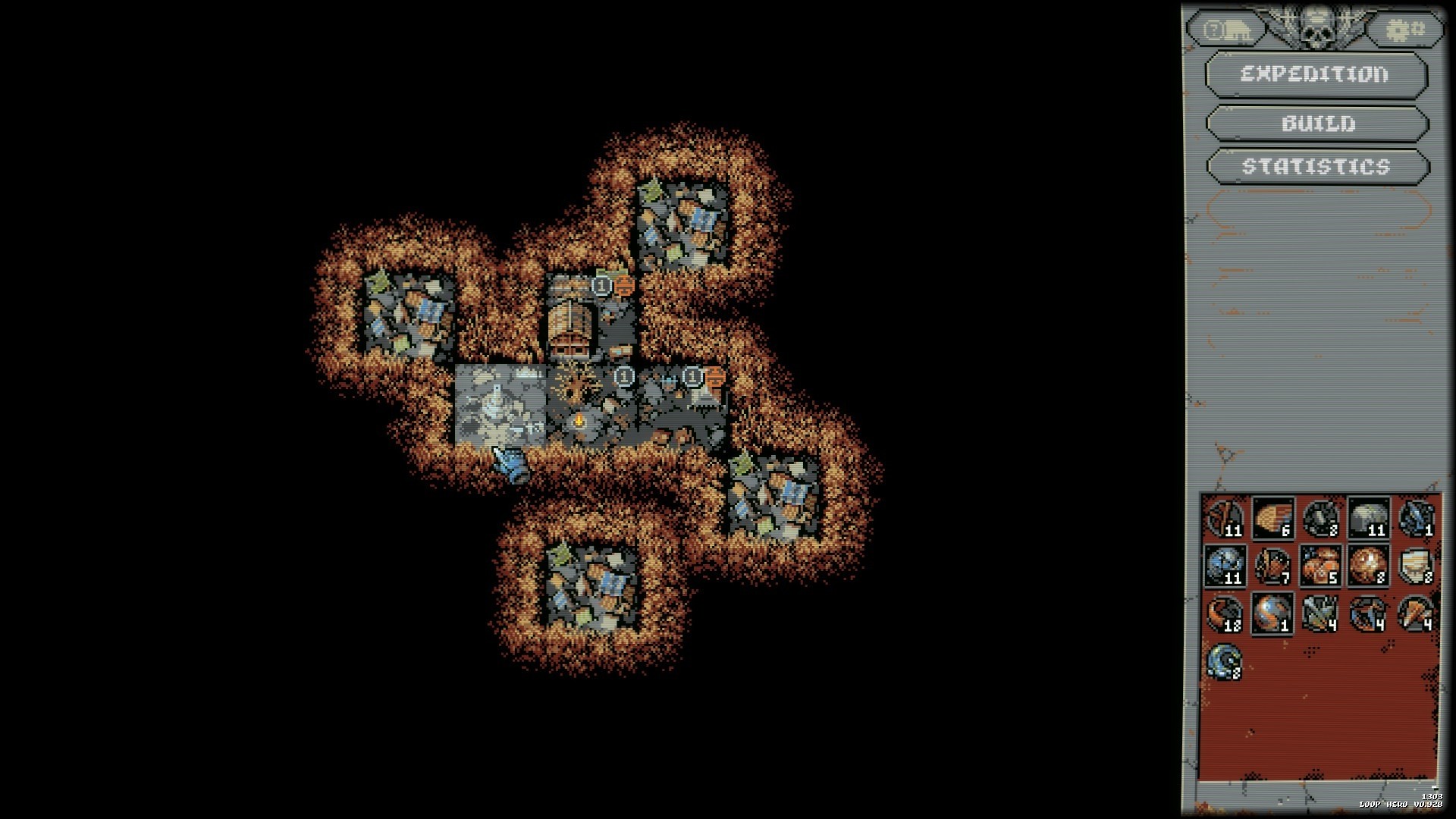
The camp layer holds it together. Resources you bank build permanent structures, a few of which — the Gymnasium for traits, the Intel Center for Desert and golden cards — change what a run can be rather than adding a percentage. Progress survives a failed expedition, which is what makes the retreat decision interesting instead of punishing.
Where it drags
The criticism is pacing, and it is not small.
The camp needs a lot of resources, and the fastest way to get them is to replay loops you have already solved. So the middle of the campaign becomes a series of expeditions where you are not learning anything and not at risk — you are farming. Because the hero fights without your input, farming in Loop Hero means watching. A run you have under control is a run where you place two cards and then wait.
The second issue is related: the game's own difficulty dial makes it easy to remove the tension entirely. Once you understand that placing nothing is always an option, a cautious player can flatten the risk out of most of a chapter. That is good design in the sense that the tools work, and awkward in the sense that the optimal play is often the least interesting one.
Loop Hero is also unusually unforgiving about a rule it never states: dying costs you most of your haul, while retreating at the campfire keeps it. Players who learn this in hour ten have spent nine hours losing progress they earned. It is the single biggest source of early frustration and it is a tutorial problem, not a design one.
Where it stands
| Aspect | Where it is |
|---|---|
| Release | March 2021 |
| Developer and publisher | Four Quarters, published by Devolver Digital |
| Steam reception | 92 percent positive from roughly 36,500 reviews |
| Structure | Four chapters, each ending in a boss — the Lich, the Priestess, the Hunter, the Destroyer |
| Localisation | Japanese, Russian, Simplified and Traditional Chinese, Korean and 8 more, with full audio and subtitles |
How it compares
| Against | Loop Hero is | Which suits you if |
|---|---|---|
| Slay the Spire | Less about the deck, more about the board. Your cards make terrain, not attacks | You want a spatial puzzle rather than a combat puzzle |
| Vampire Survivors | Slower, colder and far more deliberate. Both have automatic combat; only this one asks you to design the encounter | You liked the idea of automatic combat but wanted decisions attached to it |
| Darkest Dungeon | Much lighter on management and much lighter on cruelty. The permanent layer here is a camp, not a roster of broken people | You want the meta-progression without the attrition |
| An idle game | Not one, though the farming stretches can feel like it. The decisions are real, they are just infrequent | You are happy with dense decisions separated by quiet stretches |
For the two comparisons worth following up: the Slay the Spire review covers the deckbuilder this is most often measured against, and the Vampire Survivors review covers the other well-known game where combat happens without you.
Who should buy it
| Buy it if | Skip it if |
|---|---|
| You want a genuinely novel mechanic rather than a refined familiar one | You want to control fights directly — you never will here |
| You enjoy working out undocumented interactions yourself | You want the game to explain its economy, because it does not |
| You are happy for a meta layer to be the real progression | Grinding earlier content to fund a base sounds like a chore rather than a loop |
| You play in Japanese, Russian, Chinese or Korean and want full localisation | You have limited patience for watching a solved encounter play out |
Verdict
Loop Hero is one of the most original strategy games of its generation and it is honestly a bit of a slog in the middle. Both of those are true, and the second does not cancel the first.
The trade at its centre — summon harder enemies because harder enemies are where everything you want comes from — is a genuinely good idea, executed with enough depth that the combination tiles and the class-deck interactions stay interesting long after the novelty wears off. What it lacks is a reason for the campaign to be as long as it is. Chapters three and four ask you to repeat solved content to fund the camp, and a game where the hero fights by itself is a difficult one to spend that time in.
Buy it for the idea, which is worth the money on its own. Do not feel obliged to finish chapter four to have had the experience.
For the opening hours, see the beginner guide — the retreat economy is the thing to learn first. The cards guide lists every combination, the class tier list explains why the three classes need different decks, and the camp build order covers which buildings actually gate progress.