Vampire Survivors is the game that started the "survivor-like" genre. Made by the small studio poncle, it began as a free browser game in 2021, reached version 1.0 on Steam in October 2022, and has kept getting updates and expansions since. Its Steam user rating is Overwhelmingly Positive from well over a quarter of a million reviews. The real question is whether its style suits you, and which add-ons are worth your money.
Buy, wait or skip
| Your situation | Verdict | Why |
|---|---|---|
| You want short, low-stress sessions where you get much stronger within one run | Buy | That growth curve is the whole design, and runs last 15 to 30 minutes |
| You like long unlock lists and collecting | Buy | Characters, weapons, stages, relics and secrets keep unlocking for dozens of hours |
| You mainly play on a phone | Buy (it is free) | The mobile version is the full game, works offline and only shows ads you choose to watch |
| You want to play with friends | Buy | Up to 4 players locally or online with a private lobby code; no matchmaking |
| You already own it and wonder about DLC | Wait until you want more | The base game lasts a long time; start with the free expansions, then Ode to Castlevania |
| You are curious but price-sensitive | Wait for a sale, or try mobile | It is cheap already and often discounted; the free mobile version shows whether it clicks |
| You want aiming, dodging and reflex-based action | Skip | You only control movement, and late in a run even that matters less |
| Dense flashing effects tire you or make you feel unwell | Skip or check the options first | The late game fills the screen; toggles help but do not remove the clutter |
Short version: for its price, there is little risk. The people who regret it are mostly those who wanted an action game, not those who found it too simple.
What kind of game it is
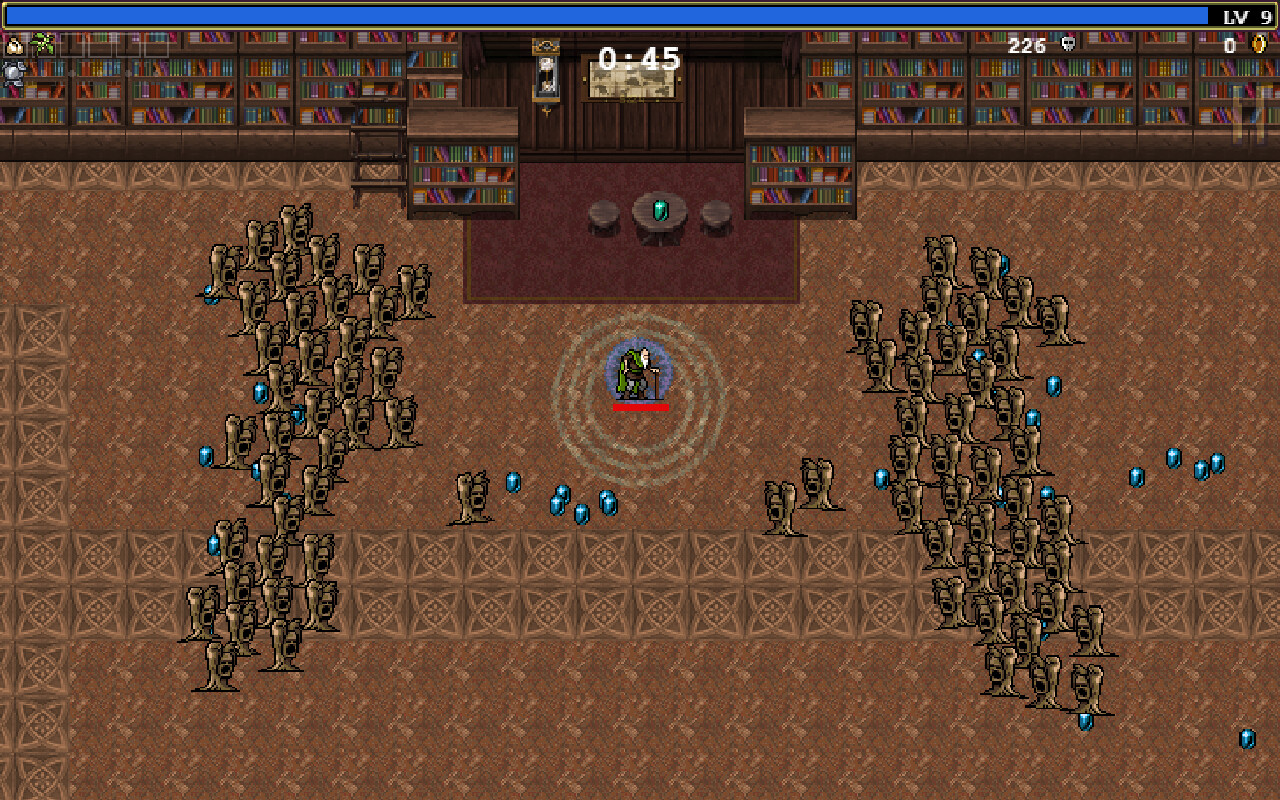
You pick a character and walk around a large stage while enemies close in from every side. Your weapons attack on their own. Killed enemies drop experience gems; each level-up offers 3 or 4 choices of a new weapon, a passive item, or an upgrade to one you already hold. You can carry 6 weapons and 6 passives. Max a weapon, own its paired passive, and open a boss chest after the 10-minute mark, and the weapon evolves into a far stronger version. Most stages end at 30 minutes, when the Reaper appears; some end at 15 or 20.
Between runs you spend gold on permanent PowerUps and new characters, and almost every run unlocks something new: a stage, a weapon, a passive, a hidden character. That second layer is what keeps people playing for a long time. The Beginner Guide has a run-by-run plan for the first sessions, and the Weapon Evolution Guide lists every base-game recipe.
Current state: what you get today
| Item | Status |
|---|---|
| Release | Full release (version 1.0 in October 2022), still updated |
| Platforms | Windows and macOS (Steam, Epic), Xbox One and Series X|S, PlayStation 4 and 5, Nintendo Switch, iOS and Android (free), Apple Arcade, and a VR version for Meta Quest |
| Recent free updates | 1.14 (October 2025): online co-op. 1.15 (June 2026): multiple save slots, content filters, a new stage (The Lycaeum), late-game stability and loading improvements |
| Free expansions | Emerald Diorama (SaGa collaboration, April 2025) and Ante Chamber (Balatro collaboration, October 2025) |
| Paid expansions | Six: Legacy of the Moonspell, Tides of the Foscari, Emergency Meeting, Operation Guns, Ode to Castlevania, Legacy of the Bloodmoon |
| Multiplayer | Local co-op for up to 4 players (not on mobile) and online co-op with private lobbies; no cross-play |
| Monetisation | One-time purchase on PC and console; free on mobile with optional ads; no loot boxes or premium currency |
| Interface languages | 14 on Steam, including Japanese, Korean, both Chinese scripts, Russian, German, French, Italian, Spanish and Brazilian Portuguese |
The game is far larger than at 1.0: the wiki counts 80 official stages, including those inside the adventure mode, and the developer says free updates will continue. On mobile, ads are only buttons you may press for a revive or extra gold; nothing forces you to watch one.
What the DLC is worth
All six paid expansions are priced below the base game, and together they cost a little under three times the base game at US list prices. You do not need any of them to enjoy the game; each adds its own stage or stages, characters, weapons and evolutions, and most add an adventure.
| Expansion | Theme | What it adds | Verdict |
|---|---|---|---|
| Legacy of the Moonspell | Japanese folklore | 8 characters, 13 weapons, Mt. Moonspell stage; 7 extra unlocks added in 2026 | Cheapest tier after a 2026 price cut; good value now |
| Tides of the Foscari | Fantasy academy | 8 characters, 13 weapons, two stages (Lake Foscari, Abyss Foscari) | Fine but not essential |
| Emergency Meeting | Among Us | 9 characters, 15 weapons, Polus Replica stage, weapons built around co-op | Best if you play co-op or like Among Us |
| Operation Guns | Contra | 12 characters, 22 weapons, two stages; evolutions need the Weapon Power-Up item | Good for run-and-gun fans; different evolution rules |
| Ode to Castlevania | Castlevania | 96 characters (40 standard, 56 secret), 126 weapons, one very large stage, 11 relics, over 100 music tracks | The best paid expansion by far; buy this first |
| Legacy of the Bloodmoon | Dark twin of Moonspell | 12 characters, 16+ weapons, Red Moon Manor (a very large stage), an adventure | Cheapest tier; newest, released August 2026 |
| Emerald Diorama | SaGa: Emerald Beyond | 12+ characters, 16+ weapons, party characters and the Glimmer mechanic | Free; install it |
| Ante Chamber | Balatro | 4 characters, 4 weapons with evolutions, a stage styled after Balatro's interface | Free; small but fun |
Ode to Castlevania is the one most players should buy if they buy only one. It is not just more of the same: its stage is huge and full of secrets, and many of its weapons combine into unions with other weapons instead of pairing with passives. If you arrive expecting the base-game recipe pattern, check its rules first. Fans of the card game will like Ante Chamber, which is free; our Balatro review covers the game it borrows from.
What it does well
Growth you can see
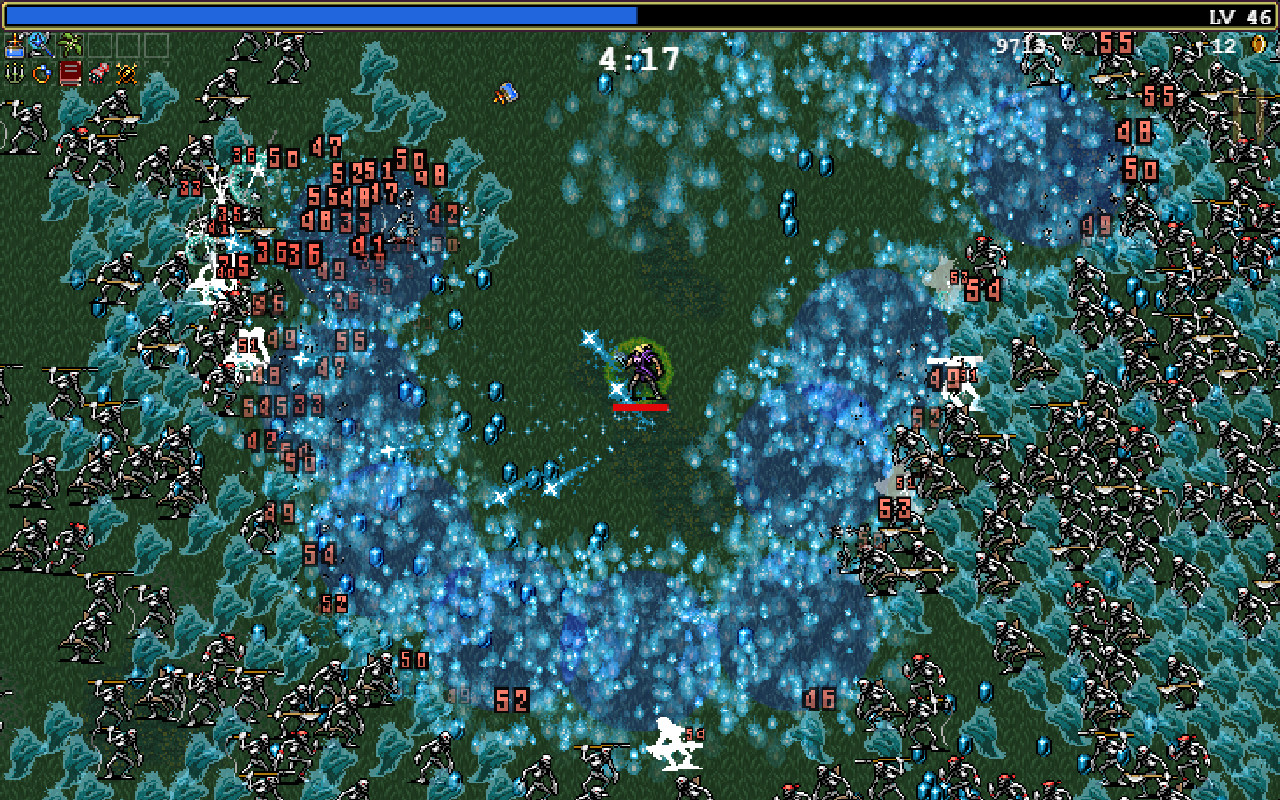
The core pleasure is the curve from "barely surviving" to "the screen is mine" inside one 30-minute run. You start with one weapon that hits a narrow area. By minute 10 or 15 you have an evolution such as La Borra (Santa Water + Attractorb), which leaves damaging pools that follow you, or Unholy Vespers (King Bible + Spellbinder), which circles you constantly. By minute 25 enemies die before they reach you. Few games deliver that much growth in such a short session.
Easy to start, real decisions underneath
Controls are one stick or the arrow keys. Anyone can play, and on mobile it works with one thumb. The decisions are in the level-up screen: which weapons cover different directions, which evolution to commit to, when to take its passive, and when your slots are full. The Best Builds Guide explains why committing to one evolution early beats taking whatever is offered.
A huge amount of content for the price
Even without DLC, unlocking everything takes a very long time: hidden characters, secret stages, relics, Arcanas, and modes such as Hyper, Hurry, Inverse and Endless. The Unlocks Guide lists the secrets, and the Character Tier List ranks the roster.
Where it falls short
The late game is visual noise
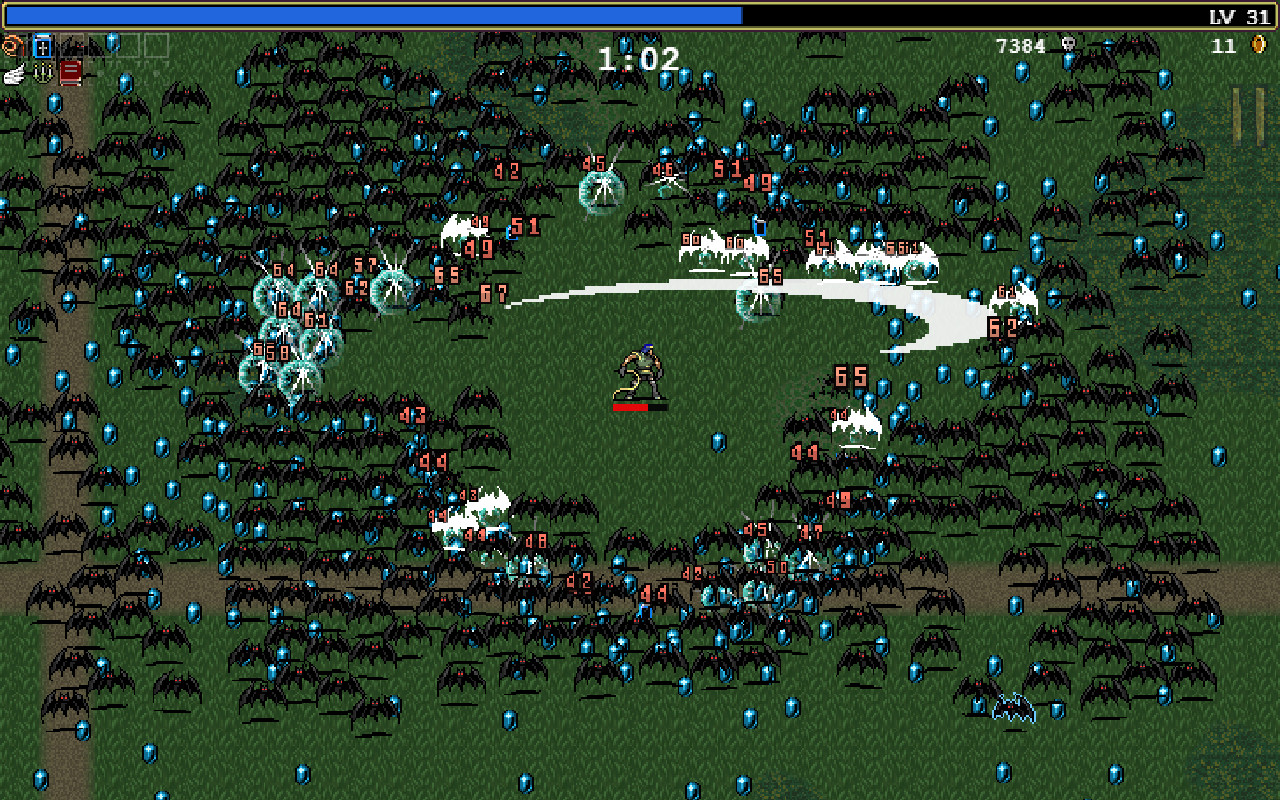
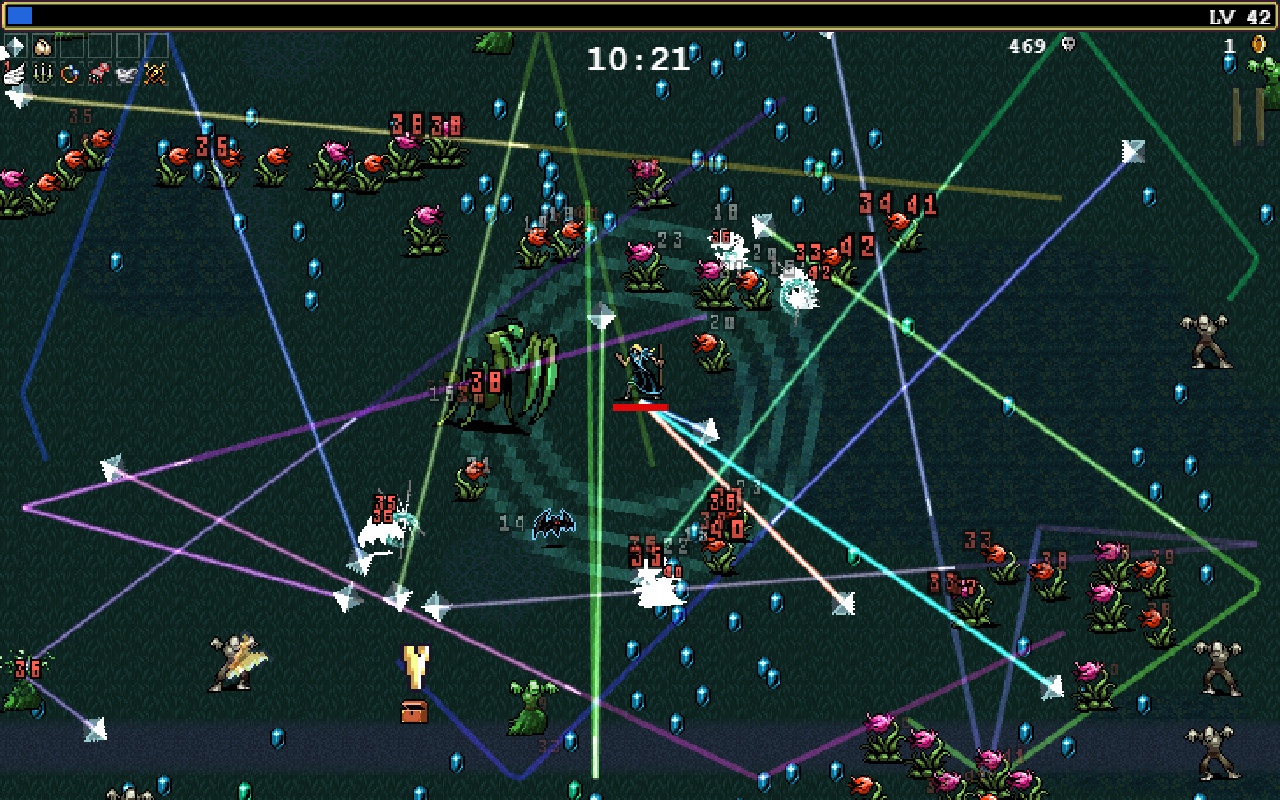
From around minute 20, evolved weapons, effects, damage numbers and hundreds of enemies cover the screen. You can lose track of your own character, and enemy projectiles or a boss can be hard to see. The options help: you can turn off damage numbers, flashing effects, blood and weapon screen shake. They reduce the problem but do not remove it, and the developer itself named "late-game on-screen chaos" as a target for later updates.
Runs can feel like they play themselves
Once your build is complete, there is often little left to decide. Your weapons clear the screen and you walk in circles until the Reaper comes. Some enjoy that relaxing finish; others find the last 10 to 15 minutes empty. Hurry Mode, which doubles the clock speed and so halves a run in real time, is the best fix if you only want the growth part.
The game explains almost nothing
Evolution recipes, which chests can evolve, how stages unlock (by level reached, not by time survived), and many secret unlock conditions are not shown in a useful way. You can play happily without knowing them, but you will progress much more slowly.
Common complaints, and how true they are
| Complaint | Is it true? | What helps |
|---|---|---|
| You cannot see anything late in a run | Yes, after about minute 20 | Turn off damage numbers, flashing effects, blood and weapon screen shake |
| It plays itself | Partly; the end of a run needs little input once your build is done | Hurry Mode to shorten runs; Inverse or Endless for more challenge |
| It is too easy | The base stages are, once you have PowerUps | Hyper and Inverse modes, Curse, challenge stages, and fewer PowerUps |
| It gets repetitive | After the main unlocks, yes | Adventures, the free expansions, Ode to Castlevania, and new characters with different starting weapons |
| Too much DLC to understand | Partly; the menus are long | You need none of it; 1.15 added content filters to the character and unlocks menus |
Compared with similar games
| Game | What is different | Choose it over Vampire Survivors if |
|---|---|---|
| Brotato | Short arena waves (20 to 90 seconds) with a shop between them, up to 6 weapons, optional manual aiming, local co-op for 4 | You want more decisions per minute and less waiting for the build to finish itself |
| Halls of Torment | Diablo-style pre-rendered look, items found in runs that you can bring back for later runs, quest-based progression, single-player | You want a darker, slower, more RPG-like version |
| Deep Rock Galactic: Survivor | You mine through cave walls, complete mission objectives and reach the drop pod; single-player; costs more | You want more active movement and goals beyond surviving the timer |
Vampire Survivors is the only one of the four with online co-op, it is free on mobile, and it has the longest list of content to unlock. Its competitors usually give you more to do in the middle of a run. If you know you want depth from items and equipment, read our Halls of Torment review; for mining and missions, the Deep Rock Galactic: Survivor review. If you have played enough of the genre to want a build system to take apart, the Soulstone Survivors review covers the most complex one.
Related guides
New to the game: Beginner Guide. Every evolution recipe: Weapon Evolution Guide. Which evolution to build and in what order: Best Builds Guide. Who to play: Character Tier List. Secrets and hidden characters: Unlocks Guide.
★Honest Take — still the easiest recommendation in the genre
Vampire Survivors keeps its 8.7 because it does one thing better than anything else: it makes you much stronger, very quickly, for almost no money and with almost no learning curve. Years after 1.0 it is still growing, with co-op, save slots, free expansions and new stages. The reservations are honest ones. Its late game is a blur of effects, the last part of a run can feel automatic, and the game hides most of what you need to know. Its rivals now beat it on decisions per minute and on readability. But none of them matches its mix of low price, sheer amount of content, co-op and a free mobile version. If you want hands-on action, look elsewhere; if you want a game for a short break that keeps rewarding you for months, this is still the first one to try.