Your warband is a business, not a party
Wartales rarely kills a playthrough with a single disastrous battle. It ends runs slowly, through a ledger that stops balancing. Wages come due, food drains, injuries demand rest, rest demands more food, and somewhere in that loop a companion decides the arrangement is no longer worth it and leaves.
Understanding the upkeep systems is therefore not optional housekeeping — it is the core strategic layer of the game. Everything below is about making that ledger work in your favour.
The single most useful mental shift for a new player: you are not building an adventuring party, you are running a company that happens to fight. Payroll comes first.
The four pressures
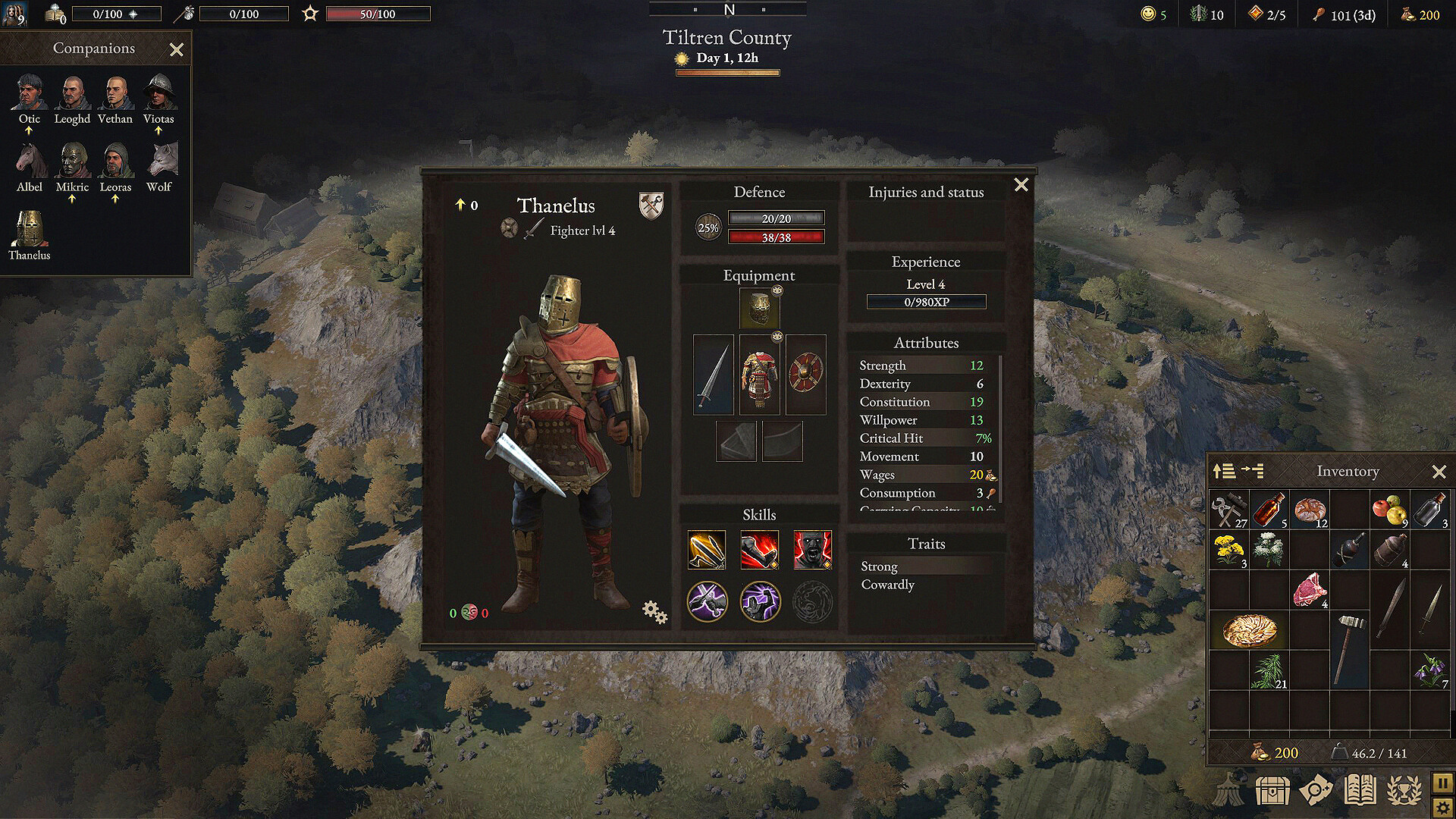
Wages. Every companion draws pay on a timer, and that timer is indifferent to how your contracts went. A run of low-paying work does not pause payroll; it just quietly drains your reserve. Miss payments and happiness falls.
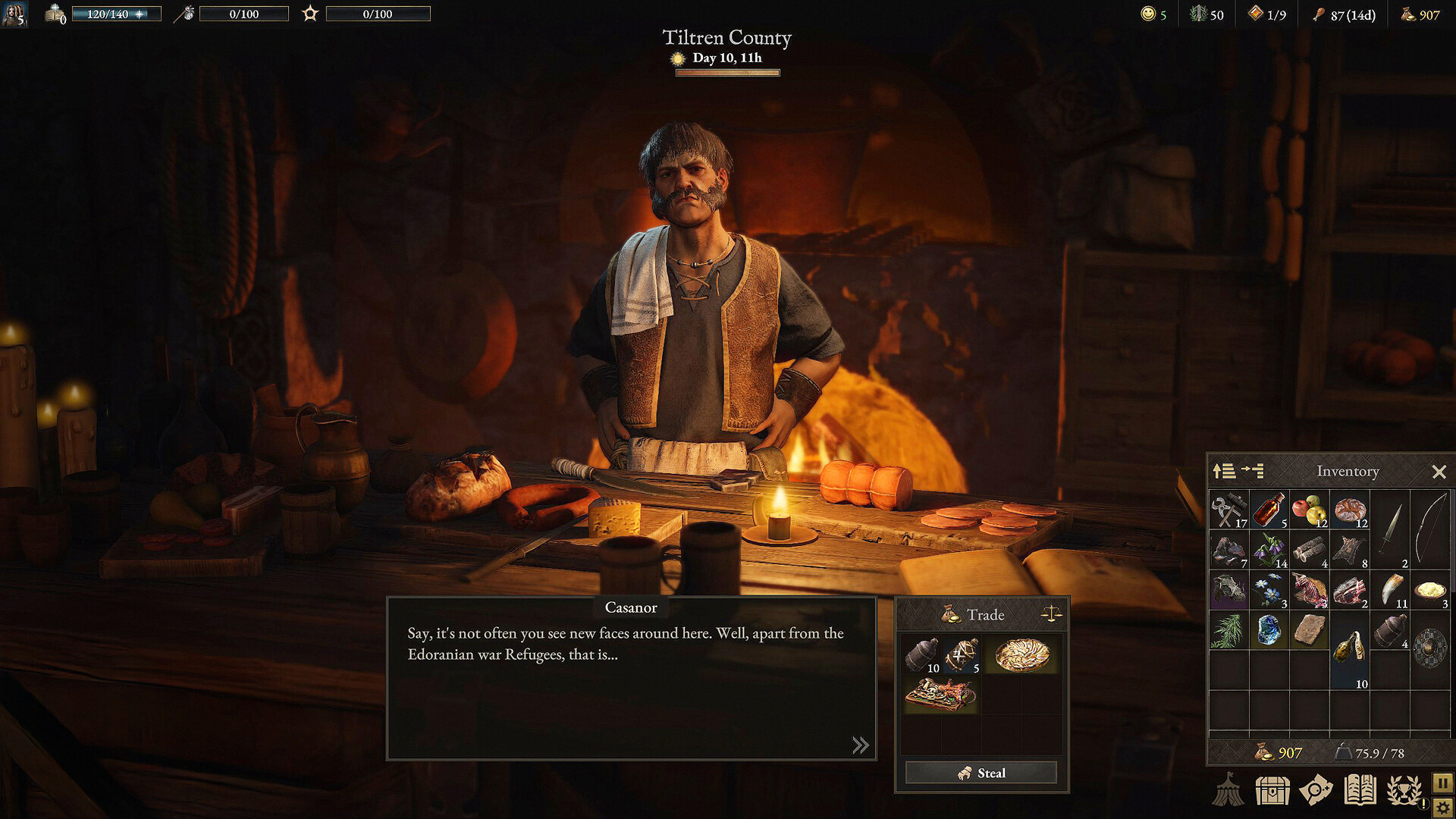
Food. Each companion eats roughly one ration per day. This is a constant, unavoidable drain that scales directly with headcount.
Rest. Healing injuries means resting at camp, and resting costs food per person on top of the daily drain. A rough fight is therefore expensive twice: once in injuries, once in the rations needed to clear them.
Happiness. Unpaid wages and missing food both push happiness down. Let it fall far enough and companions desert — taking their levels, their specialisation choices and their profession progress with them.
The compounding relationship between these is what catches people out. More companions means more wages and more daily rations and more food consumed per rest. Headcount is the multiplier on all of your costs simultaneously.
Recruit later than feels comfortable
The instinct when you meet a promising companion is to hire them. Resist it more often than you give in.
A tight warband of well-built specialists clears contracts more reliably than a sprawling one, for three reasons: your costs stay manageable, your core fighters absorb the experience they need to reach milestones at levels 2, 3, 5, 8, 10 and 12, and fewer companions means fewer injuries to rest off after each fight.
Recruit when you have identified a specific role gap — no armour breaking, no ranged damage, nobody who can hold a second flank — and when your income comfortably absorbs another wage. Not because someone good was standing in a tavern.
Camp upgrades: two that pay for themselves
Camp is where your warband rests, cooks, crafts and works. Most upgrades are useful. Two are transformative.
Cooking pot — build this first
A tier 2 cooking pot saves four food per rest. Because resting is something you do constantly to clear injuries, that saving compounds across a playthrough into an enormous number of rations. It is effectively a permanent discount on your largest recurring expense, and it is the reason a warband that has upgraded its pot feels dramatically less pressured than one that has not.
Tent — build this second
A tier 3 tent grants a Valour Point at the start of every battle. Valour Points fund your strongest abilities and normally accumulate only as your companions attack and land kills, which means the opening turns of a fight are usually your weakest. Starting with a point in the bank turns turn one from setup into something decisive.
Cooking pot fixes your economy, tent fixes your opening turn. Build them in that order — the food saving is what funds everything else.
Beyond those two, camp is where professions do their work and where companions can be assigned to tasks that restore happiness. Nobody should ever be standing idle; an unassigned companion at camp is a wage you are paying for nothing.
The eight professions
The professions are Blacksmith, Cook, Alchemist, Thief, Angler, Scholar, Miner and Tinkerer. They operate outside combat, and they level with use.
That last point drives the most important rule: assign early and stop reshuffling. Moving a companion between professions throws away accumulated progress, and a mid-level profession is worth far more than two low-level ones.
The first four to fill
Cook. Attacks the problem that constrains you most directly. Combined with an upgraded cooking pot, a Cook meaningfully reduces the food drain that dictates how far you can travel and how often you can afford to rest.
Blacksmith. Keeps gear repaired and improvable. Without one you are repeatedly buying replacements, which is a slow and avoidable bleed on your reserve.
Miner. Turns the mines scattered around the world into a genuine income stream rather than scenery. Given how much of Wartales is walking, having a profession that converts exploration into money is valuable early.
Alchemist. Becomes important as soon as injuries start stacking, because anything that reduces how often you must rest also reduces how much food you burn.
| Profession | What it does for the warband | Priority |
|---|---|---|
| Cook | Directly reduces the food drain that dictates your travel range | First |
| Blacksmith | Repairs and improves gear so you stop buying replacements | First |
| Miner | Turns the mines you explore into a real income stream | First |
| Alchemist | Reduces how often you must rest, which saves rations too | Early |
| Angler | A food source that does not cost purchase money | As you grow |
| Thief | Opens options in and around settlements | As you grow |
| Scholar | Supports knowledge-based progression | As you grow |
| Tinkerer | Feeds crafting and camp improvement | As you grow |
The other four
Thief opens options in and around settlements. Angler provides a food source that does not cost purchase money. Scholar supports knowledge-based progression. Tinkerer feeds crafting and camp improvement.
Fill these as your warband grows past the core. There is no reason to leave any profession unassigned once you have the bodies — every one of them converts idle travel time into something.
Route planning is an economic decision
Because food drains per day, the distance you walk is a cost. Two contracts in the same area are dramatically cheaper than two contracts three days apart, even if the distant one pays slightly better.
Practical habits:
- Cluster contracts. Take everything available in one area before moving on.
- Sell as you go. Loot and prisoners are income; hoarding them is just weight.
- Rest deliberately. Resting is a food expense, not a free reset. Clear injuries when you need to, not reflexively after every skirmish.
- Keep a buffer. Living at zero rations means one bad stretch turns into a morale collapse.
When the economy stops being interesting
An honest note, because it affects how you plan a playthrough: these systems are excellent pressure early and become administrative later. With six companions and a thin reserve, every one of the decisions above genuinely matters. With a mature warband and a healthy income, the same systems keep demanding attention without producing meaningful choices.
The practical response is to front-load the work. Build the cooking pot and tent early, get every profession assigned and levelling, and keep headcount disciplined. Do that and the upkeep layer stays in the background where it belongs, leaving you free to do the part of Wartales that stays interesting — choosing which region you are finally strong enough to walk into.
The professions here exist to feed your fighters, so they pair directly with the Wartales builds guide. For the first ten hours, where the upkeep pressure is at its sharpest, see the beginner guide.