What Wartales actually is
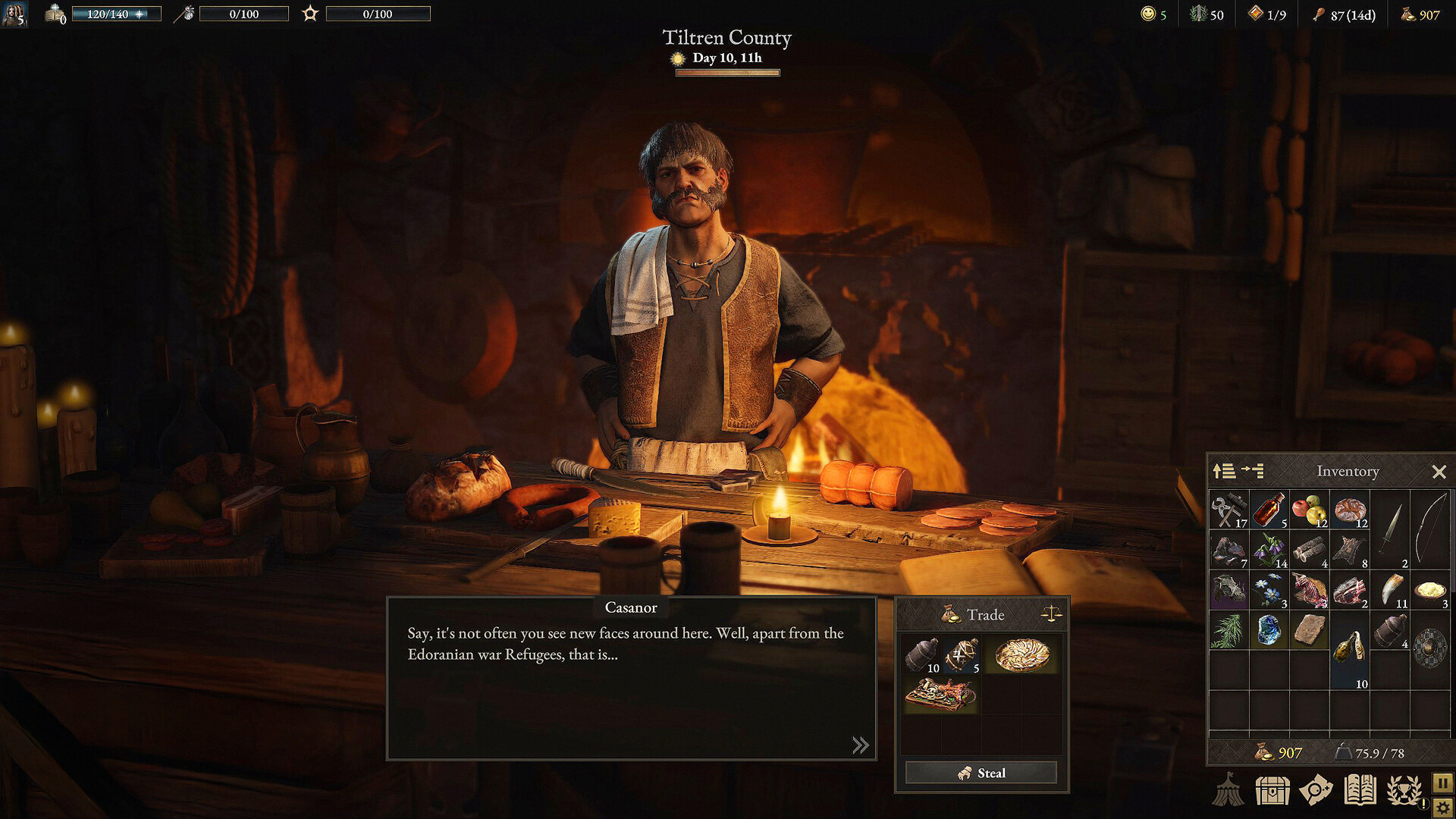
Wartales opens by making its position clear: you are not a chosen one, you are a employer of last resort. A plague tore the old empire apart roughly a century ago, and what is left is a patchwork of counties held together by whoever can afford guards. You lead a handful of mercenaries into that, and the entire game flows from one question — can you keep these people paid, fed and willing to follow you?
That framing is the best thing about it. Almost every decision has a price tag attached. A contract that pays well might drag you across two regions, burning food. A prisoner is worth money but eats like everyone else. A fight you win can still cost you, because injuries need rest and rest costs rations. The game is at its strongest in the first fifteen or twenty hours, when the margins are thin and every choice is genuinely a trade-off.
Wartales does not scale enemies to your level. Regions have fixed difficulty tiers, so the order in which you travel is a real strategic decision rather than a cosmetic one. Tiltren County is the intended starting region.
The open world is the headline feature
The reason to pick Wartales over its obvious comparison point is structure. Battle Brothers, the game most people will measure this against, uses an abstracted campaign map — you see icons, you move between them, you fight. Wartales gives you an actual world to walk through, with mines to enter, crypts to loot, camps to raid and paths that connect regions you may not be ready for.
That decision pays off in two ways. First, it makes exploration meaningful, because a region you can see is not necessarily a region you can survive. Second, it gives the world a texture that a map screen cannot: you find things by looking rather than by clicking a marker. The trade-off is pacing — walking takes real time, and backtracking across regions you have already cleared is one of the places the game drags.
Co-op deserves a mention here too, because it is genuinely rare in this niche. Up to four players can share the world, and a game about managing a struggling company becomes a different and often funnier experience when the decisions are argued over.
Combat is solid rather than spectacular
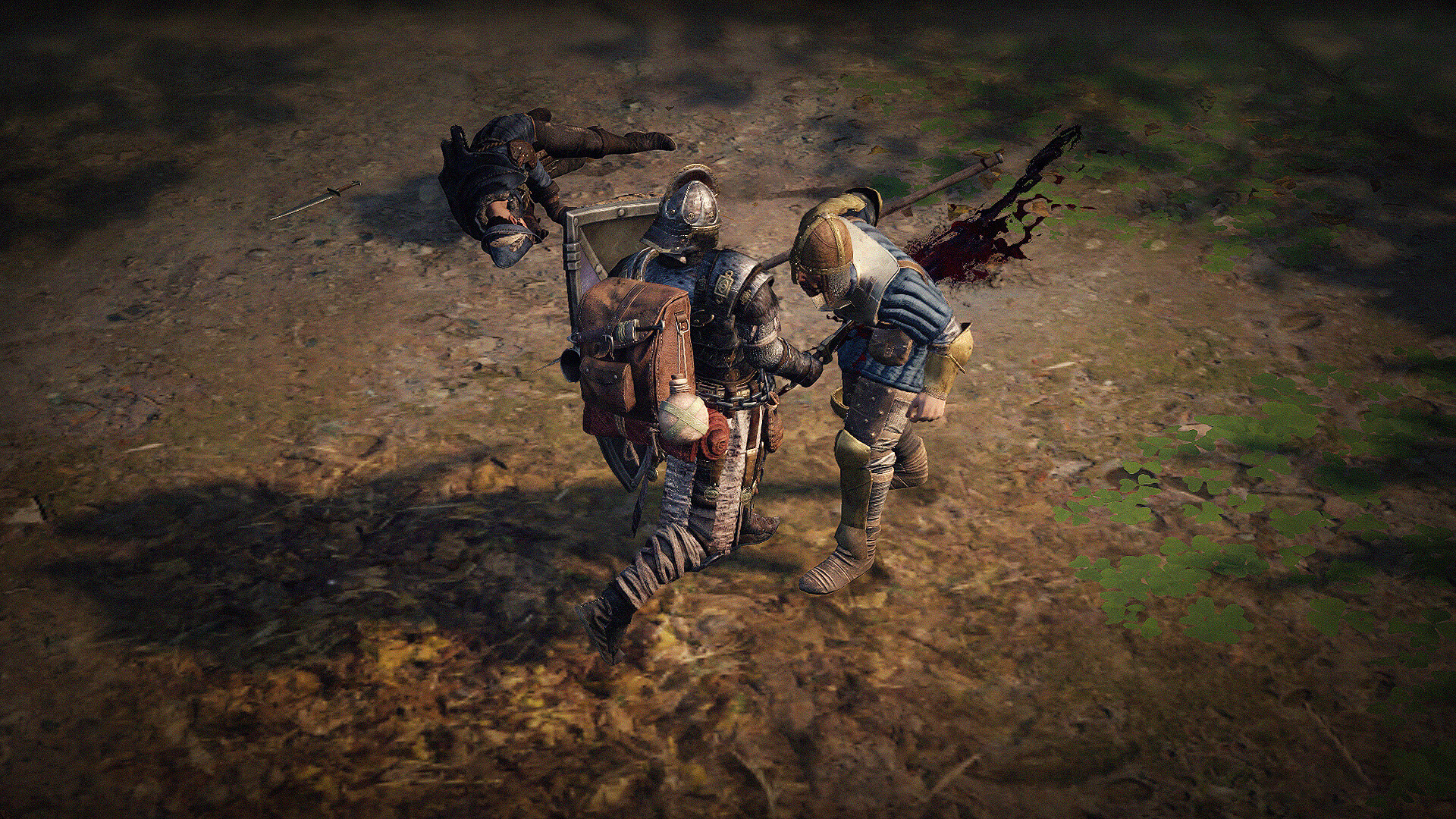
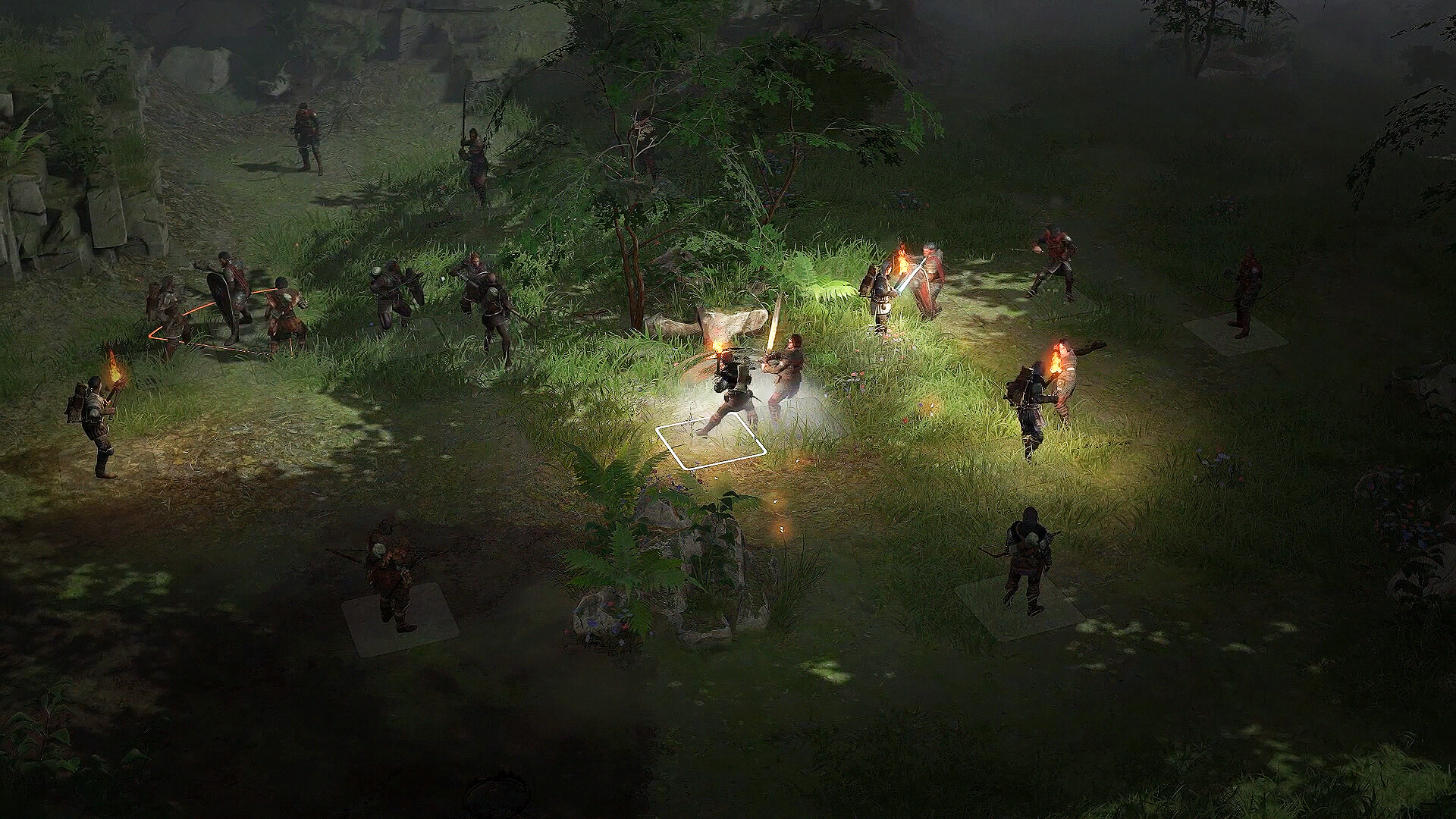
Battles are turn-based and grid-free, fought on the terrain where you met the enemy. The core concepts are engagement — units lock each other in place, and moving out of an engagement invites a free hit — and Valour Points, a shared resource that builds through attacks and kills and pays for your strongest abilities.
It works. Positioning matters, flanking matters, and the difference between a clean win and three injured companions is usually whether you controlled who was engaged with whom. Where it falls slightly short of the very best in the genre is variety: many fights against the same enemy archetypes resolve the same way once you have a working formation, and the mid-game in particular can settle into repetition.
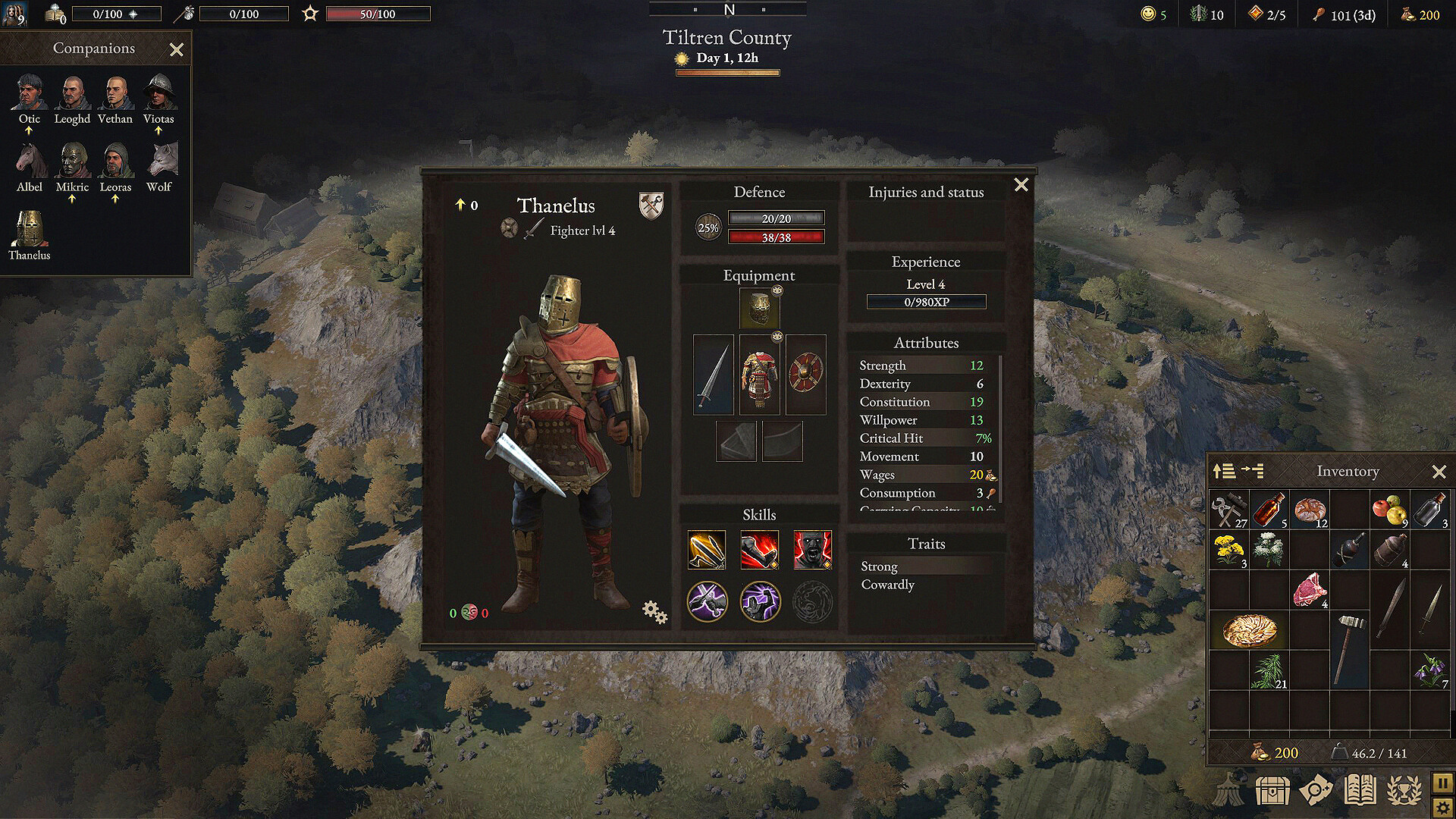
The specialisation system is where the depth lives. Every companion picks from a small set of options at levels 2, 3, 5, 8, 10 and 12, and the level at which the named sub-paths appear differs by class — Swordsman, Warrior and Brute branch at level 2, while Archer, Ranger and Spearman branch at level 3. Building a companion is a long-term commitment, and two warbands with the same classes can play very differently.
The upkeep loop: the honest problem
This is the part a fair review has to be blunt about. Wages, food, fatigue and happiness are excellent pressure when you have six companions. They are a chore when you have fifteen.
Food drains constantly, wages come due on a timer regardless of how your contracts went, injuries want rest, and rest wants more food. Early on this produces exactly the desperate mercenary fantasy the game is selling. Later, once your economy is solid, it stops being a meaningful constraint and becomes an administrative task you perform between the parts you actually want to play. The systems never get harder in an interesting way; they just get bigger.
If a management layer that demands constant attention without adding late-game decisions sounds tiring to you, this is the aspect of Wartales most likely to end your playthrough — not the combat difficulty.
Balance churn and the Mixed recent reviews
Wartales carries a Very Positive all-time rating on Steam across roughly 31,000 reviews, which reflects a game a lot of people have enjoyed a lot. Its recent reviews, though, sit at Mixed, and it would be dishonest to review the game without addressing why.
Two complaints recur. The first is balance: Shiro Games has repeatedly adjusted and nerfed builds and systems, and a section of the long-time player base is frustrated at having strategies they enjoyed reworked out from under them. The second is cost: a paid cosmetic bundle drew criticism for how much it added to the price of the complete package on top of the existing expansions.
Neither complaint is about the game being broken, and a new player arriving today is unlikely to feel the first one at all — you cannot miss builds you never had. But it does tell you something real about the game's direction, and if you are the kind of player who invests hundreds of hours into an optimised warband, it is worth knowing that the ground has moved before.
Presentation and language support
Visually Wartales is clean and readable rather than lavish: a muted, painterly medieval palette that suits the tone, with clear unit silhouettes that make combat legible. The soundtrack is understated and does its job without demanding attention. It is a good-looking game that never tries to be a showpiece, which is the right call for something you will spend a hundred hours in.
The language situation is a genuine limitation. Steam lists English, French, German, Spanish, Brazilian Portuguese, Russian, Simplified Chinese and Korean. There is no Japanese, no Traditional Chinese and no Italian. For a game this text-dense — contracts, dialogue, tooltips, item descriptions, systems explained in prose — that is a hard barrier rather than an inconvenience.
At a glance
Pros
- +A genuine open world for a warband game — fixed-difficulty regions make exploration a real decision.
- +Warband upkeep gives every contract weight: wages, food, fatigue and happiness all bite.
- +Deep per-class specialisation trees and a useful profession system outside combat.
- +Online co-op for up to four players, which almost no game in this niche offers.
Cons
- −The upkeep loop slides from tense to tedious once the warband grows.
- −Repeated balance nerfs have frustrated long-time players; recent Steam reviews sit at Mixed.
- −A paid cosmetic bundle drew criticism about the cost of the complete package.
- −No Japanese, Traditional Chinese or Italian, in a game with an enormous amount of text.
Verdict
Wartales is a very good game with a clearly visible ceiling. It does the thing almost nobody else does, putting a mercenary company into a real open world with fixed-difficulty regions and co-op, and the first stretch of a playthrough is genuinely excellent — tense, economical, and full of decisions that cost something. The combat is solid, the specialisation trees are deep enough to support multiple playthroughs, and the sense of place is strong.
It is held back by an upkeep loop that expands without deepening, a mid-game that can settle into repetition, and a development pattern of balance reworks and paid cosmetics that has visibly cost it goodwill with veterans. Buy it for the world, the tactics and the company-building. Do not buy it expecting the management layer to stay interesting for a hundred hours, and check the language list before you spend anything.
If this reads like a game you want to play, the Wartales beginner guide covers the opening hours where most runs go wrong, and the class tier list covers the recruitment decisions the upkeep loop makes expensive to reverse.