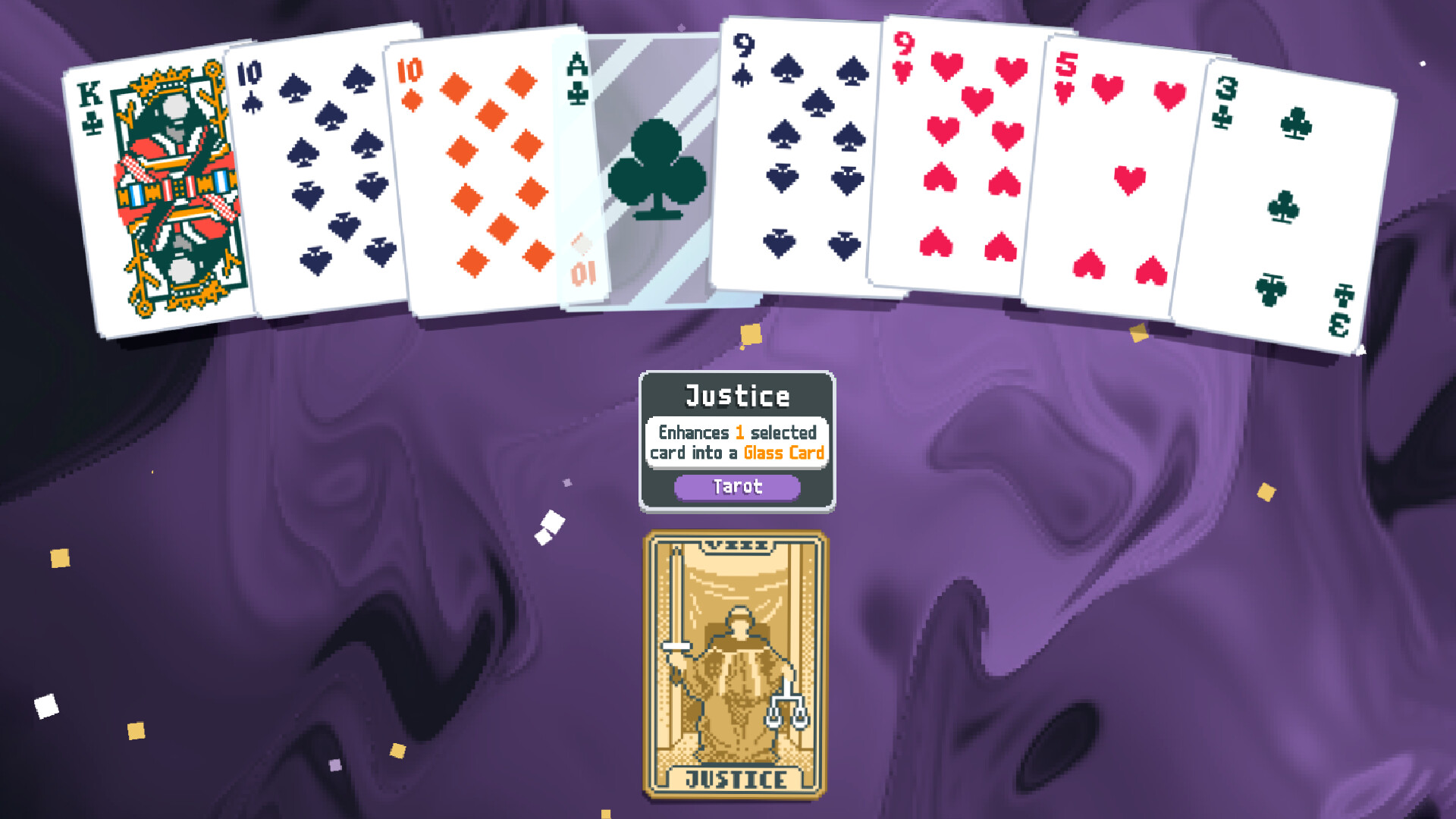
Balatro looks like poker, but you are not playing against anyone. Each round you must reach a score with a limited number of hands, and the score you need grows much faster than your cards do on their own. The run is decided by what you build between rounds: which Jokers you buy, which poker hand you level up, and how you manage money.
Every number in this guide was checked against the Balatro Wiki for the current version (1.0.1). By default you play 4 hands and have 3 discards per round, hold 8 cards, and have 5 Joker slots and 2 consumable slots.
How to win your first run
If you only read one section, read this one. It is the plan that turns a random first run into a win at White Stake.
| Step | What to do | Why |
|---|---|---|
| 1. Setup | Red Deck (+1 discard) or Blue Deck (+1 hand), White Stake | An extra discard or hand per round is the most forgiving start |
| 2. Antes 1 and 2 | Buy any cheap Joker that adds Mult on most hands (Joker, Jolly Joker, Half Joker) | 300 to 1,600 chips is reachable with +Mult alone |
| 3. Money | Stop spending at $25 when you can | $25 earns the maximum $5 interest every round |
| 4. By Ante 3 | Choose one poker hand and buy Jokers that reward it | Jokers for two different hands each work half the time |
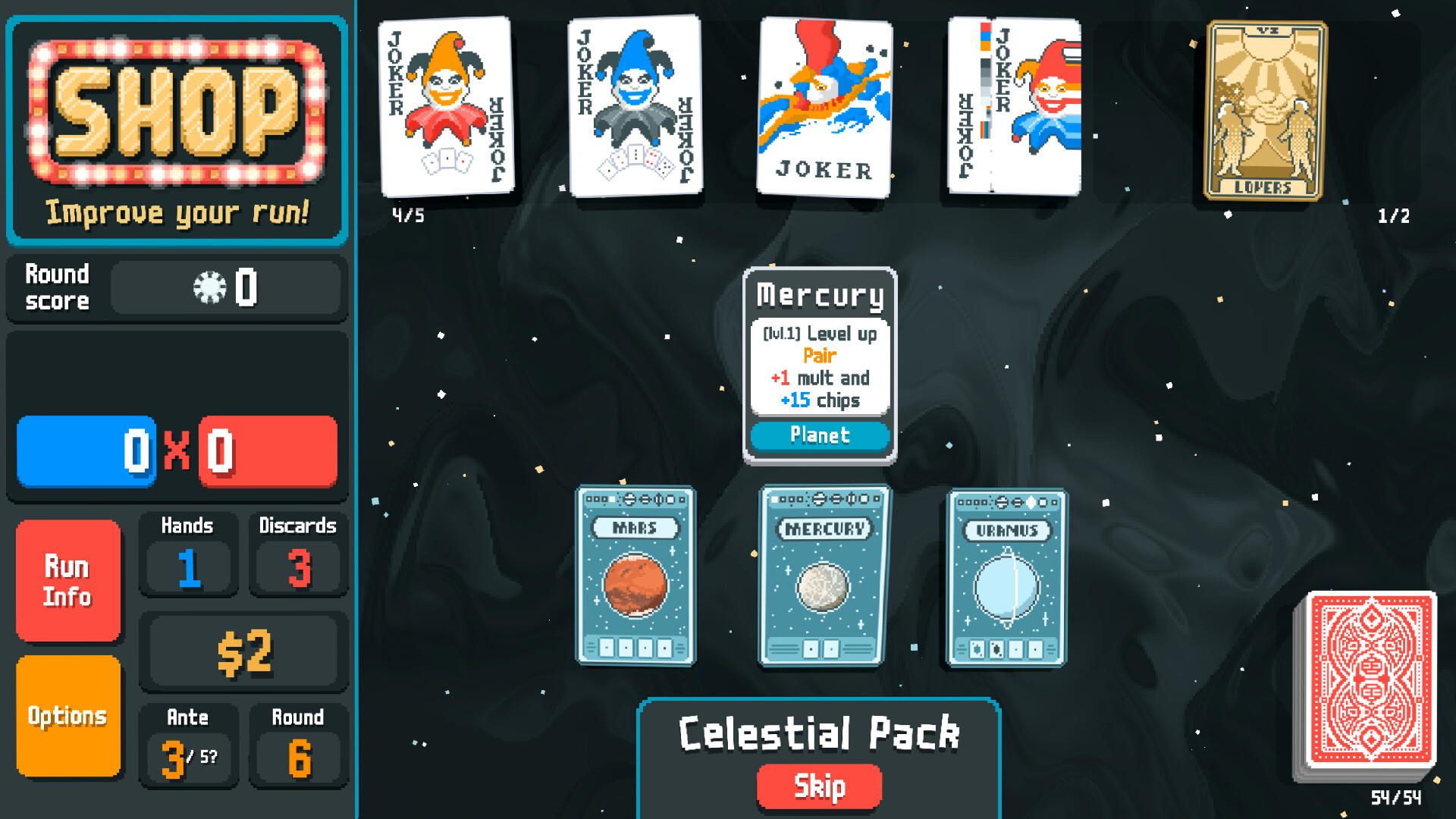
| 5. Level it | Buy or open the Planet card for that hand (Jupiter for Flush, Mercury for Pair) | Every level adds base Chips and Mult to every hand you play |
| 6. Antes 4 to 6 | Add XMult Jokers and sell the weakest +Mult filler | The Ante 6 Boss needs 40,000 chips and +Mult stops keeping up |
| 7. Every Boss | Read the Boss Blind's effect before you start the Ante | A boss that debuffs your suit or hand type can end a run you were winning |
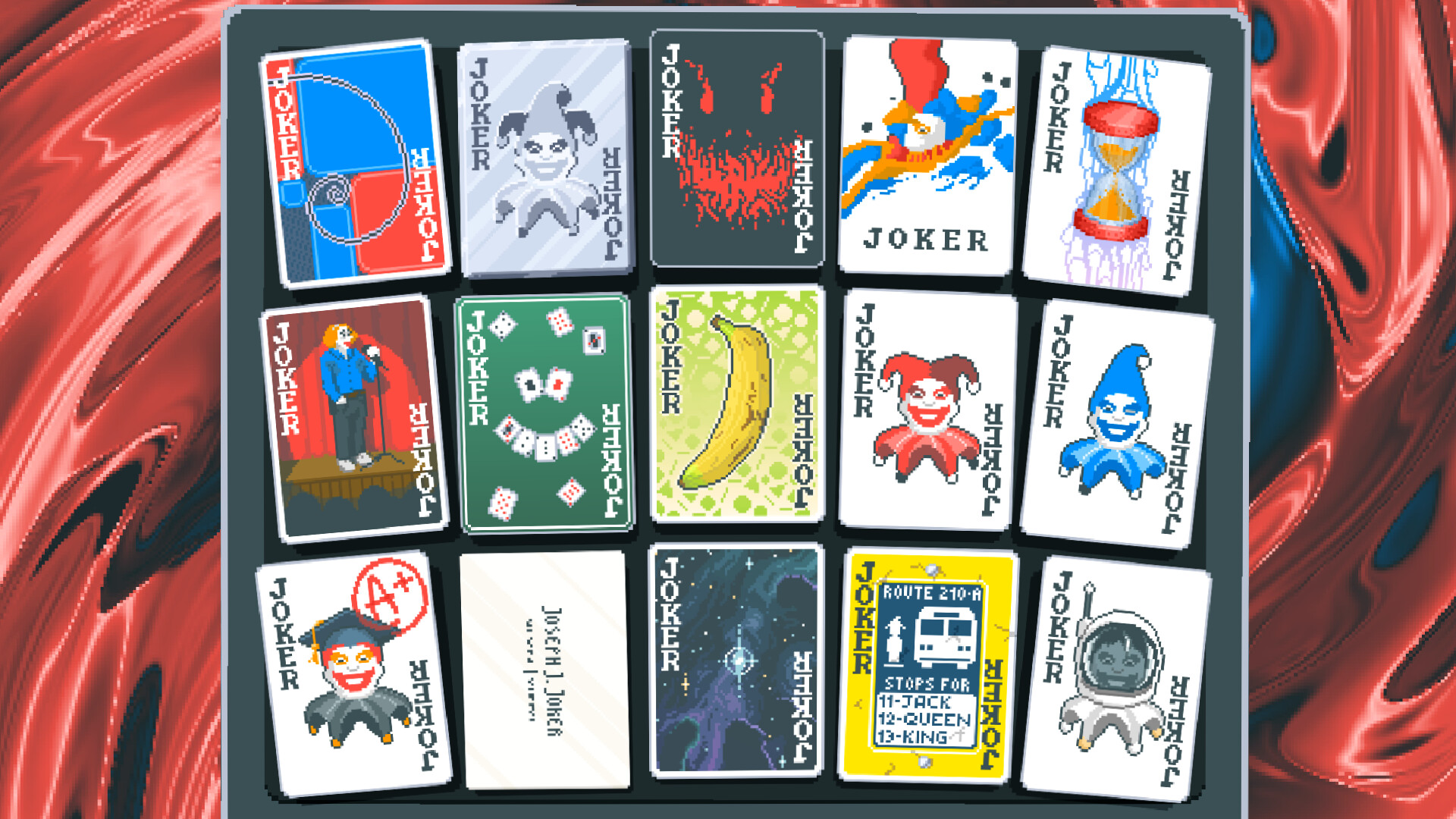
Joker choices follow the same order: Chips and +Mult first, XMult second. Which specific Jokers are worth buying is covered in the Joker Tier List; this guide focuses on the rules and decisions around them.
How scoring works
Every hand you play scores Chips × Mult. The poker hand gives a base amount of both, and only the cards that form the hand add their Chips: an Ace adds 11, a face card (J, Q, K) adds 10, and a number card adds its rank. Extra cards played alongside a Pair do not score.
| Poker hand | Base at level 1 | Planet card | Per level |
|---|---|---|---|
| High Card | 5 Chips × 1 Mult | Pluto | +10 Chips, +1 Mult |
| Pair | 10 × 2 | Mercury | +15 Chips, +1 Mult |
| Two Pair | 20 × 2 | Uranus | +20 Chips, +1 Mult |
| Three of a Kind | 30 × 3 | Venus | +20 Chips, +2 Mult |
| Straight | 30 × 4 | Saturn | +30 Chips, +3 Mult |
| Flush | 35 × 4 | Jupiter | +15 Chips, +2 Mult |
| Full House | 40 × 4 | Earth | +25 Chips, +2 Mult |
| Four of a Kind | 60 × 7 | Mars | +30 Chips, +3 Mult |
| Straight Flush | 100 × 8 | Neptune | +40 Chips, +4 Mult |
Three secret hands (Five of a Kind, Flush House and Flush Five) only become possible once you add or change cards in your deck. You will not see them in a first run.
A worked example
A Pair of Kings with no Jokers scores (10 + 10 + 10) × 2 = 60. Add a Joker (+4 Mult) and a Jolly Joker (+8 Mult on a Pair) and it becomes 30 × 14 = 420, enough to clear the 300-chip Ante 1 Small Blind in one hand.
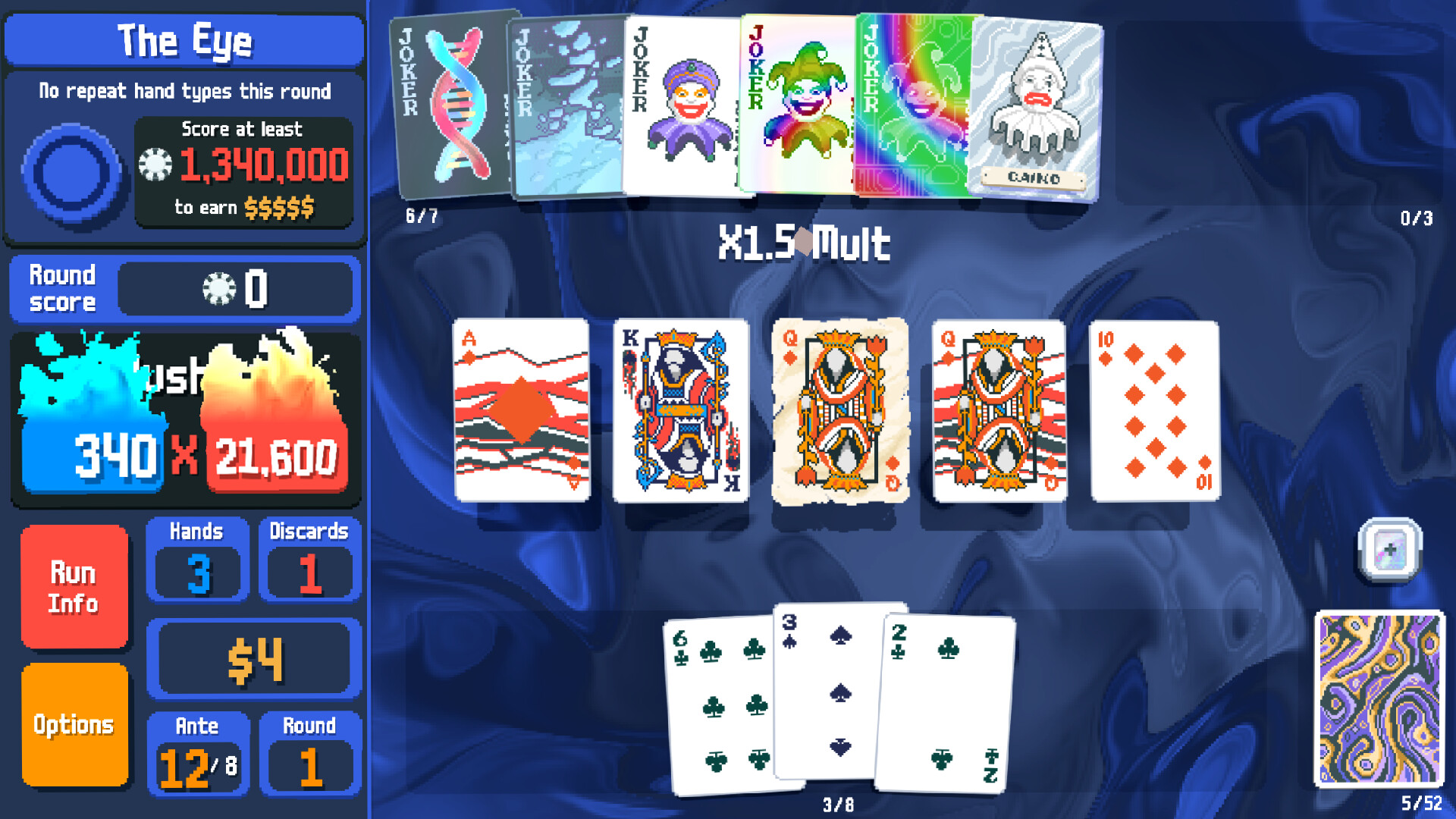
A Flush of K, Q, 9, 7 and 4 scores (35 + 10 + 10 + 9 + 7 + 4) × 4 = 300. With Droll Joker (+10 Mult on a Flush) it is 75 × 14 = 1,050. Level the Flush twice with Jupiter and the base becomes 65 Chips × 8 Mult, so the same cards score 105 × 18 = 1,890. Add The Tribe (X2 Mult on a Flush) and it doubles to 3,780. That is the whole game in miniature: base value from levels, flat bonuses from +Mult, then multiplication on top.
The order things happen in
Scoring runs in a fixed order: the played cards score left to right (each card's Chips, then its enhancement and edition, then Jokers that trigger on scored cards), then cards held in hand (Steel Cards, Baron), then your Jokers from left to right. Because Jokers fire in slot order, a +Mult Joker placed before an XMult Joker scores more than the reverse: with 40 Chips and 4 Mult, +4 then X2 gives 640, while X2 then +4 gives 480. Drag Jokers so additions come first and multipliers last. The Joker Tier List covers slot order, Blueprint and copy rules in detail.
Antes, Blinds and Boss Blinds
A run has 8 Antes. Each Ante has three Blinds: a Small Blind (1x the base score), a Big Blind (1.5x) and a Boss Blind (2x, with a special effect). Beat the Ante 8 Boss, called a Showdown Blind, and you win; you can then continue in Endless Mode.
The useful way to read the requirement is per hand. You have 4 hands per round, so the last column is what each hand must average to beat the Boss.
| Ante | Base (White Stake) | Small / Big Blind | Boss Blind | Boss ÷ 4 hands |
|---|---|---|---|---|
| 1 | 300 | 300 / 450 | 600 | 150 |
| 2 | 800 | 800 / 1,200 | 1,600 | 400 |
| 3 | 2,000 | 2,000 / 3,000 | 4,000 | 1,000 |
| 4 | 5,000 | 5,000 / 7,500 | 10,000 | 2,500 |
| 5 | 11,000 | 11,000 / 16,500 | 22,000 | 5,500 |
| 6 | 20,000 | 20,000 / 30,000 | 40,000 | 10,000 |
| 7 | 35,000 | 35,000 / 52,500 | 70,000 | 17,500 |
| 8 | 50,000 | 50,000 / 75,000 | 100,000 | 25,000 |
From Ante 1 to Ante 8 the requirement grows by about 167 times. Planet levels grow a hand's base by a fixed amount each time, so they cannot close that gap alone; multiplication from Jokers has to do most of it. If your best hand is still scoring a few thousand at Ante 5, fix that before Ante 6, not during it.
Boss Blinds add a rule for that round: debuff all cards of one suit (The Club, The Goad, The Head, The Window), debuff face cards (The Plant), force 5-card hands (The Psychic), allow only one hand (The Needle, which asks for 1x base instead), or double the target (The Wall, 4x base). The Ante 8 Showdown Blinds are harder versions, such as Violet Vessel (6x base) or Crimson Heart (disables a random Joker every hand). Each Ante's Boss is shown before you play, so check it while you still have a shop to prepare. Counters for every Boss are in the Boss Blind Guide.
Skipping a Small or Big Blind gives a Tag instead (there are 24, such as a free Rare Joker in the next shop or a free Mega Buffoon Pack). The cost is real: you lose the blind's money, the shop after it, and that round's interest. In early runs, play every blind unless the Tag is something you clearly need.
Money: rewards, interest, rerolls and selling
Most decks start with $4. After each blind you cash out:
| Source | Amount | Note |
|---|---|---|
| Small Blind | $3 | Nothing from Red Stake upward |
| Big Blind | $4 | |
| Boss Blind | $5 | Showdown Blinds at Ante 8 pay $8 |
| Unused hands | $1 each | Discards left over pay nothing by default |
| Interest | $1 per $5 held | Capped at $5 per round, reached at $25 |
A Big Blind beaten with 2 hands left while holding $25 pays $4 + $2 + $5 = $11. The same round at $9 pays only $7. That gap, repeated every round, is why holding $25 is so strong in the first antes: three rounds of full interest buys a Joker.
The Seed Money voucher raises the interest cap to $10 (at $50) and Money Tree to $20 (at $100). Golden Joker and Rocket pay out after interest is calculated, so their money does not count towards that round's interest.
Rerolling the shop costs $5, then $1 more for each further reroll, and resets to $5 in the next shop. It replaces only the two random cards; Booster Packs and the Voucher stay. Chaos the Clown makes the first reroll in each shop free. A reroll that drops you below $25 also costs interest, so early on a reroll really costs $5 plus the interest it breaks.
Selling a Joker or consumable returns half its buy cost, rounded down (minimum $1): a $6 Golden Joker sells for $3. Selling frees a slot; it is not a way to make money, except with Egg, which gains $3 of sell value every round.
The shop and its card types
Each shop offers 2 random cards (about 71% Jokers, 14% Tarot, 14% Planet), 2 Booster Packs and 1 Voucher. The first shop of every run always includes a normal Buffoon Pack. In the shop, a Joker is Common 70% of the time, Uncommon 25% and Rare 5%.
| Card type | What it does | Price | Beginner priority |
|---|---|---|---|
| Joker | Permanent effect while it sits in one of your 5 slots | Common $1 to $6, Uncommon $4 to $8, Rare $7 to $10 | Highest; your score comes from here |
| Planet card | Levels up one poker hand by one level | $3 | High, but only for your chosen hand |
| Tarot card | Enhances, converts or destroys playing cards, or makes money | $3 | Medium; pick the ones that fit your hand |
| Spectral card | Powerful effects with a cost (destroys cards or Jokers, lowers hand size) | Packs only, unless you play Ghost Deck | Low; read the downside first |
| Voucher | Permanent upgrade for the rest of the run | $10 | Medium to high from Ante 2 |
| Booster Pack | Choose cards from a small random selection | $4 / $6 / $8 | Depends on the pack type |
Booster Packs
Packs come in Normal ($4), Jumbo ($6) and Mega ($8) sizes. Normal and Jumbo let you take 1 card, Mega lets you take 2. Buffoon (Joker) and Spectral packs show fewer cards than the others.
| Pack | Contents (Normal / Jumbo / Mega) | When to buy |
|---|---|---|
| Buffoon Pack | Jokers: 1 of 2 / 1 of 4 / 2 of 4 | Whenever you have a free slot and need Jokers |
| Celestial Pack | Planet cards: 1 of 3 / 1 of 5 / 2 of 5 | Once you have chosen a hand to level |
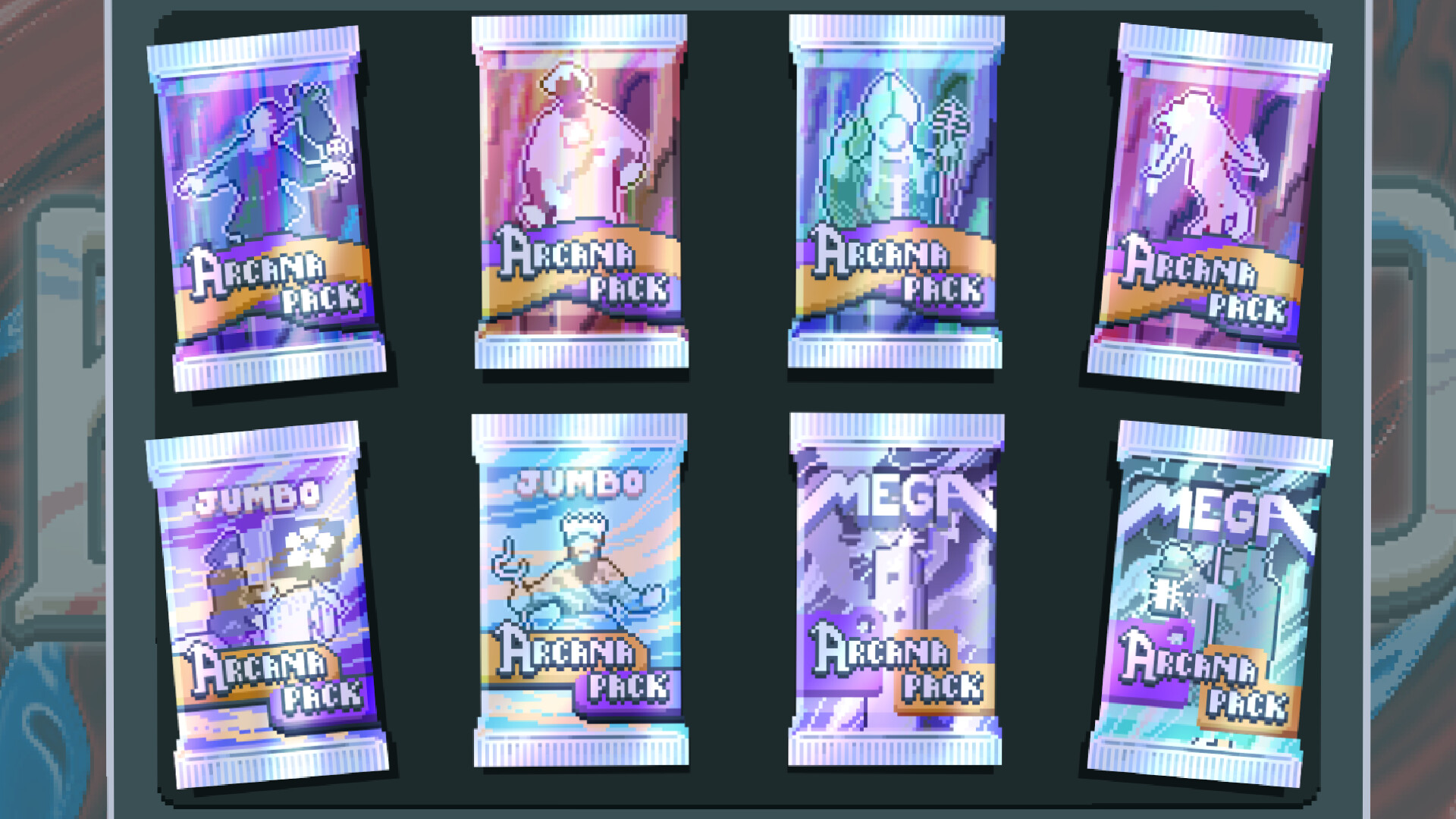
| Arcana Pack | Tarot cards: 1 of 3 / 1 of 5 / 2 of 5 | When your deck needs enhancements or suit changes |
| Standard Pack | Playing cards added to your deck: 1 of 3 / 1 of 5 / 2 of 5 | Rarely in a first run; extra cards dilute your deck |
| Spectral Pack | Spectral cards: 1 of 2 / 1 of 4 / 2 of 4 | Only if you can afford the downsides |
Tarot and Spectral cards from a pack are used on the spot, on a hand of playing cards dealt while the pack is open. You can always skip a pack.
Tarot, Spectral and Voucher picks for beginners
Tarot cards that help most are the ones that make your chosen hand easier to make or score:
- The Empress (2 cards become Mult Cards, +4 Mult each) and The Hierophant (2 cards become Bonus Cards, +30 Chips each): permanent value in any build.
- The Star, The Moon, The Sun and The World convert up to 3 cards to Diamonds, Clubs, Hearts or Spades. In a Flush run they make Flushes appear in most hands.
- The Hanged Man destroys up to 2 cards, so the cards that fit your hand come up more often.
- The Hermit doubles your money (max $20) and Temperance pays the total sell value of your Jokers (max $50). Both are strong in Antes 1 to 3.
Spectral cards are strong but most have a cost. Hex adds Polychrome to one Joker and destroys all the others, Ankh copies one random Joker and destroys the rest, and Wraith creates a Rare Joker but sets your money to $0. Safe picks are Black Hole (levels every poker hand once) and The Soul (a Legendary Joker, if you have a free slot).
Vouchers cost $10, last the whole run, and only one is offered per Ante (it restocks after the Boss Blind). Good first buys are Grabber (+1 hand per round), Wasteful (+1 discard per round), Clearance Sale (25% off the shop), Seed Money (interest cap $10) and Telescope (Celestial Packs always contain the Planet for your most played hand).
Choosing a hand type
The hand you commit to decides which Jokers, Planets and Tarots are worth buying. Each option trades ease of making it against base score and support.
| Hand | Base and level gain | Strength | Weakness |
|---|---|---|---|
| Flush | 35 × 4, +15 Chips / +2 Mult | Suit-changing Tarots make it consistent; many Jokers reward it (Droll, Crafty, The Tribe) | Bosses that debuff a suit; needs 5 cards of one suit unless you have Four Fingers |
| Pair | 10 × 2, +15 Chips / +1 Mult | Almost every hand contains one; Jolly Joker, Sly Joker and The Duo reward it | Lowest scoring base of the common hands, so it leans hardest on Jokers |
| Two Pair | 20 × 2, +20 Chips / +1 Mult | Still easy to make; also triggers Pair Jokers because it contains a Pair | Base Mult stays low without help |
| Three of a Kind | 30 × 3, +20 Chips / +2 Mult | Better base than Pair; triggers Pair Jokers too | Less reliable to draw without deck thinning |
| Straight | 30 × 4, +30 Chips / +3 Mult | Largest level gain of the five-card common hands | Hard to draw consistently; best with Four Fingers or Shortcut |
| High Card | 5 × 1, +10 Chips / +1 Mult | You can always play it | Lowest base in the game; depends entirely on Jokers |
For a first win, Flush is the safest default and Pair or Two Pair is the fallback when your early Jokers already reward pairs. Do not decide in Ante 1; decide by Ante 3 based on the Jokers and Planets the shop has given you. Once you choose, sell Jokers that reward other hands, and ignore Planets for hands you will not play. Deck shaping for each hand is covered in the Deck Build Guide.
Decks and Stakes
You start with only the Red Deck. Other decks unlock as you discover Collection items and win runs.
| Deck | Effect | How to unlock |
|---|---|---|
| Red Deck | +1 discard every round | Available from the start |
| Blue Deck | +1 hand every round | Discover 20 Collection items |
| Yellow Deck | Start with an extra $10 | Discover 50 items |
| Green Deck | $2 per remaining hand and $1 per remaining discard; no interest | Discover 75 items |
| Black Deck | +1 Joker slot, -1 hand every round | Discover 100 items |
| Magic, Nebula, Ghost, Abandoned, Checkered | Each changes the start (vouchers, Spectral cards in the shop, no face cards, two suits) | Win with Red, Blue, Yellow, Green and Black Deck respectively |
| Zodiac, Painted, Anaglyph, Plasma, Erratic | Stronger rule changes for experienced players | Win with any deck on Red, Green, Black, Blue and Orange Stake respectively |
There are 15 decks. Blue Deck is the easiest start because an extra hand directly raises what you can score per round; Red Deck is next, especially for Flush, where the extra discard digs for suits.
Stakes are difficulty levels, each adding its rule on top of the previous ones. They unlock per deck: winning White Stake with Red Deck opens Red Stake for Red Deck only.
| Stake | Added rule |
|---|---|
| White | Base difficulty |
| Red | Small Blind gives no reward money |
| Green | Required score scales faster each Ante (Ante 8 base 100,000) |
| Black | Shop can have Eternal Jokers (cannot be sold or destroyed) |
| Blue | -1 discard |
| Purple | Required score scales faster again (Ante 8 base 200,000) |
| Orange | Shop can have Perishable Jokers (debuffed after 5 rounds) |
| Gold | Shop can have Rental Jokers (cost $3 per round) |
Stay on White Stake until you win consistently. Red Stake only takes $3 per Ante from your economy; Green Stake is the real step up, because it doubles the Ante 8 requirement.
Common beginner mistakes
- Building for two hands at once. A Flush Joker and a Pair Joker each work in half your hands. Pick one hand by Ante 3 and sell the other Joker.
- Spending to $0 every shop. Below $25 you lose interest every round. Early on, skipping a marginal Joker to keep $25 is usually the stronger play.
- No XMult by Ante 5. +Mult Jokers that carried Antes 1 to 3 cannot reach the 22,000 to 40,000 Boss targets of Antes 5 and 6. Replace the weakest one as soon as an XMult Joker appears.
- Ignoring Planets for your hand. Each level adds to every hand you play for the rest of the run. Three Jupiters turn a Flush from 35 × 4 into 80 × 10.
- Starting an Ante without reading the Boss. If the Boss debuffs your suit or your hand, buy around it in the shop before it, not after.
Related guides
Which Jokers to buy and keep: Joker Tier List. How to shape your deck for one hand: Deck Build Guide. Counters for every Boss Blind and Stake: Boss Blind Guide. Our verdict on the game: Balatro Review.
★Honest Take — the rules are simple, the economy is the real lesson
Balatro teaches its scoring well: you see Chips and Mult multiply on screen, and the first time an XMult Joker doubles your total, the core idea clicks. What it does not explain is money. Interest, reroll costs and sell values are all in the game, but nothing tells you that holding $25 in Ante 1 is worth more than a mediocre Joker, and most early losses trace back to a broke mid-game rather than a bad hand. The other honest caveat is variance: some runs never offer an XMult Joker or the right Planet, and no plan fixes that. Follow the plan above, accept that a few runs are simply lost, and the first win usually arrives within a handful of attempts.