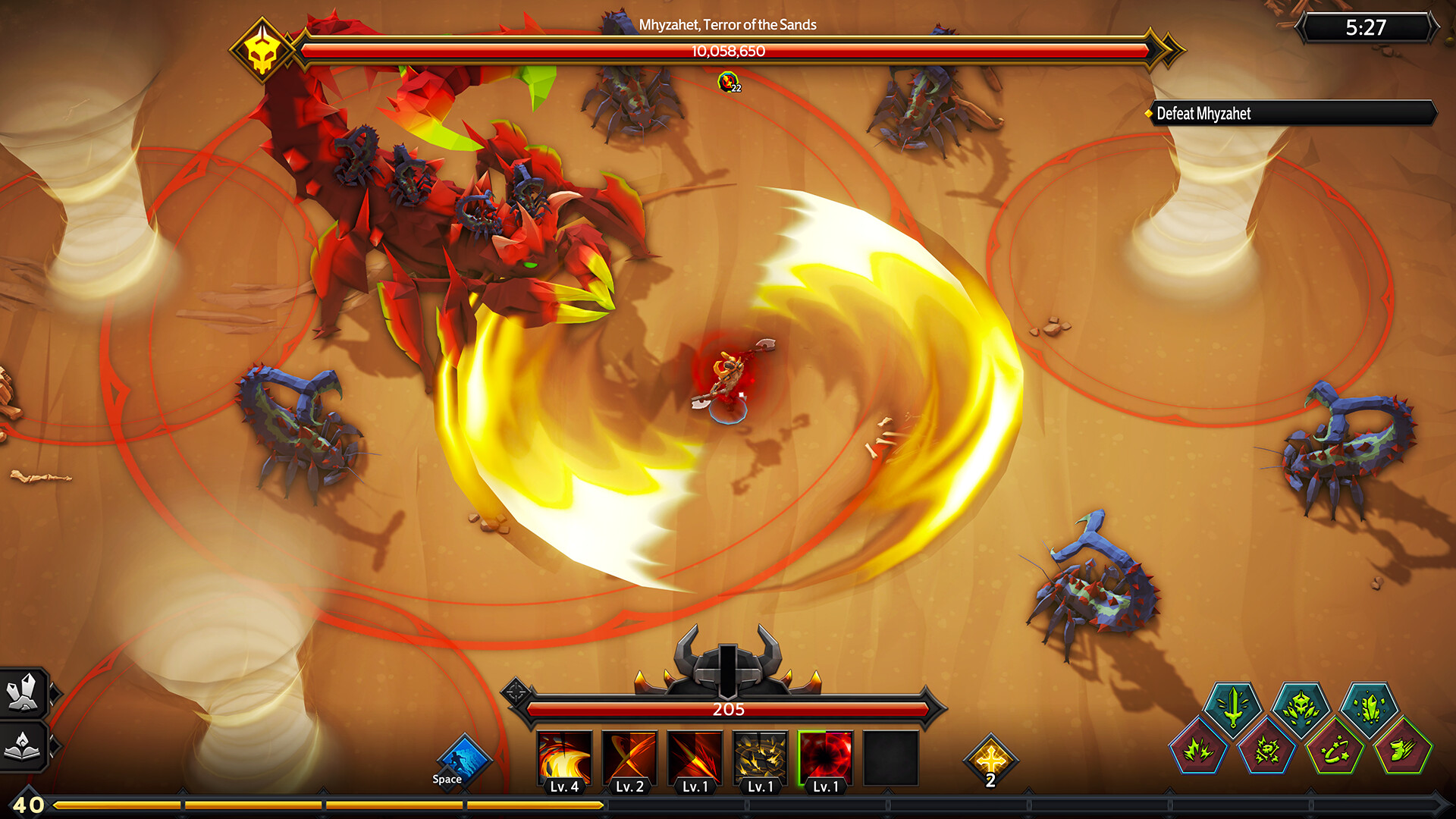
Soulstone Survivors is the most mechanically ambitious game in the survivor-like genre, and it is the one most likely to be uninstalled after an hour. Those two facts have the same cause.
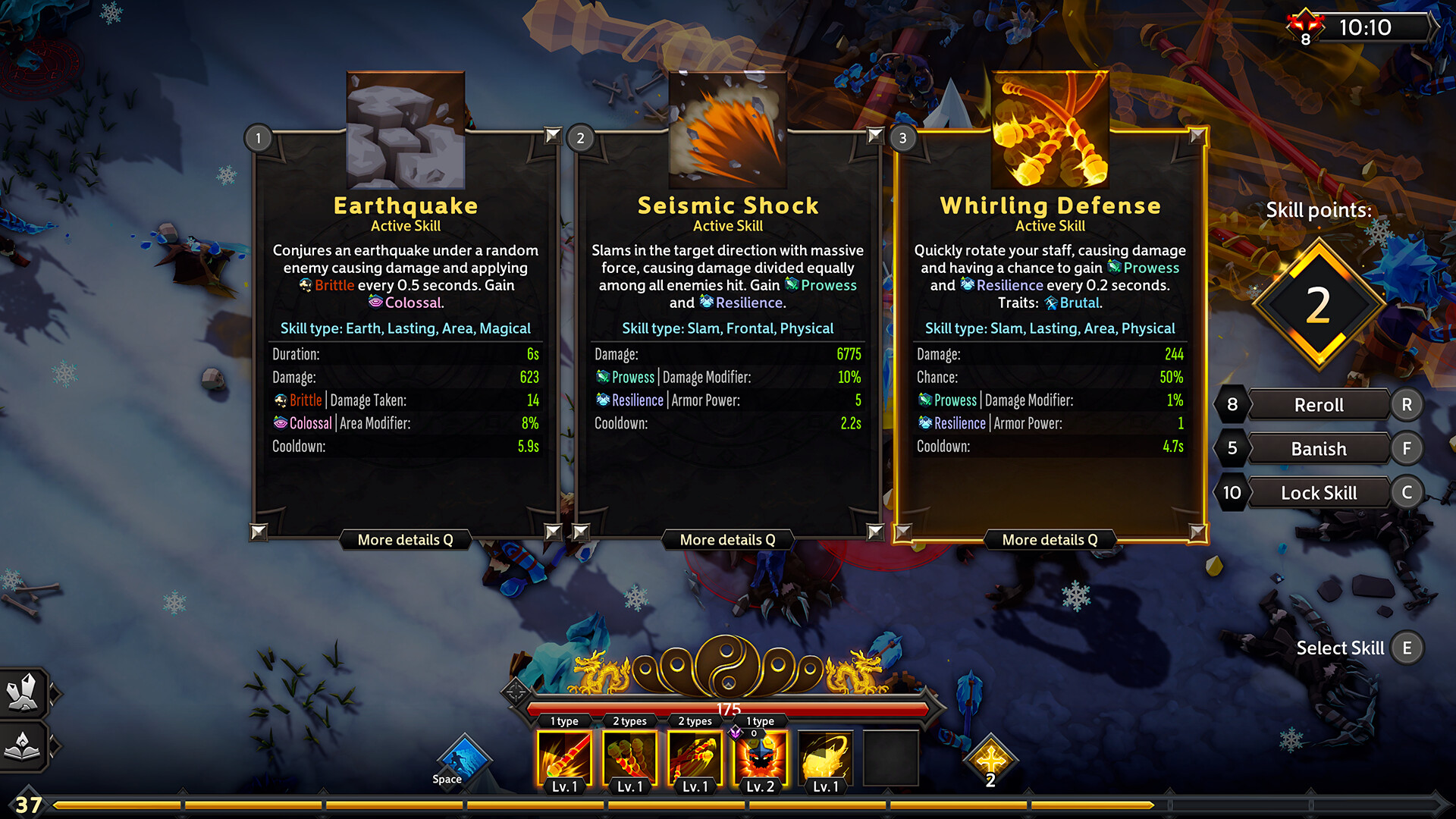
Underneath the familiar surface — hordes, level-ups, three cards to choose from — sits a system where the cards you are offered depend on what you already picked. A power that adds Burn on hit needs one source of Burn. The critical-hit version needs two. The powers that increase Burn's damage and tick rate need three. The same gate sits on the buff chain, the debuff chain and the skill-type chains.
It is a genuinely good idea. The game never mentions it.
What the depth actually buys you
Once you know the rule, a run stops being a slot machine. You are choosing which threshold to reach and spending banishes to get there, and a well-assembled run produces output that looks broken next to a greedy one. That is a real strategic layer, and no other game in this category has anything like it.
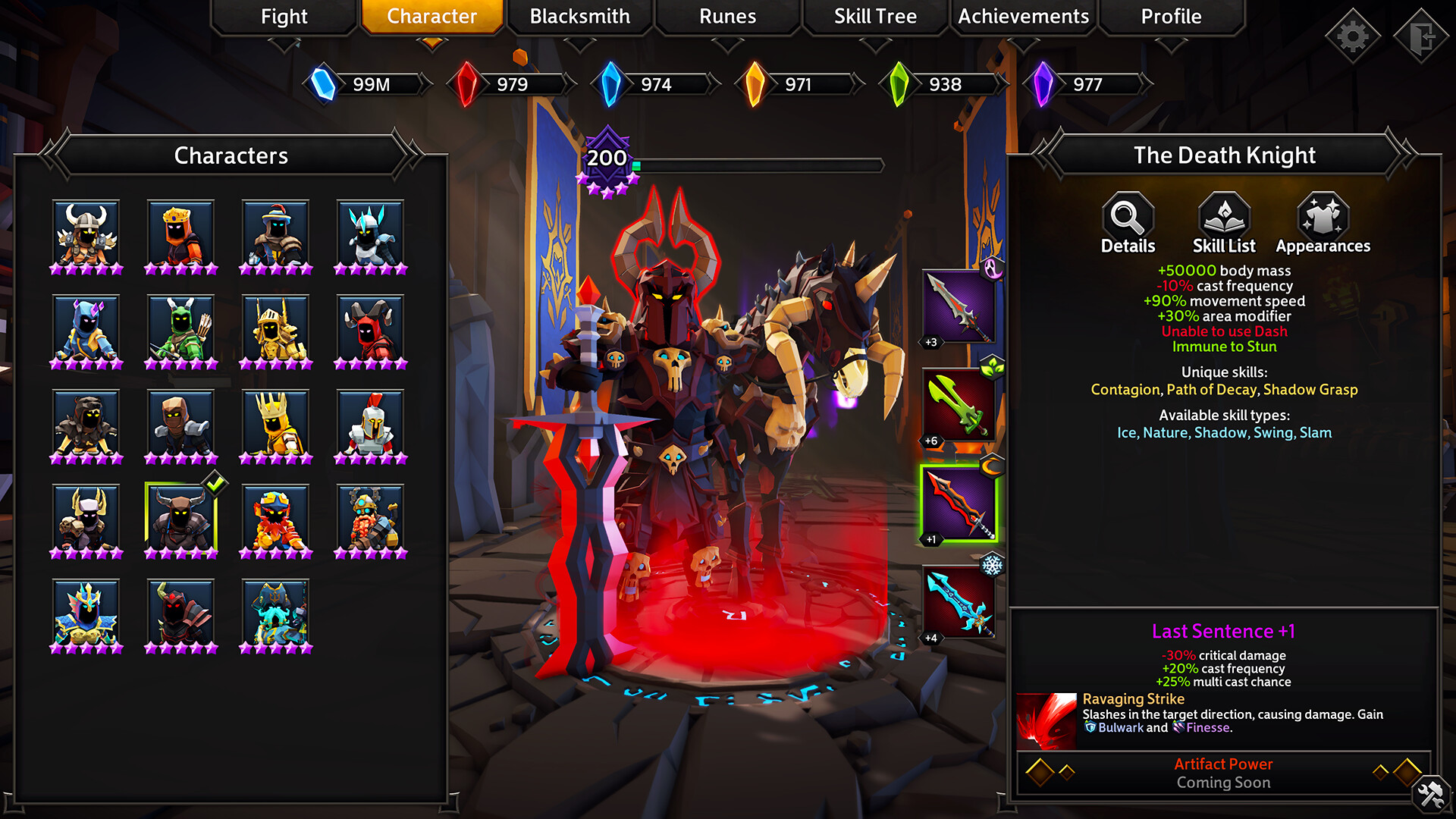
The supporting numbers are large in a way that matters rather than a way that pads a store page. There are 373 active skills across 15 primary types, and your character's five Main Skill Types filter which of them you can even be offered — so a character is effectively a curated skill pool rather than a stat block. Twenty-three characters, each with five weapons that change their starting skill and their special skill. Runes equipped before the match that are multiplicative where in-run powers are additive.
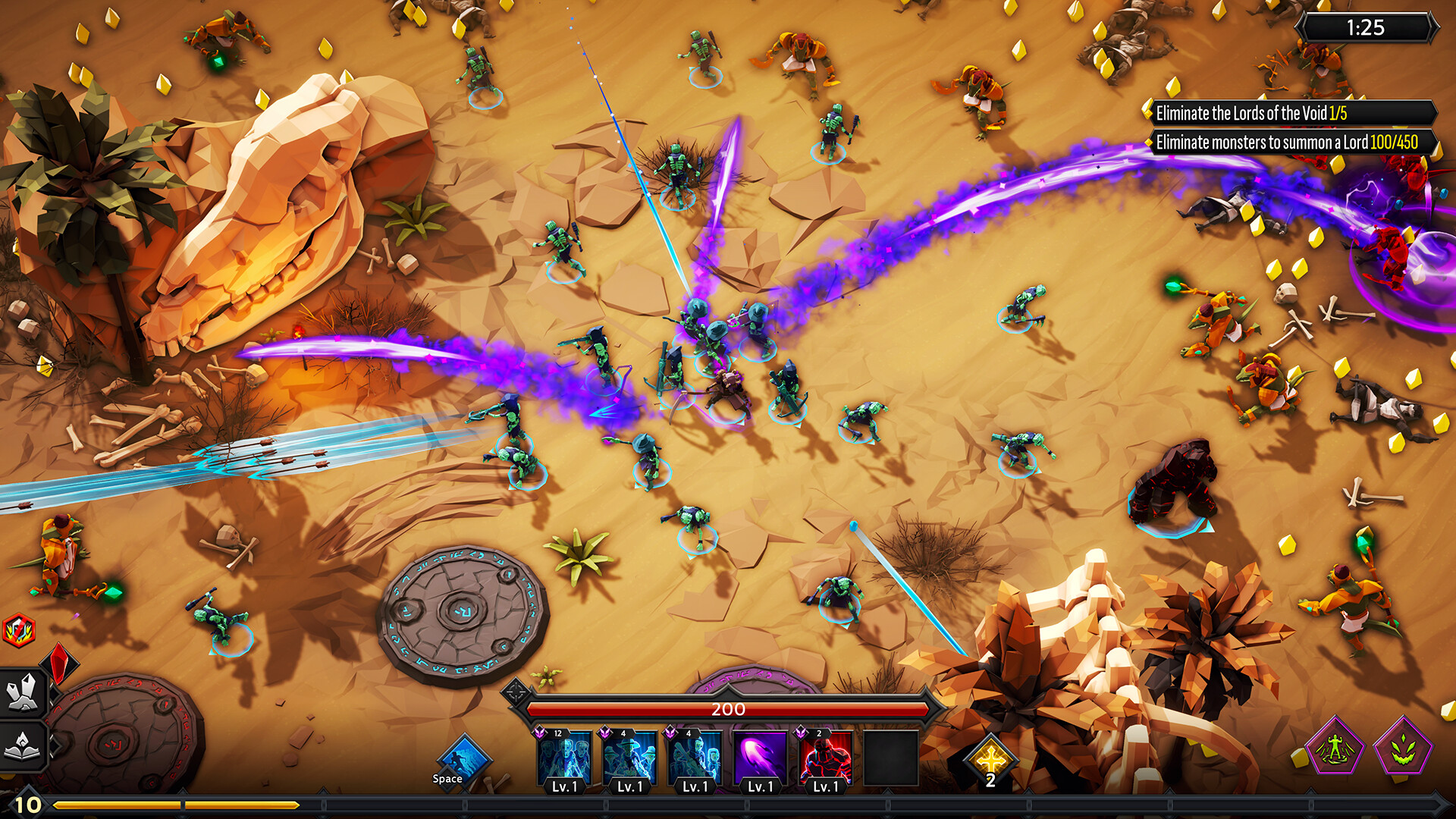
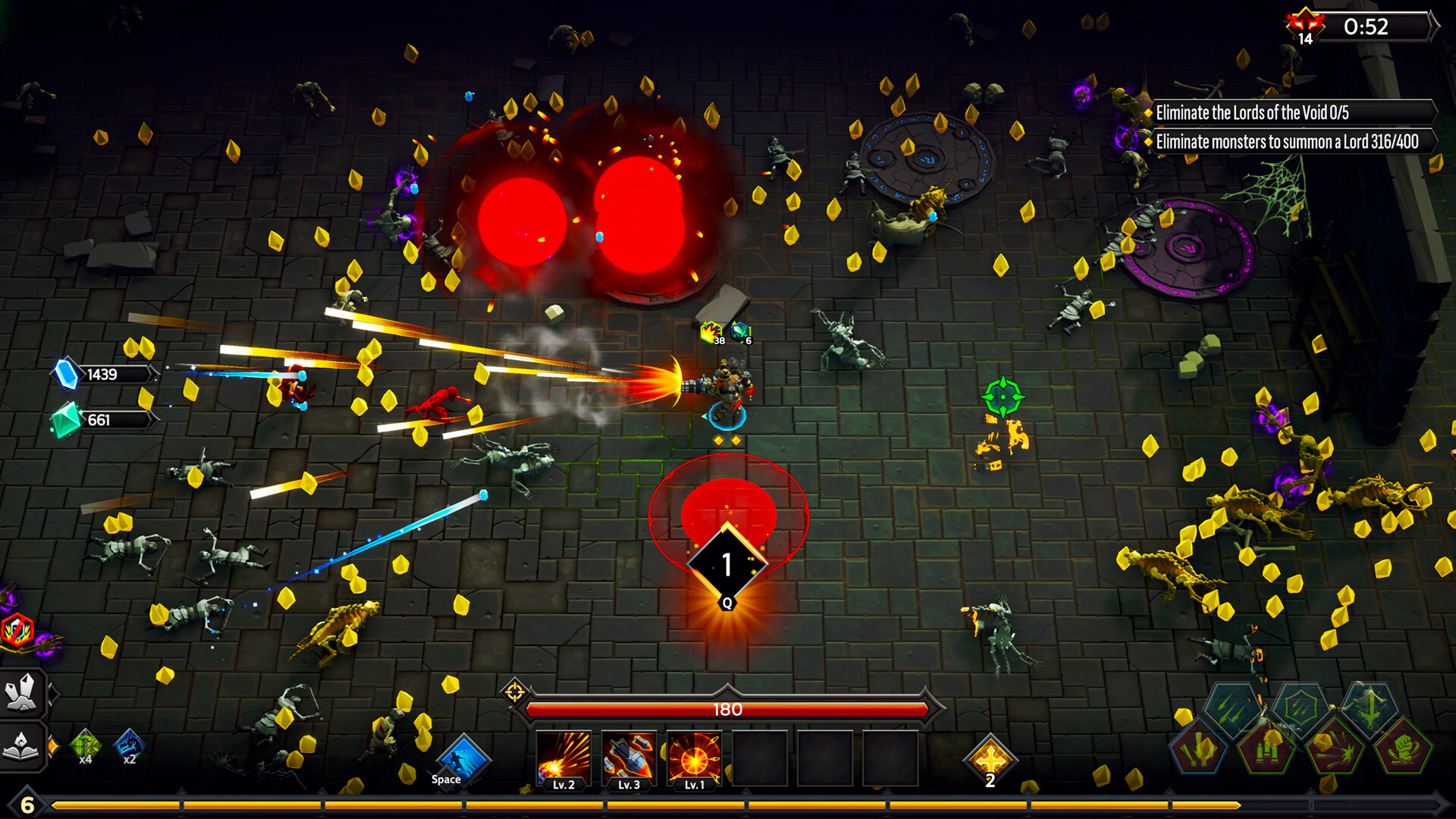
There are five game modes, not one loop with sliders: Void Fields, Overlord, Endless, Titan Hunt and the Unholy Cathedral. Titan Hunt alone has its own progression through five sigils, a separate map called the Netherworld, a Corrupted Void Hunter encounter and a three-phase fight with the Void King. This is a lot of game.
Where it falls down
The criticism is singular and it is large: the game does not teach its own systems.
Nothing in the interface tells you that powers are conditional. Nothing indicates how many sources of an effect you currently have, or that three is the number that matters. Nothing warns you that skills with a base cooldown above 8 seconds do not count toward skill chains — a rule that silently invalidates a build piece you were counting on. Players who work this out have a great time. Players who do not conclude the game is shallow and repetitive, and from where they are standing, that conclusion is reasonable.
The second issue is pacing. Meta-progression is long, and for the first several hours the global Skill Tree contributes more to your success than your decisions do. Failing a run early usually means your permanent stats are thin rather than that you played badly. Some players find that reassuring — progress is guaranteed. Others find it hollow, because the feedback loop is not telling them anything about their own play.
The two problems compound. A new player who does not know the conditional power rule will attribute their flat runs to insufficient Skill Tree progress, grind for hours, and still have flat runs — because the actual problem was never the stats.
Where it stands now
| Aspect | Where it is |
|---|---|
| Release | 1.0 in June 2025, after entering Early Access in November 2022 |
| Steam reception | Around 91 percent positive from roughly 27,000 reviews |
| Content | 23 characters, 5 maps in Void Fields, 5 game modes, a final boss encounter with the Void King |
| Localisation | Japanese, Russian, Simplified and Traditional Chinese, Korean and 8 more, with full audio |
| Developer | Game Smithing Limited, self-published |
Nearly three years in Early Access shows in a good way — the systems have clearly been iterated on rather than designed once. It also shows in a less good way: several mechanics feel like they were added for players who already understood the previous ones.
How it compares
| Against | Soulstone Survivors is | Which suits you if |
|---|---|---|
| Vampire Survivors | Far deeper and far less immediately readable. You aim and dash rather than watch | You want to solve something rather than unwind |
| Halls of Torment | More systems, less atmosphere. Halls of Torment is the better-presented game; this one has more to chew on | You care more about build depth than about how a run feels moment to moment |
| Deep Rock Galactic: Survivor | More build complexity, less tactile feedback. DRG Survivor's mining loop is the more novel hook | You prefer character and power planning to positioning decisions |
| Diablo-style ARPGs | A compressed version of the same itch — the skill and effect interactions are closer to an ARPG than to an autobattler | You liked ARPG theorycrafting more than ARPG loot grinding |
If you want to read our take on those comparisons directly: the Vampire Survivors review, the Halls of Torment review and the Deep Rock Galactic: Survivor review each cover a different answer to the same design problem.
Who should buy it
| Buy it if | Skip it if |
|---|---|
| You enjoy reading systems and testing interactions, and a guide feels like part of the game | You want to relax, and looking things up feels like the game failing you |
| You want a genre entry with real strategic depth rather than escalating numbers | You bounced off the genre because runs felt samey — the depth here is hidden, so it will not rescue that |
| You are happy with a long meta-progression curve | You want your skill to be the main variable from hour one |
| You play in Japanese, Russian, Chinese or Korean and want full localisation | You need the game to explain itself, in any language |
Verdict
Soulstone Survivors is the best game in its genre for a specific person: the one who enjoys finding the rule that the interface never states, and then exploiting it. For that player, the conditional power system is a gift, Titan Hunt is a genuine second game, and 23 characters with filtered skill pools means the theorycrafting does not run out.
For everyone else it is a handsome, competent survivor-like whose best ideas stay invisible. That is a real flaw and not a matter of taste — a system this good should not need a stranger on the internet to explain it. But the system is that good, and the explanation is not hard to find. If you are reading this, you have already done the difficult part.
Start with the beginner guide for the opening hours, the build guide for the rule the game withholds, the character tier list for who to invest in, and the curse guide when you start pushing difficulty.