The most important choice in the game
Before a single turn is played in Dominions 6, you make the decision that shapes everything that follows: the design of your Pretender God. This is the would-be deity at the head of your nation, and how you build it determines your early power, your access to magic, the strength of your economy, and the blessings your holy troops receive. The whole thing works from a points budget — a pool you spend across four things: a chassis (the god's physical form), its magic paths, your nation's scales, and a bless for your sacred units. Every point spent in one area is a point unavailable elsewhere, so designing a Pretender is an exercise in trade-offs aimed at a strategy. There is no universally correct god; there is only the god that fits your nation and the way you intend to play. This guide explains the pieces and the main archetypes so you can build deliberately.
Get this choice right and your whole game flows from a position of strength; get it wrong and you spend the game fighting your own design. So it is worth understanding each lever before you commit.
You cannot maximise everything. A god with a huge bless will have weaker scales; one with superb scales will be a modest combatant; one available from turn one costs the points a later-arriving god could spend on magic. Decide what your strategy needs most, and spend your budget there.
The points budget: chassis, paths, scales and bless
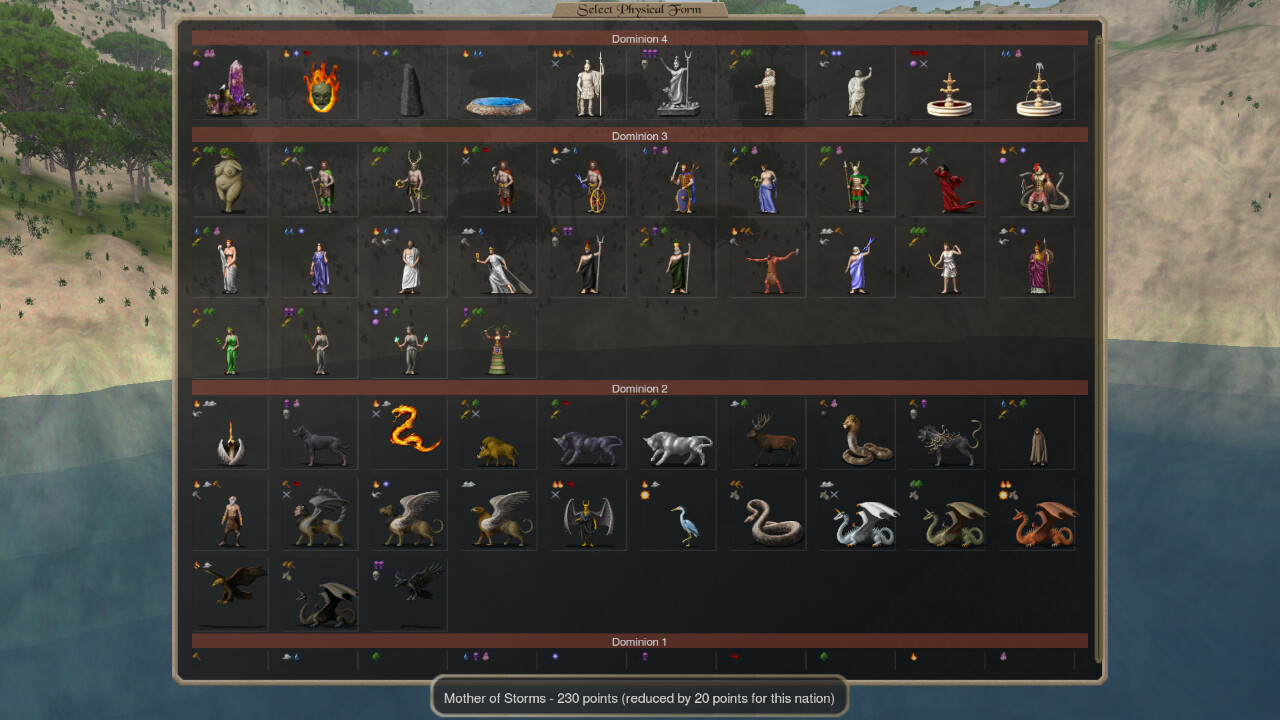
Designing a Pretender means dividing your points across four levers, each pulling against the others. The chassis is the god's body, and it ranges enormously: a mighty titan or monster makes a powerful combatant that can fight and expand from the start, while a cheap immobile chassis — essentially a statue that sits in your capital — spends almost nothing on the body so you can pour points into magic and scales instead. Magic paths are the levels of magic your god possesses — Dominions 6 has nine arcane paths plus Holy; raising them gives your nation access to spells, summons and forging it might otherwise lack, and higher paths also unlock stronger blesses. Scales are your nationwide settings — order, productivity, growth and the rest — that, spread by your dominion, make your provinces richer and more productive. And the bless is the package of bonuses your sacred units gain when blessed, bought through your god's magic paths.
The art is to spend this budget toward a clear plan rather than spreading it thinly. A combat chassis eats points your scales or bless could use; a powerful bless usually forces you to take weaker scales to pay for it; strong scales mean a cheaper, less capable god. Decide what matters most for your nation and strategy — early fighting power, a strong bless, deep magic, or a rich economy — and concentrate your points there, accepting weakness in the areas that matter least to your plan.
A common, flexible template is a cheap chassis with most points in scales and modest magic, giving your nation a strong economy and useful spell access without a huge bless. If your nation has great sacreds, instead pour points into magic paths for a powerful bless. Let your nation's strengths decide where the points go.
The six scales, and what they actually cost
Scales are the part of Pretender design with the clearest arithmetic, and the part most often eyeballed. There are six axes, each running from a favourable to an unfavourable end.
| Scale | Favourable end gives | Unfavourable end |
|---|---|---|
| Order / Turmoil | +10% recruitment points, +3% income, +2% resources, -3% events | Turmoil reverses these |
| Productivity / Sloth | +15% resources, +3% income | Sloth reverses these |
| Heat / Cold | Each point away from your nation's preferred temperature costs -10% supplies and -5% income | Extremes of 3 or more also raise encumbrance; Cold adds a 15% snow chance in battle |
| Growth / Death | +10% supplies, +1% income, +0.2% population growth | Death reverses these |
| Fortune / Misfortune | Events 10% more likely to be good, +0.5% hero submission chance | Misfortune worsens event quality; both ends add +5% events |
| Magic / Drain | +1 research ability, -0.5 magic resistance for mages in friendly dominion | Drain reverses these |
Two numbers turn this from vibes into a budget:
- Each scale tip costs or grants 40 Pretender points. Taking a negative scale is not merely a drawback — it is how you pay for a bigger chassis, deeper paths or a stronger bless.
- Scales cap at plus or minus 2 from zero, adjustable by nation and Pretender modifiers.
Temperature is the odd one out. The other five simply want to be as positive as you can afford, but Heat and Cold are measured against your nation's own preference, so the target is that nation's preferred temperature rather than any particular direction. Read your nation's preference before spending here.
Awake, dormant or imprisoned
Layered on top of how you spend your points is when your god arrives, and this is one of the most important trade-offs in the design. An awake Pretender is present from the very first turn, ready to march out and clear provinces or cast spells immediately — but this immediacy is the most expensive option, leaving you the fewest points for scales and magic. A dormant Pretender arrives after a number of turns, typically in time for your first serious war, and in exchange for that delay you get more points to spend on its design. An imprisoned Pretender arrives much later still, but rewards your patience with the largest points budget of all, enough to buy excellent scales and strong magic. The choice maps directly onto your strategy: if you want to expand aggressively and fight early, you want an awake combat god; if you are happy to play a patient, scaling game and unleash your god later, an imprisoned one buys you a far stronger nation in the long run.
This timing decision interacts with your archetype. An awake expander wants a strong combat chassis it can use immediately. A bless rush usually wants its god awake or dormant, since the most powerful blesses require the god to be present and alive. A scales-focused build, by contrast, often takes an imprisoned god precisely because it does not need the body early and would rather spend the points on its economy and magic.
The main god archetypes
In practice, most Pretender designs fall into a few archetypes, each serving a different strategy. The expander is an awake god built around a strong combat chassis, designed to clear independent provinces from turn one and give your nation a fast, aggressive start — you spend on the body and enough magic to be useful, and accept more modest scales. The bless-focused god pours its points into high magic paths to grant a powerful blessing, turning your nation's sacred units into elite troops; it usually sacrifices scales to afford the bless and is the engine of a bless-rush strategy. The magic-focused god is designed to give your nation magic it otherwise lacks — raising specific paths to unlock key spells, summons or forging — and is often a cheaper chassis so the points go into the paths themselves. And the scales-focused god is typically a cheap, often imprisoned chassis that dumps its points into excellent scales and a little magic, giving your nation a rich economy and strong unit production for a patient, long-game plan.
Knowing these archetypes lets you design with intent: identify what your nation needs and your strategy wants, then build the god that delivers it. To turn your god's magic into a winning game, see our magic guide and strategies tier list; if you are still finding your feet, the beginner guide covers a simple first god.
Do not overspend on a giant bless or combat chassis and cripple your scales unless your strategy truly needs it. A god so expensive that your economy suffers can leave your whole nation weak once the early game passes. Balance your design against the long game — a strong bless means little if your provinces are too poor to field an army behind it.