
Hollow Knight is a 2D action-exploration game by Team Cherry, a small Australian studio. It launched on PC in February 2017 and later on Switch, PlayStation and Xbox, and its Steam user reviews sit at Overwhelmingly Positive. Since its sequel, Hollow Knight: Silksong, came out on 4 September 2025, the common question is no longer whether Hollow Knight is good, but whether it is still the right purchase, and in which order. This review answers that first.
Buy, wait or skip
| Your situation | Verdict | Why |
|---|---|---|
| You like exploring and finding your own way | Buy | The map, the hidden paths and the ability gates are the best part of the game |
| You enjoy learning boss patterns until you win | Buy | Main bosses are hard but readable, and the free content packs add many more |
| You are deciding between Hollow Knight and Silksong | Buy Hollow Knight first | It is gentler, cheaper and sets up Hornet's story; Silksong is harder from the start |
| You already finished Silksong and loved it | Buy | Different kingdom, bosses and endings; you will find the combat slower but the world just as dense |
| You are price-sensitive | Wait for a sale | Discounts are frequent and the game is complete at any price |
| You need objective markers and a map from the start | Skip, or play with a guide | Maps are bought, and the game rarely says where to go next |
| You want an easy mode or a story-only setting | Skip | There is no difficulty setting; the only extra mode, Steel Soul, is harder |
| Losing progress on death ruins the game for you | Skip or try carefully | Death drops your Geo, and dying again before you recover it loses that Geo for good |
Short version: if you have enjoyed any exploration-heavy action game, Hollow Knight is one of the safest purchases in the genre. People who regret it usually dislike being lost, not the combat.
What kind of game it is
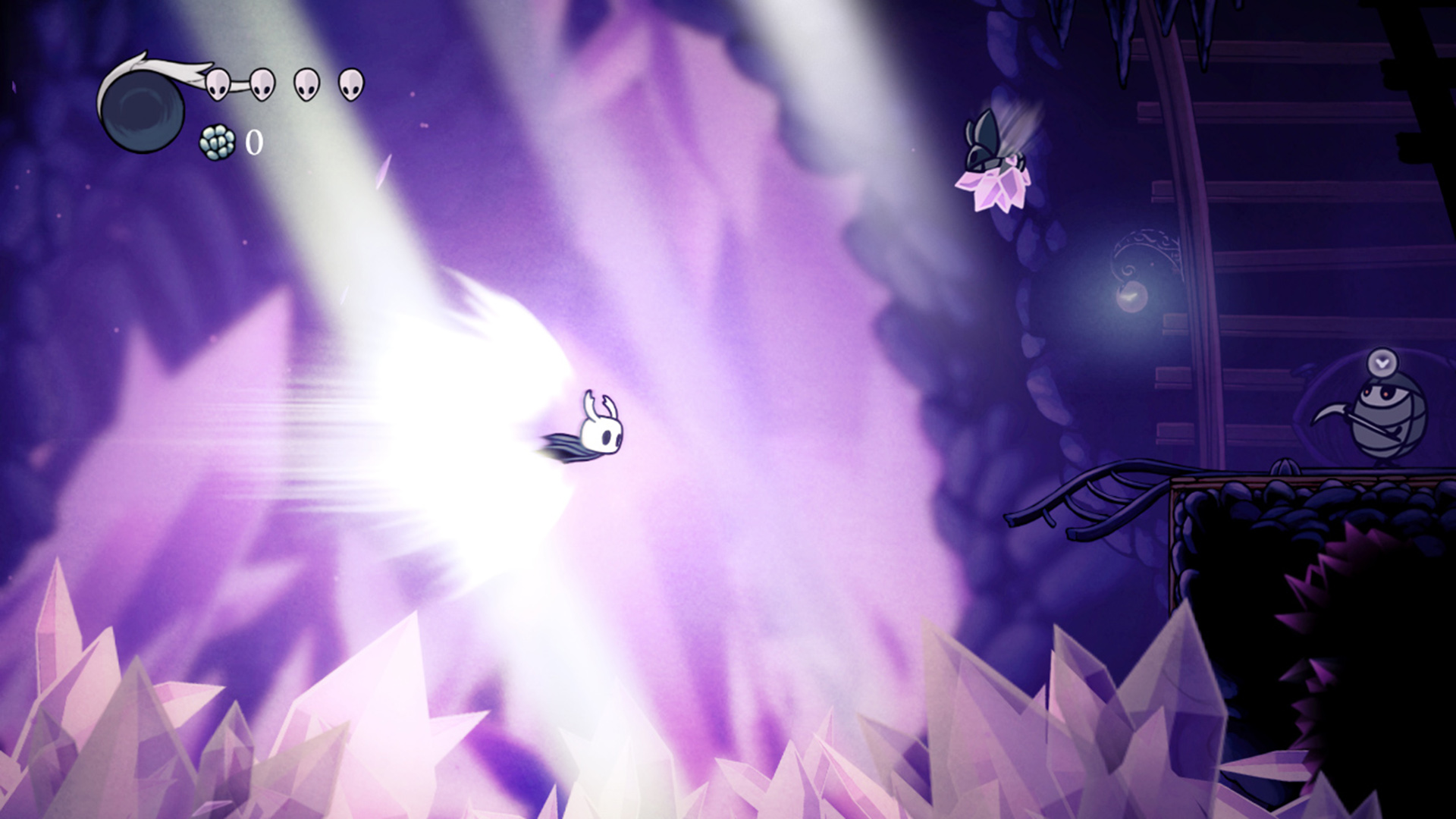
You play the Knight, a small masked warrior exploring Hallownest, a fallen bug kingdom underneath the town of Dirtmouth. The whole world is one connected map. Areas are blocked by things you cannot pass yet — a wall too high, a gap too wide, a pool of acid — and abilities such as the Mothwing Cloak (dash), Mantis Claw (wall jump), Crystal Heart (super dash) and Monarch Wings (double jump) open them up. Combat uses your nail: every hit fills your SOUL meter, and SOUL pays for both healing (Focus) and spells.
The structure is what makes it memorable. You will see a ledge in the first hours, forget about it, and return twenty hours later with the ability to reach it. The Exploration Guide covers that order, and the Beginner Guide covers the first hours.
Current state: what you get today
| Item | Status |
|---|---|
| Release | Full release: PC in February 2017, Switch in June 2018, PS4 and Xbox One in September 2018 |
| Newer consoles | Switch 2, PS5 and Xbox Series X|S versions released on 5 February 2026; free upgrade for Switch, PS4 and Xbox owners |
| Platforms | Windows, macOS and Linux (Steam), Switch, Switch 2, PS4, PS5, Xbox One, Xbox Series X|S |
| Content | Base game plus four free content packs; five main endings |
| Monetisation | One-time purchase at an indie price; no paid DLC, no microtransactions |
| Multiplayer | None; single-player only |
| Difficulty options | None. Steel Soul Mode (permadeath) unlocks after your first clear |
| Languages | 11 on Steam, including Japanese, Korean, both Chinese scripts, Russian and Brazilian Portuguese |
The February 2026 update reached every platform. Team Cherry says it brought higher frame rates and resolutions on the new consoles, full 21:9 and 16:10 support on PC, and under-the-hood improvements carried over from Silksong. It added no new gameplay content.
The four free content packs
All four are part of every copy, so you do not need to buy or download anything separately. On PS4 and Xbox One, the game was released as the Voidheart Edition, with all four packs included.
| Pack | Released | What it added |
|---|---|---|
| Hidden Dreams | August 2017 | Two optional dream bosses (White Defender, Grey Prince Zote), the Dreamgate and an extra Stag Station |
| The Grimm Troupe | October 2017 | A quest with Troupe Master Grimm and the Nightmare King, eight new charms (including the Unbreakable charms) and the Path of Pain platforming challenge |
| Lifeblood | April 2018 | The Hive Knight boss, map markers, rebalanced enemies and charms, visual and performance improvements |
| Godmaster | August 2018 | Godhome: the Hall of Gods for boss rematches, five Pantheons (boss rushes) and two more endings |
Together they make the endgame much larger than the main story suggests. They are also where the hardest content lives: the Path of Pain and the Pantheon of Hallownest are far beyond anything required for the first ending.
Silksong is out: does it change anything?
Hollow Knight: Silksong is a separate sequel. You play Hornet, the princess-protector you fight twice in Hollow Knight, in a new kingdom called Pharloom. It began as planned DLC and grew into a standalone game. It costs a little more than the original, is faster and more acrobatic, heals three masks at once with silk, replaces charms with Tools and Crests, and tracks side quests called Wishes. Critics and players widely found it harder than the first game, and Team Cherry's first patch in September 2025 eased some early bosses. Team Cherry has also announced a free expansion for it, Sea of Sorrow, which had no release date at the time of writing.
None of that makes Hollow Knight obsolete. The two games share a style but not a world, bosses or story. If anything, Silksong's difficulty is the main reason to play Hollow Knight first.
What it does well
A map that keeps opening up
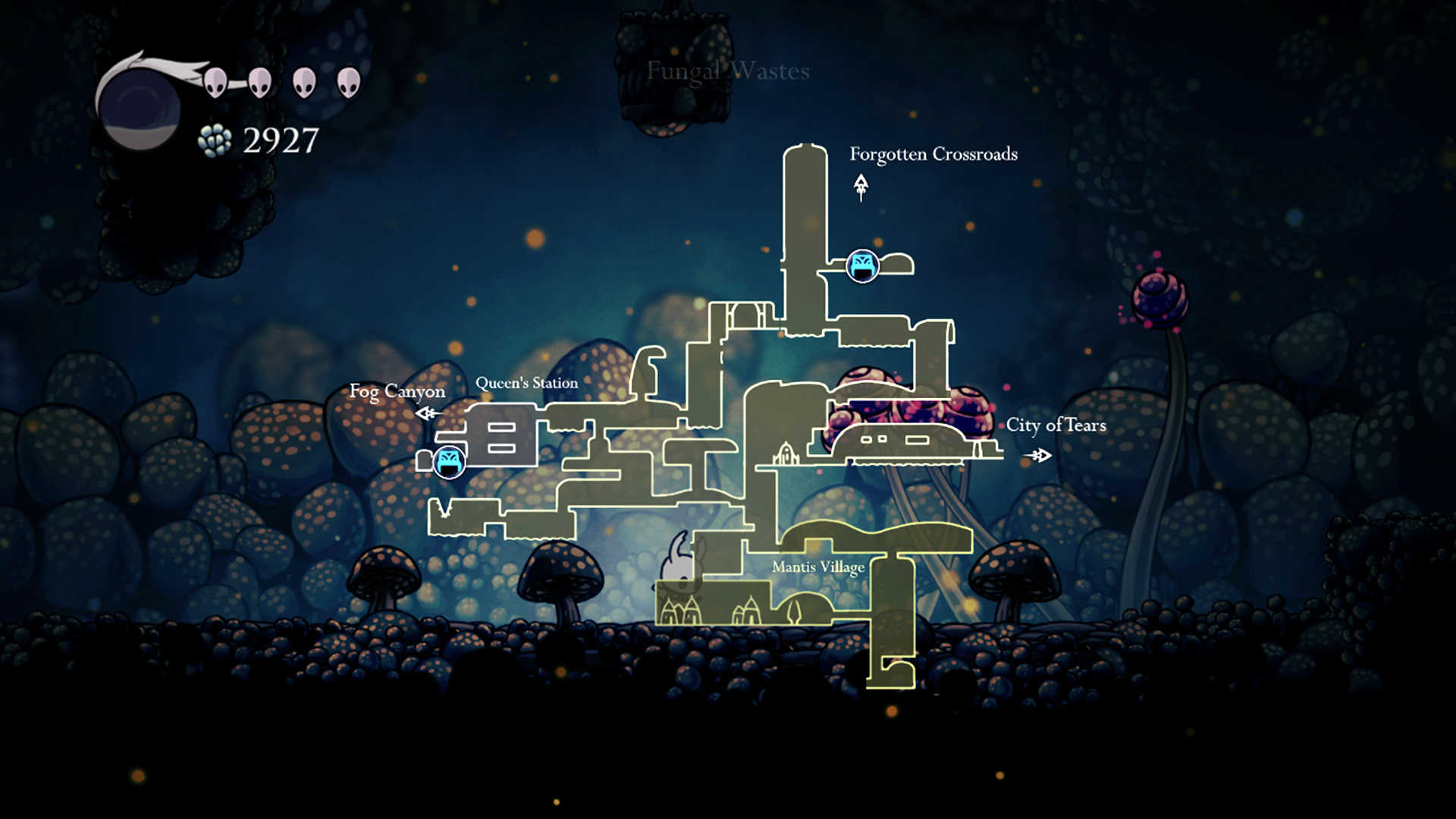
Hallownest is the reason to play. Areas loop back into each other, shortcuts connect distant zones, and secret walls hide whole rooms. Each movement ability changes how you read the map you already have, so backtracking often feels like discovery rather than repetition. The game trusts you to notice things, and finding a hidden area on your own is the core reward.
Bosses that are hard but fair
The main bosses — Hornet, the Mantis Lords, Soul Master, the Watcher Knights — each teach one thing. Almost every attack has a visible wind-up, and almost every fight has a moment when it is safe to heal. When you lose, you usually know why. And because nail upgrades raise damage from 5 to 21 and you can grow from 5 to 9 masks, coming back stronger is a real option. Attacks, heal windows and charm setups are in the Boss Guide.
Charms make the same character play differently
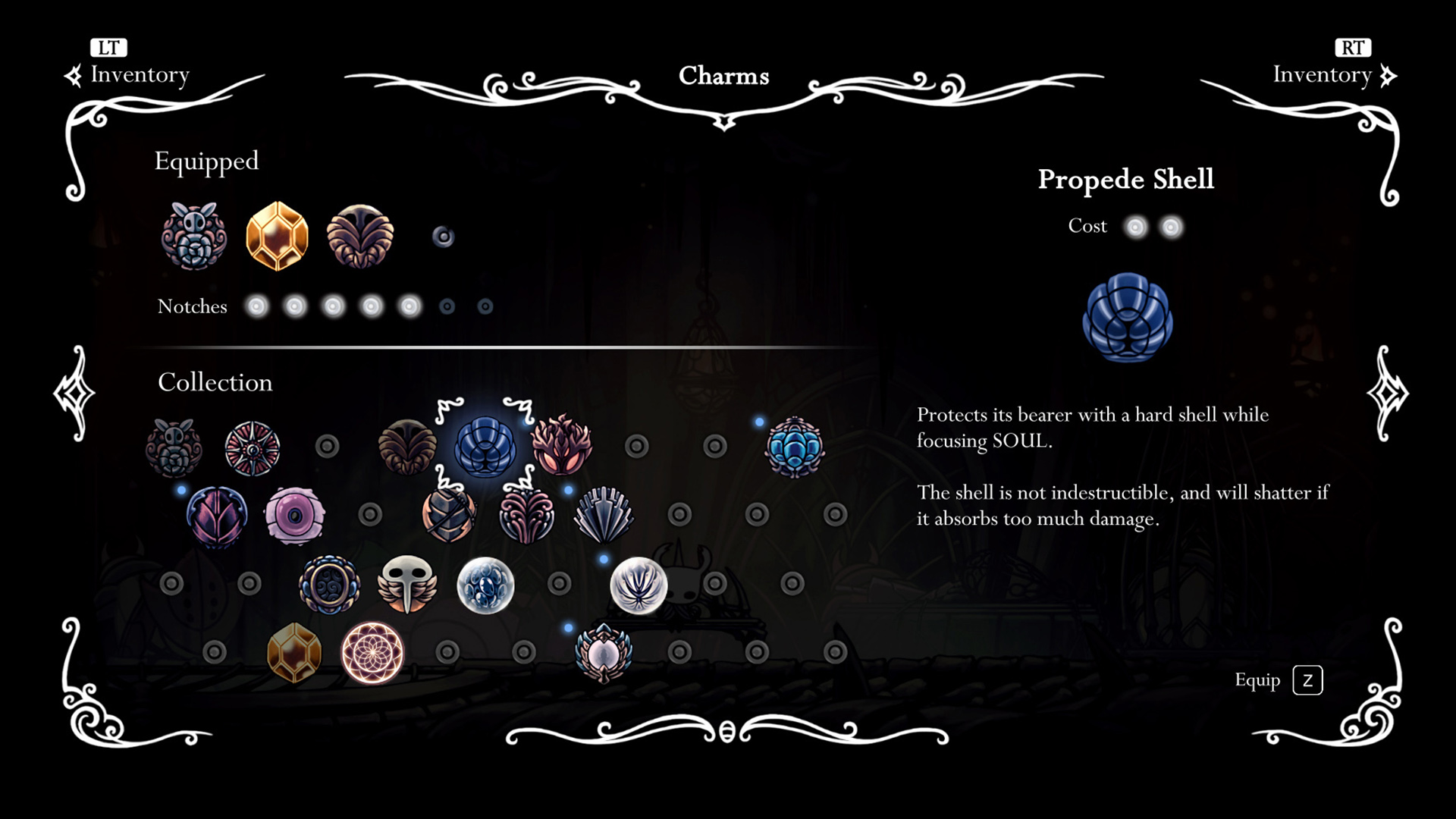
You start with 3 charm notches and can reach 11. Quick Focus makes healing safer, Shaman Stone turns spells into your main damage, Mark of Pride and Longnail extend your reach. Swapping charms at a bench before a fight is often a better fix than practising the same approach again. The Charm Guide lists the best setup for every notch count.
Art, sound and value
Every area has its own palette and music, from the rain of the City of Tears to the dark of Deepnest, and Christopher Larkin's score is one of the most praised in the genre. The Steam store page lists over 130 enemies and 30 bosses. At an indie price, with no paid extras, the value is hard to match.
Where it falls short
You will get lost, and it is on purpose
There is no objective marker. Each area's map must be bought from Cornifer, the mapmaker you find by following his humming; it only fills in as you explore if you also own the Quill, and it only updates when you rest at a bench. The Wayward Compass charm, which shows where you are, costs a notch. Many players who quit in the first hours were missing these items, not skill.
Death costs money and time
When you die, you return to your last bench, all your Geo stays with your Shade where you fell, and your SOUL meter is reduced until you kill it. If you die on the way back, the old Geo is gone. Some benches are far from boss arenas, so failed attempts include long walks. None of this is unfair, but it punishes exploring with a full wallet.
No difficulty setting, and a steep optional endgame
There is no easy mode, no assist option and no way to skip a boss. The main path is manageable for most players who are patient. The optional content is not: the Path of Pain, Nightmare King Grimm and the Pantheon of Hallownest are among the hardest challenges in the genre, and the Godmaster endings require the last of them.
Travel before shortcuts
Until you open Stag Stations and get the later movement abilities, crossing the map takes time. The slowest stretch is the start: the Forgotten Crossroads is the least varied area, and you have no dash yet.
Common complaints, and how true they are
| Complaint | Is it true? | What helps |
|---|---|---|
| I keep getting lost | Yes; it is the design, not a bug | Buy each map from Cornifer, the Quill from Iselda, and wear the Wayward Compass early |
| It is too hard | For the optional endgame, yes; for the main path, mostly no | Upgrade the nail, collect Mask Shards, use Quick Focus, and explore elsewhere when a boss stops you |
| Losing Geo on death is harsh | It can be | Spend Geo before risky trips and go straight back to your Shade |
| The start is slow | Partly; the Crossroads are plain and you have few abilities | Head for Greenpath and the Mothwing Cloak; the game opens up quickly after that |
| Too much backtracking | Early, yes | Open Stag Stations as you find them; later abilities create shortcuts |
| Silksong makes it outdated | No | Different world, bosses and story; play Hollow Knight first if you are new |
The difficulty complaint deserves a clearer answer, because it decides most purchases. Hollow Knight's main bosses ask for patience more than reflexes: players who get stuck are usually healing at the wrong time or fighting with the starting nail. The game almost always lets you leave, explore, and come back stronger. What it never does is lower the bar for you.
Hollow Knight compared with similar games
| Game | Core loop | Guidance and difficulty | How Hollow Knight differs |
|---|---|---|---|
| Hollow Knight: Silksong | Same genre and team, playing as Hornet in Pharloom | Harder from the start; quests are tracked in a menu | Slower, more deliberate combat and a gentler entry point |
| Ori and the Blind Forest / Will of the Wisps | Platforming-led exploration with a story told through cutscenes | More directed; combat is lighter | Combat and bosses matter far more; the story is told mostly through the world itself |
| Dead Cells | Roguelite runs through levels that change each time | Each run is short; permanent unlocks carry over | One hand-built map that you learn and own; death costs Geo, not the whole run |
| Metroid Dread | Fast sci-fi exploration on Nintendo Switch | The map comes with the game and the path is clearer | Much less guidance, a more open order of areas, and a much lower price |
If you liked Dead Cells for its combat but missed a world to learn, Hollow Knight is the natural next step. If you liked Ori for its atmosphere, expect a much harder game. If Metroid Dread was your first metroidvania, Hollow Knight will feel far less guided.
Hollow Knight or Silksong first?
For a newcomer, Hollow Knight first. It is cheaper, its early game is easier, and Silksong's story builds on Hornet's role here. If you already know the genre well and want the newest, most demanding game, Silksong stands on its own; many players then go back to the original and find it calmer.
Related guides
Your first hours and early route: Beginner Guide. Where to go and which ability opens what: Exploration Guide. Every main boss, heal window and ending: Boss Guide. Builds for every notch count: Charm Guide.
★Honest Take — still the benchmark, as long as you accept being lost
Hollow Knight keeps its 9.4 because its world rewards attention in a way few games do: the map you were confused by in hour three makes sense in hour twenty, and the boss that stopped you is beaten with a better nail and the right charm. The value is extraordinary, with four free content packs and nothing to buy. The reservations are honest ones. The game hides its basic tools (map, Quill, compass), punishes deaths with lost Geo and long walks, and offers no easier way through. Silksong does not replace it; it is a harder sequel that is best played after this one. If wandering without directions sounds like a pleasure, buy it. If it sounds like a chore, this is the game where that feeling will be strongest.