Verdict Games Verdict Games
Factorio Main Bus Design|The Central Highway for a Scalable Factory

Factorio Main Bus Design|The Central Highway for a Scalable Factory

Author: Verdict Games Editorial Team Last Updated:

The Bottom Line

The standard bus runs key materials — iron, copper, green circuits — in parallel groups of four, with assemblers expanding off one side. Start with 2-4 belts and grow as needed. Build a working version first, then refine.

Summary

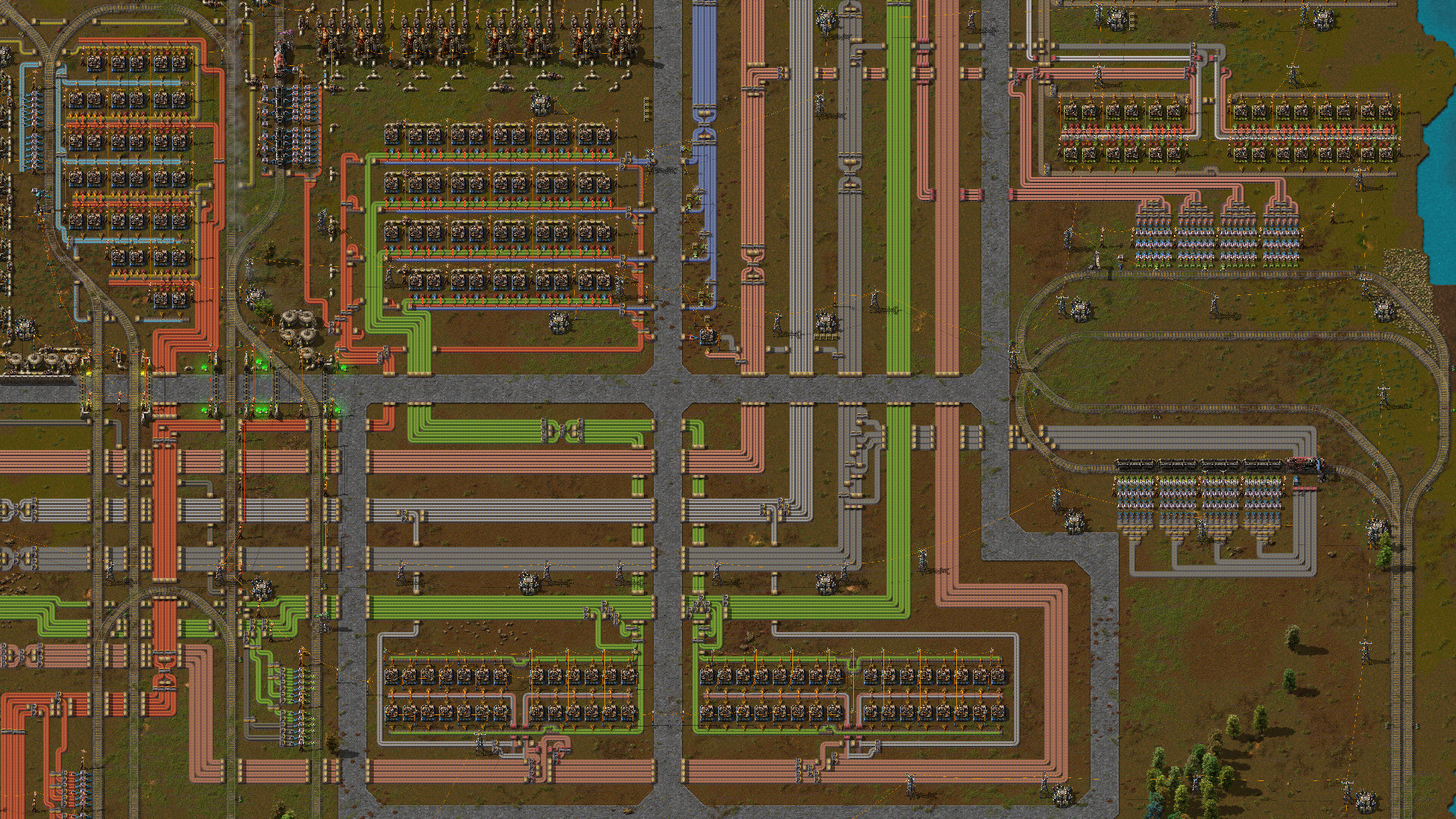
A main bus is the standard factory pattern — run key materials down the middle in parallel belts and split off assemblers on one side. By centralizing iron plates, copper plates, green circuits, and other staples, you get a factory that is both readable and easy to scale. This guide covers the basic structure, how to decide belt counts, and the operational habits that keep a bus working.

Who This Is For: Players whose factory is becoming a mess or who want to learn an efficient layout Intermediate

Key Points

Key Points

1

The main bus runs key materials in parallel belts down the middle

2

Groups of 4 belts with 2-tile gaps let underground belts cross

3

Place assemblers only on one side — the other side stays open for expansion

4

Put green circuits on the bus but not gears or copper wire (make those on-site)

Bus Fundamentals

The main bus is the canonical factory layout — run key materials in parallel belts down the center, expand assemblers off one side. It keeps things readable and makes the factory easy to scale.

The standard pattern is groups of 4 belts with a 2-tile gap between groups. The 2-tile gap lets an underground belt (yellow can span up to 4 tiles) cross the bus cleanly to deliver a tap from any group.

What Belongs on the Bus

Material On bus? Reason
Iron / copper plate Yes Used in almost every recipe
Steel Yes Major mid-game ingredient
Green / red / blue circuits Yes High demand and expensive to produce
Stone / stone brick Yes Needed for furnaces, walls, buildings
Gears / copper wire No One assembler on-site is enough
Plastic / sulfur Maybe Promote to bus from the mid-game onward

Putting gears or copper wire on the bus inflates belt counts and complicates routing. Make them next to where they're consumed — for example, a copper-wire assembler sitting directly beside the green-circuit line. The bus is for shared materials only.

Design Steps

  1. 1

    Start with 2-4 belts

    Roughly two iron and two copper is enough for an early working bus. Don't aim for perfect from the start.

  2. 2

    Apply the 4-belt + 2-tile rule

    Group belts in fours with a 2-tile gap, so undergrounds can split off cleanly.

  3. 3

    Expand assemblers on one side

    Leave the other side open for future materials and additional lanes.

  4. 4

    Upgrade belt tier as you scale

    Mid-game move to red belts (2x speed) and ultimately to blue belts (4x speed).

Sizing for Scale

Factorio gives you essentially infinite space, so always leave 3x more room than you think you need. The most common beginner mistake is cramping the bus and having to rebuild the whole factory later. "Too big" is always better than "too small."

Toward the Rocket Launch

Once the bus is in place, layer in research and advanced parts (red circuits, blue circuits, plastic, batteries) to push toward a rocket launch. For the full progression path see the Progression Guide, and for the basics see the Beginner Guide.

★Honest Take: The Bus Changes the Game

Honestly, learning the main bus is a before-and-after moment in Factorio. A chaotic factory suddenly looks orderly, and scaling becomes a non-issue. Skip the bus and you'll likely stall in the mid-game. Don't aim for a perfect first attempt — get a rough bus running, refactor as needed, and the game stays fun and approachable.
FAQ

FAQ

It's a "material highway" running down the center of your factory. High-use staples like iron plates, copper plates, and green circuits flow in parallel belts, and you tap off to supply each production line as needed. The pattern keeps wiring clean and makes expansion painless, which is why it's the de-facto standard layout in Factorio.
A typical early bus is two iron, two copper, and one green circuit, growing as your factory scales. The classic rule is "groups of 4 belts with a 2-tile gap" — the gap lets underground belts split off without disrupting the line.
Put high-use items shared across many production lines on the bus — iron plate, copper plate, steel, green/red/blue circuits, stone bricks. Don't bus intermediate parts like gears and copper wire — those are trivial to produce on-site next to whichever assembler needs them.
Not recommended. One-sided expansion keeps the other side free for adding new materials or extra lanes later. Two-sided expansion forces belts to cross the bus, complicating routing. Especially for beginners, one-sided expansion is the safer choice.

Our editorial policy is honest, no-spin reviews. We separate facts from opinion and back every rating with reasoning. View Editorial Policy

Related

Related Articles