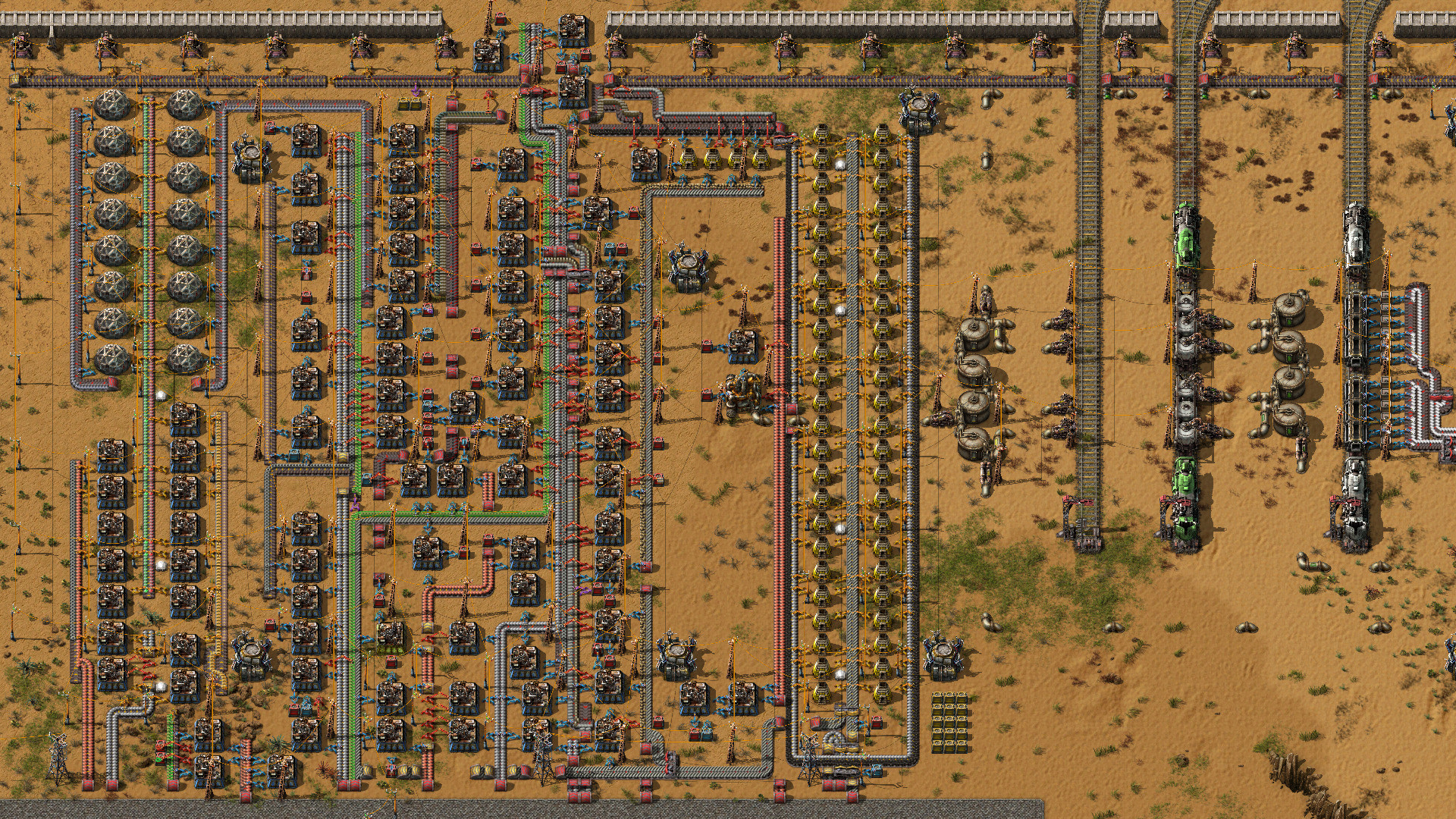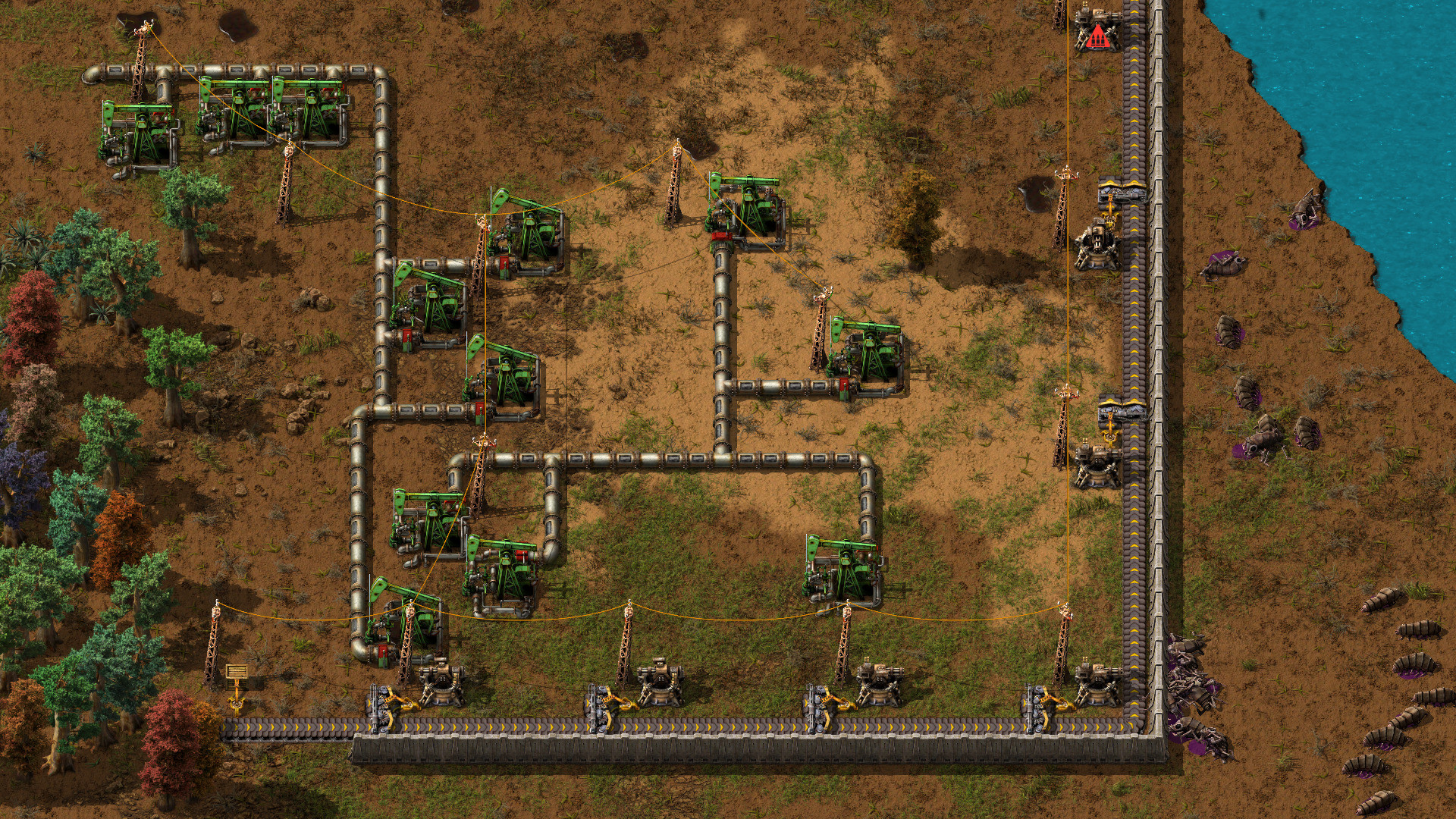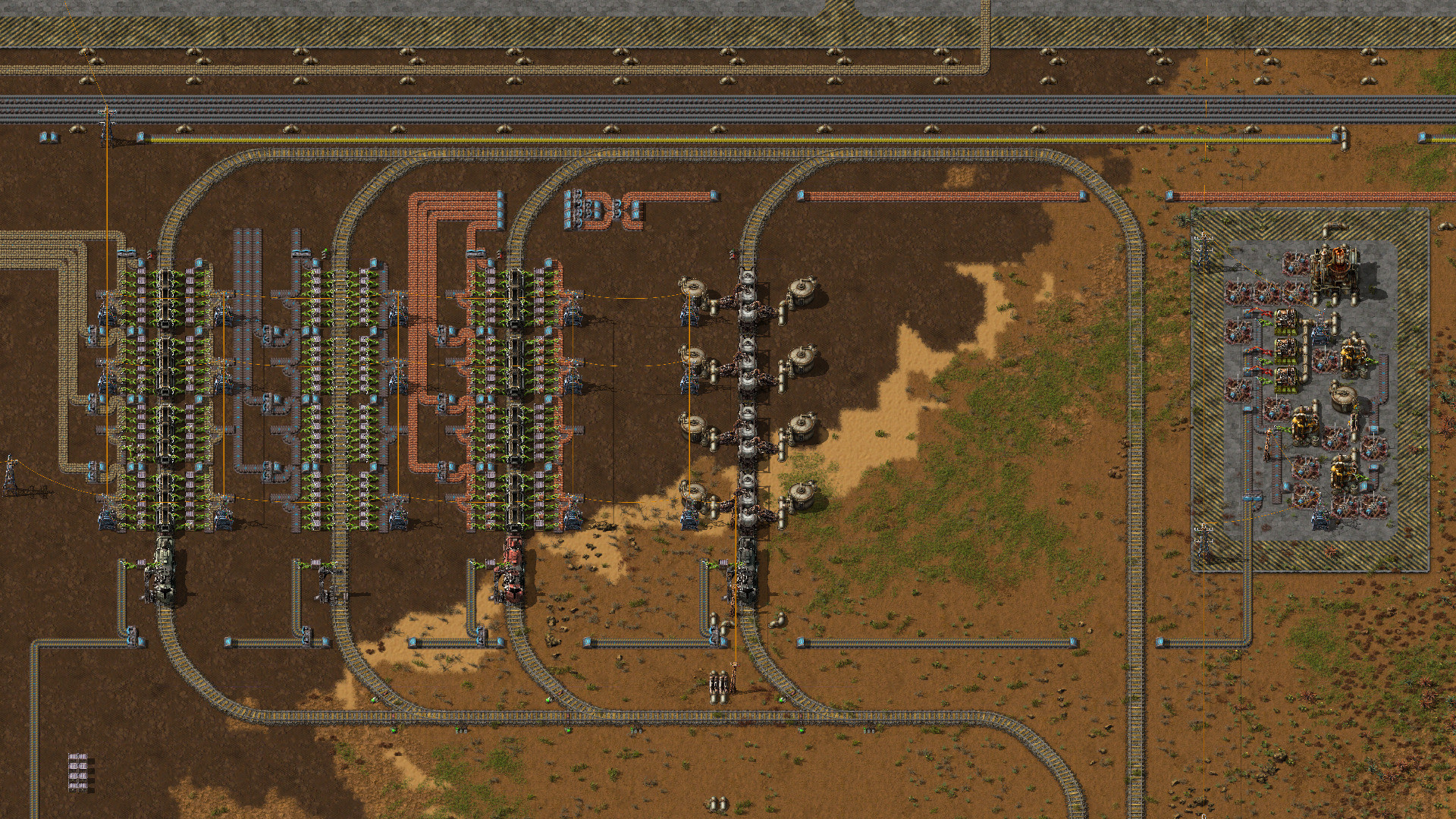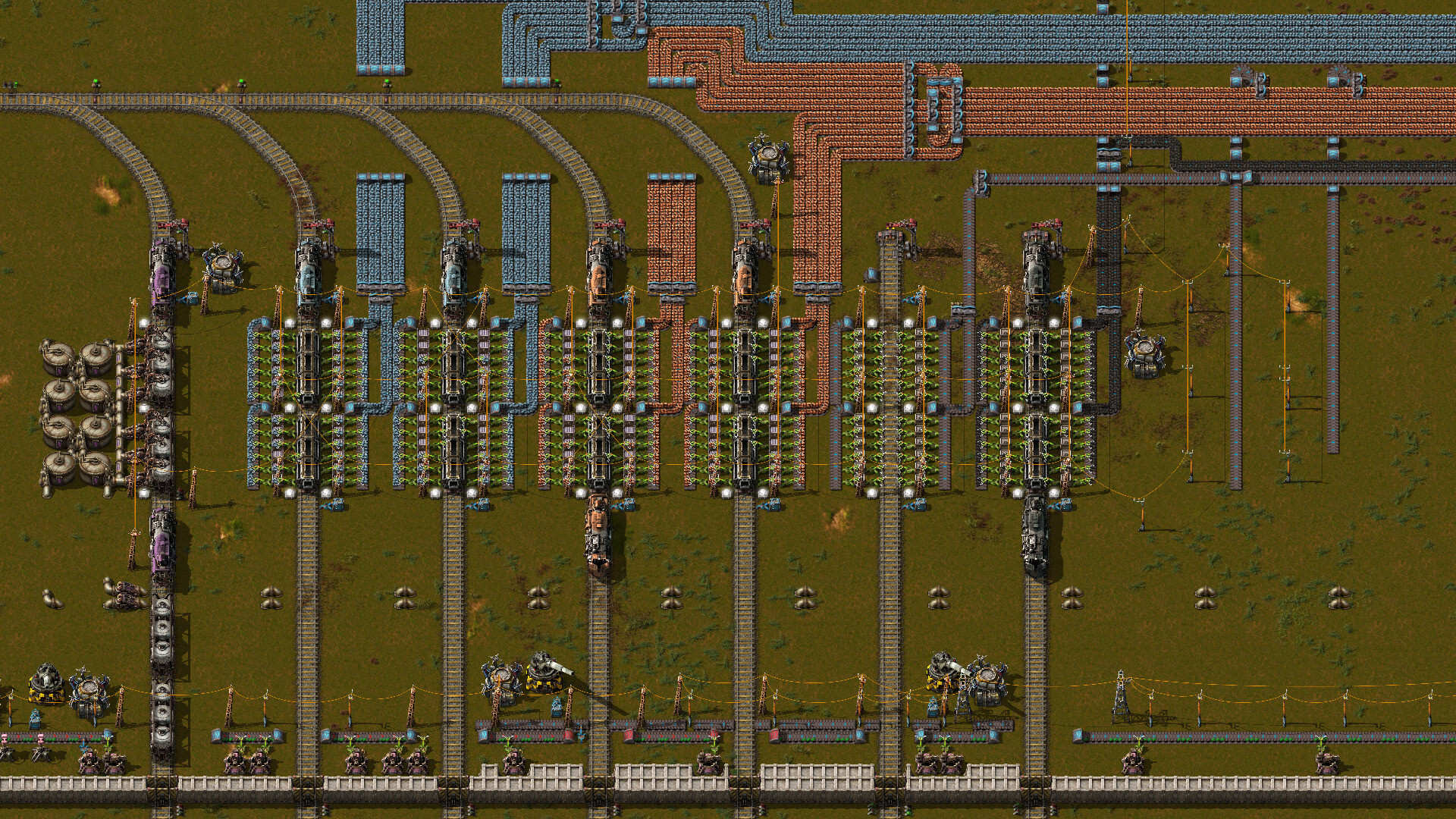
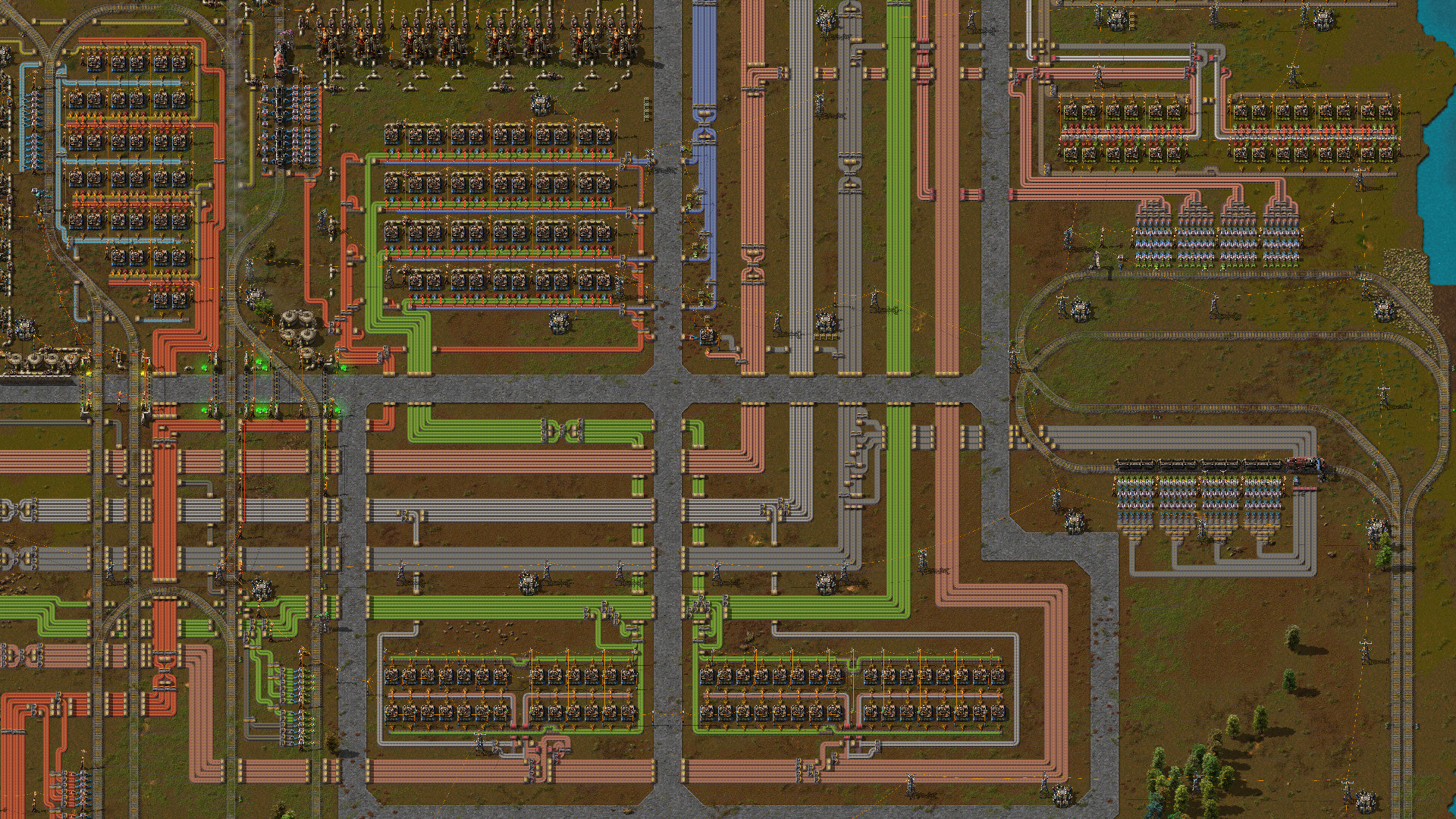
Factorio has no quest log. Its tech tree decides the order instead: each science pack needs the products of the previous tier, so "what should I build next?" almost always means "what does the next science pack need?". See the route as a chain of science packs and the mid-game stops feeling like an open sea.
This guide is written for Factorio 2.0 (base game). Recipes, research costs and machine stats come from the official Factorio Wiki, for normal quality. The first hour, up to automated red and green science, is in the Beginner Guide; this guide runs from there to the rocket.
Space Age: the route up to the rocket silo is the same, but the silo is cheaper to research, the rocket is cheaper to build and the satellite is replaced by space platforms. Differences are noted where they matter.
The route at a glance
| Stage | Key research | What to build | Typical bottleneck |
|---|---|---|---|
| Red (automation) | Automation, Electric mining drill, Logistics, Logistic science pack | Steam power, gear and red-pack assemblers | Coal for the boilers; too few furnaces |
| Green (logistic) | Steel processing, Engine, Fluid handling, Oil gathering, Railway | Inserter, belt and green-pack lines; a small main bus | Electronic circuits |
| Military (gray), optional | Military 2, Stone wall, Military science pack | Piercing ammo, grenade and wall lines | Only needed once attacks outgrow gun turrets |
| Oil | Oil gathering, Oil processing (trigger), Plastics, Sulfur processing | Pumpjacks, oil refineries, chemical plants | Petroleum gas; learning fluids |
| Blue (chemical) | Advanced circuit (200 units), Sulfur processing (150), Chemical science pack (75) | Advanced circuits, engine units, sulfur | Plastic for advanced circuits |
| Advanced oil | Advanced oil processing (red, green, blue) | Cracking chemical plants, lubricant | Heavy or light oil backing up and stopping refineries |
| Purple (production) | Railway, Productivity module, Advanced material processing 2, Production science pack (100) | Electric furnaces, productivity modules, rails | Steel and iron volume |
| Yellow (utility) | Processing unit (300), Low density structure (300), Robotics (75), Utility science pack (100) | Processing units, flying robot frames, low density structures | Copper, plastic and sulfuric acid |
| Rocket | Rocket fuel, Speed module 3, Productivity module 3, Concrete, Solar energy, Electric energy accumulators, Rocket silo | Rocket silo, cargo landing pad, satellite | Processing units and rocket fuel |
Numbers in brackets are research units; each unit uses one of every pack the technology lists. Two facts shape the whole route:
- Military science is a side branch. The Rocket silo research needs "all science packs except for military", in the wiki's words. Gray science is a defense decision, not a step.
- Purple and yellow are parallel. Both cost only red, green and blue. Build them in either order; most players work on both at once.
How big is the whole job? The wiki totals the base-game science for the rocket silo and every technology leading to it (figures given for version 2.1, which per the developers adds no new research trees): 5,960 red, 5,785 green, 3,350 blue, 1,600 purple and 1,000 yellow. Almost a third of the blue and all of the yellow go into the silo research itself.
What each science pack costs
| Pack | Recipe | Time | Output | Unlocked by |
|---|---|---|---|---|
| Automation (red) | 1 copper plate + 1 iron gear wheel | 5 s | 1 | Crafting a lab (trigger) |
| Logistic (green) | 1 inserter + 1 transport belt | 6 s | 1 | Logistic science pack (75 red) |
| Military (gray) | 1 piercing rounds magazine + 1 grenade + 2 walls | 10 s | 2 | Military science pack (red, green) |
| Chemical (blue) | 3 advanced circuits + 2 engine units + 1 sulfur | 24 s | 2 | Chemical science pack (75 red + green) |
| Production (purple) | 1 electric furnace + 1 productivity module + 30 rails | 21 s | 3 | Production science pack (100 red + green + blue) |
| Utility (yellow) | 2 processing units + 1 flying robot frame + 3 low density structures | 21 s | 3 | Utility science pack (100 red + green + blue) |
| Space (white) | Not crafted | — | 1,000 per satellite | Rocket silo |
Plate costs per pack and the belt counts they imply are in the Main Bus Guide. In short: red, green and blue are cheap; purple uses 52.5 iron plates per pack and yellow nearly 50 copper plates, which is where comfortable factories stop being comfortable.
Red and green science
Red science is the opening, covered step by step in the Beginner Guide: craft a lab to unlock the recipe, research Automation, Electric mining drill and Logistics, then Logistic science pack (75 red).
Green science opens most of the early tree. The research that matters for progress:
- Steel processing — steel goes into engine units, rails, electric furnaces and most mid-game buildings.
- Engine and Logistics 2 — the prerequisites of Railway; engine units are also half of a blue pack.
- Fluid handling, then Oil gathering (red + green), which unlocks the pumpjack.
- Railway (75 units of red + green). Not optional: it is a prerequisite of Production science pack.
The bottleneck here is electronic circuits. Green science, every building you place and later advanced circuits and processing units all eat them, so build circuit production larger than feels necessary. This is also when to start a small main bus.
Military science, and when defense matters
The Military science pack research costs red and green after Military 2 and Stone wall. The pack is a piercing rounds magazine, a grenade and two walls (2 packs per craft). It opens 13 technologies, including laser turrets, flamethrower turrets, land mines, Military 3, Rocketry and more levels of Physical projectile damage and Weapon shooting speed.
Nothing on the way to the rocket needs it. Build it when defense needs it: your pollution cloud grows with every stage and reaches more nests, evolution rises with time, pollution and every spawner you destroy, and eventually gun turrets with basic ammo stop holding. Laser turrets, which run on electricity instead of ammo deliveries, are the main reason to want gray science mid-game. If gun turrets still hold, put the resources into oil first. Turret layouts and evolution are in the Defense and Pollution Guide.
Oil processing: basic, advanced and cracking
Oil is where most runs slow down, because it is the first time you handle fluids. In 2.0 the start is:
- Oil gathering (red + green) unlocks the pumpjack.
- Oil processing is a trigger technology: the wiki lists its trigger as mining crude oil. It unlocks the oil refinery, the chemical plant, basic oil processing and solid fuel from petroleum gas.
- Plastics and Sulfur processing (150 units of red + green) turn petroleum gas into what blue science needs.
| Recipe | Building | Inputs | Outputs | Time |
|---|---|---|---|---|
| Basic oil processing | Oil refinery | 100 crude oil | 45 petroleum gas | 5 s |
| Advanced oil processing | Oil refinery | 100 crude oil + 50 water | 25 heavy oil + 45 light oil + 55 petroleum gas | 5 s |
| Heavy oil cracking | Chemical plant | 40 heavy oil + 30 water | 30 light oil | 2 s |
| Light oil cracking | Chemical plant | 30 light oil + 30 water | 20 petroleum gas | 2 s |
| Plastic bar | Chemical plant | 20 petroleum gas + 1 coal | 2 plastic bars | 1 s |
| Sulfur | Chemical plant | 30 petroleum gas + 30 water | 2 sulfur | 1 s |
| Lubricant | Chemical plant | 10 heavy oil | 10 lubricant | 1 s |
| Solid fuel (from light oil) | Chemical plant | 10 light oil | 1 solid fuel | 1 s |
Basic or advanced? Basic oil processing gives only petroleum gas, which is all plastic and sulfur need. Advanced oil processing needs blue science to research, so you cannot start with it. With cracking it gets more petroleum gas per crude oil, and it is the base game's source of heavy oil (lubricant) and light oil (solid fuel, rocket fuel) apart from coal liquefaction, which arrives with purple science.
The cracking ratio. A refinery stops when any of its outputs is full, so heavy and light oil must be used up. For maximum petroleum gas the wiki gives 20 refineries : 5 heavy oil cracking : 17 light oil cracking, with 8 : 2 : 7 close enough. Since you will also take heavy oil for lubricant and light oil for solid fuel, treat cracking as overflow: crack only what other lines do not use.
The classic oil stall: you switch to advanced oil processing, it runs for a few minutes, then heavy oil fills its tanks and every refinery stops, petroleum gas included. Build heavy oil cracking (or a lubricant line) before you switch.
Chemical science: blue
Blue science needs Advanced circuit (200 units of red + green, after Plastics) and Sulfur processing (150 units), then the Chemical science pack research (75 units). The recipe is 3 advanced circuits, 2 engine units and 1 sulfur for 2 packs in 24 seconds.
- Advanced circuits: 2 electronic circuits, 2 plastic bars and 4 copper cables, 6 seconds. A blue pack needs 1.5 of them, so 3 plastic bars per pack. Plastic, not crude oil, is the usual bottleneck.
- Engine units: 1 steel plate, 1 iron gear wheel and 2 pipes, 10 seconds. Slow, so they need more assemblers than you expect.
- Sulfur: half a sulfur per pack; one bus lane is plenty.
Blue science opens the rest of the tree: Advanced oil processing, Advanced material processing 2 (electric furnaces), Processing unit, Low density structure, Robotics and, through Uranium processing, Nuclear power (800 units of red, green and blue). Purple and yellow production, modules and beacons all raise power use, so plan your next power step before the brownouts start.
Production and utility science: purple and yellow
| Production (purple) | Utility (yellow) | |
|---|---|---|
| Research prerequisites | Advanced material processing 2, Productivity module, Railway | Low density structure, Processing unit, Robotics |
| Hidden cost | Steel: electric furnace and rails | Copper (20 per low density structure), lubricant, sulfuric acid |
| Plates per pack (wiki total raw) | 52.5 iron, 19.17 copper | 33.33 iron, 49.83 copper |
| Typical bottleneck | Iron and steel volume | Processing units and copper |
The intermediates, from the wiki:
- Electric furnace: 5 advanced circuits, 10 steel plates, 10 stone bricks. Also your best smelter: crafting speed 2, no fuel, 2 module slots.
- Productivity module 1: 5 advanced circuits and 5 electronic circuits, 15 seconds. The Productivity module research (red + green, after Modules) is cheap; take it early.
- Processing unit: 20 electronic circuits, 2 advanced circuits and 5 sulfuric acid, 10 seconds. Sulfuric acid is 5 sulfur, 1 iron plate and 100 water for 50 acid in a chemical plant.
- Low density structure: 20 copper plates, 2 steel plates and 5 plastic bars, 15 seconds.
- Flying robot frame: 2 batteries, 1 electric engine unit, 3 electronic circuits and 1 steel plate, 20 seconds. The electric engine unit needs 15 lubricant, so yellow science is what forces advanced oil processing.
Yellow science pays you back: Robotics leads to construction and logistic robots, which make building and supplying the rest of the base far faster.
Modules and beacons: the basics
The Modules research (100 units of red + green, after Advanced circuit) comes early, but modules only change how you build once purple science runs.
| Module | Tier 1 | Tier 2 | Tier 3 |
|---|---|---|---|
| Speed | +20% speed, +50% energy | +30% speed, +60% energy | +50% speed, +70% energy |
| Productivity | +4%, −5% speed, +40% energy, +5% pollution | +6%, −10% speed, +60% energy, +7% pollution | +10%, −15% speed, +80% energy, +10% pollution |
| Efficiency | −30% energy | −40% energy | −50% energy |
- Productivity modules generally only work on intermediate products — items that go into recipes rather than buildings you place. Labs accept them too.
- Productivity modules cannot go in beacons. Only speed and efficiency modules can.
- Module slots: assembling machine 3 has 4; chemical plants and oil refineries 3; electric furnaces and labs 2. Quality modules are Space Age only.
Beacons (Effect transmission: 75 units of red, green, blue and purple, after Processing unit and Production science pack) cost 20 advanced circuits, 20 electronic circuits, 10 copper cables and 10 steel plates and draw 480 kW. They have 2 module slots and pass the effects to machines in a 9×9 area at a distribution efficiency of 1.5. 2.0 added diminishing returns: when n beacons cover a machine, each beacon's strength is 1.5 ÷ √n.
| Beacons on one machine | Strength per beacon | Speed bonus with 2 speed module 3 per beacon |
|---|---|---|
| 1 | 1.5 | +150% |
| 4 | 0.75 | +300% |
| 8 | 0.53 | about +424% |
The totals are arithmetic on the wiki's formula (combined strength 1.5 × √n). Each extra beacon adds less, and every beacon also passes on the modules' extra energy use. For a first rocket, beacons are optional; the usual use is a few around the slowest lines — processing units, rocket fuel, low density structures.
Trains: when to switch
Railway (75 units of red + green, after Engine and Logistics 2) unlocks locomotives, cargo wagons and rails; Automated rail transportation (red + green) adds rail signals, chain signals and train stops. Because Railway is a prerequisite of production science, everyone researches it before purple.
Actually use trains when ore is far away (long belts are slow to build and easy for biters to cut), or when the main bus would need several blue belts of one plate. Not before: a train network is a project of its own, and if your ore is close and the bus keeps up, build science instead.
The rocket silo and the launch
The Rocket silo research costs 1,000 units of red, green, blue, purple and yellow. Its prerequisites are Concrete, Electric energy accumulators, Productivity module 3, Radar, Rocket fuel, Solar energy, Speed module 3 and Utility science pack. Productivity module 3 and Speed module 3 each cost 300 units of red, green, blue and purple, so purple science must be running well before the end.
What a first launch costs in the base game:
| What | Recipe | Count |
|---|---|---|
| Rocket silo | 1,000 concrete, 1,000 steel plates, 200 electric engine units, 200 processing units, 100 pipes | 1 |
| Cargo landing pad | 200 concrete, 10 processing units, 25 steel plates | 1 (required to launch) |
| Rocket part | 10 processing units, 10 low density structures, 10 rocket fuel (3 s) | 100 per rocket |
| Satellite | 100 processing units, 100 low density structures, 100 accumulators, 100 solar panels, 50 rocket fuel, 5 radars | 1 per launch |
| Rocket fuel | 10 solid fuel + 10 light oil (15 s, assembling machine 2 or 3) | 1,050 in total |
Added up: 1,310 processing units, 1,100 low density structures and 1,050 rocket fuel. That is the real final exam — the low density structures alone are 22,000 copper plates and 5,500 plastic bars, and each rocket fuel is 110 light oil once you count its solid fuel.
What changed in 2.0:
- No rocket control units. They were removed; recipes that used them now use processing units.
- A cargo landing pad is required somewhere on the map before a rocket can launch. Only one fits per surface.
- A payload is required to win. In the base game the valid payloads are a satellite (1,000 space science packs) or a raw fish (an achievement, but a wasted launch).
- Space science lands on the cargo landing pad; if it is full, the packs drop on the ground, marked for deconstruction. All infinite technologies use space science.
- The silo keeps working. It builds the next rocket's parts during a launch, and "Send to orbit automatically" launches as soon as a payload is loaded. Parts stay inside the silo and are lost if you deconstruct it.
Space Age differences: a rocket part costs 1 processing unit, 1 low density structure and 1 rocket fuel, and a rocket needs only 50 parts. The Rocket silo research needs only red, green and blue. There is no satellite; space science is crafted on space platforms.
Common mistakes
- Treating the colours as a strict sequence. Military science is optional, and purple and yellow are parallel. An old "red, green, gray, blue, yellow, purple" list wastes time on gray science you may not need yet.
- Switching to advanced oil processing without cracking. Heavy oil fills up and stops every refinery.
- Under-building electronic circuits. Advanced circuits, processing units, modules and beacons all consume them.
- Leaving Railway and the module techs too late. Purple needs Railway and Productivity module; the silo needs Speed module 3 and Productivity module 3.
- Underestimating copper. A bus sized for red, green and blue runs short once yellow science and low density structures start.
- Forgetting the cargo landing pad, or picking up a half-filled silo and losing its parts.
Related guides
- Beginner Guide — the first hour, ratios and research up to green science.
- Main Bus Guide — what goes on the bus, belt counts per science target, when to move to trains.
- Defense and Pollution Guide — turrets, walls, evolution and pollution.
- Factorio Review — whether the game, and Space Age, is worth your time.
★Honest Take: the route is fixed, the pace is yours
Factorio's progression is more linear than it looks. Every stage asks for the same thing — automate the next science pack — and the tech tree tells you exactly what that pack needs. The difficulty is not knowing what to do; it is scale. Red, green and blue fit in a modest factory. Purple, yellow and then 1,100 low density structures for one launch do not, and that is where most first runs stall for hours.
The 2.0 changes make the ending cleaner: the rocket is three products instead of four, and the satellite's science has a proper destination in the cargo landing pad. What has not changed is oil. It still stops the most players, and the advanced-oil stall still catches nearly everyone once. Build cracking first, treat military science as a defense decision rather than a step, and the rest of the route is a matter of building enough.