Every Slay the Spire character uses the same map, enemies and relics, but each one wins in a different way. The Ironclad scales his attacks with Strength, the Silent wears enemies down with poison or buries them in Shivs, the Defect builds a wall of orbs, and the Watcher switches stances to double her damage. Picking the right first character, and knowing what each one is looking for in Act 1, saves a lot of failed runs.
This guide starts with the comparison table, then goes through the characters one by one: starting deck, main archetypes with the cards that define them, what to take and skip early, which boss relics suit them, and the mistakes that end runs. It finishes with a table for choosing your next character.
The four characters compared
| Ironclad | Silent | Defect | Watcher | |
|---|---|---|---|---|
| Max HP (Ascension 14+) | 80 (75) | 70 (66) | 75 (71) | 72 (68) |
| Starting relic | Burning Blood: heal 6 HP at the end of combat | Ring of the Snake: draw 2 extra cards at the start of each combat | Cracked Core: Channel 1 Lightning at the start of each combat | Pure Water: add a Miracle (0 cost, +1 Energy) to your hand at the start of each combat |
| Starting deck | 5 Strike, 4 Defend, Bash (10 cards) | 5 Strike, 5 Defend, Neutralize, Survivor (12 cards) | 4 Strike, 4 Defend, Zap, Dualcast (10 cards) | 4 Strike, 4 Defend, Eruption, Vigilance (10 cards) |
| Core mechanic | Strength, Exhaust, trading HP for power | Poison, Shivs, discard and card draw | Orbs (Lightning, Frost, Dark, Plasma) scaled by Focus | Stances: Wrath doubles attack damage dealt and taken, leaving Calm gives 2 Energy |
| Main archetypes | Strength, Exhaust, Block | Poison, Shiv, discard and draw | Focus and Frost, Lightning, Power engine | Stance dance, Mantra and Divinity, Retain |
| How to unlock | Available from the start | Finish a run with the Ironclad (win or lose) | Finish a run with the Silent | Beat the Act 3 boss in a normal run once the Defect is unlocked |
| For beginners | Easiest: high HP, healing, good common cards | Hard early: weakest Act 1 damage | Hard: slow setup, needs orbs and Focus | Strongest, but mistakes in Wrath are costly |
Some of the most famous cards are not available on your first runs. Each character has five unlock levels that add cards and relics to the pool. Level 1 adds Heavy Blade, Spot Weakness and Limit Break for the Ironclad, Bane, Catalyst and Corpse Explosion for the Silent, Rebound, Equilibrium and Echo Form for the Defect, and Prostrate, Blasphemy and Devotion for the Watcher. If an archetype below feels impossible to assemble, a missing unlock may be the reason.
Ironclad
Starting deck and relic
Five Strikes, four Defends and Bash (2 Energy: 8 damage and 2 Vulnerable). Vulnerable makes the target take 50% more attack damage, so Bash first, then attack, is the Ironclad's basic turn. Burning Blood heals 6 HP after every combat, which lets him take fights the other characters would avoid. With 80 Max HP he has the most room for mistakes.
Archetypes
| Archetype | Key cards | What to look for in Act 1 |
|---|---|---|
| Strength | Inflame (+2 Strength), Spot Weakness (+3 if the enemy intends to attack), Demon Form (+2 Strength every turn), Limit Break (doubles Strength). Payoffs: Heavy Blade (Strength counts 3 times), Twin Strike, Sword Boomerang, Whirlwind | One Strength source plus one multi-hit attack. Strength is the most natural plan, so it rarely needs forcing |
| Exhaust | Corruption (Skills cost 0 but Exhaust), Feel No Pain (3 Block per card Exhausted), Dark Embrace (draw 1 per card Exhausted), True Grit, Burning Pact, Second Wind, Sentinel (2 Energy when Exhausted) | Feel No Pain, True Grit and Burning Pact are fine on their own. Corruption is the rare that makes it a full engine |
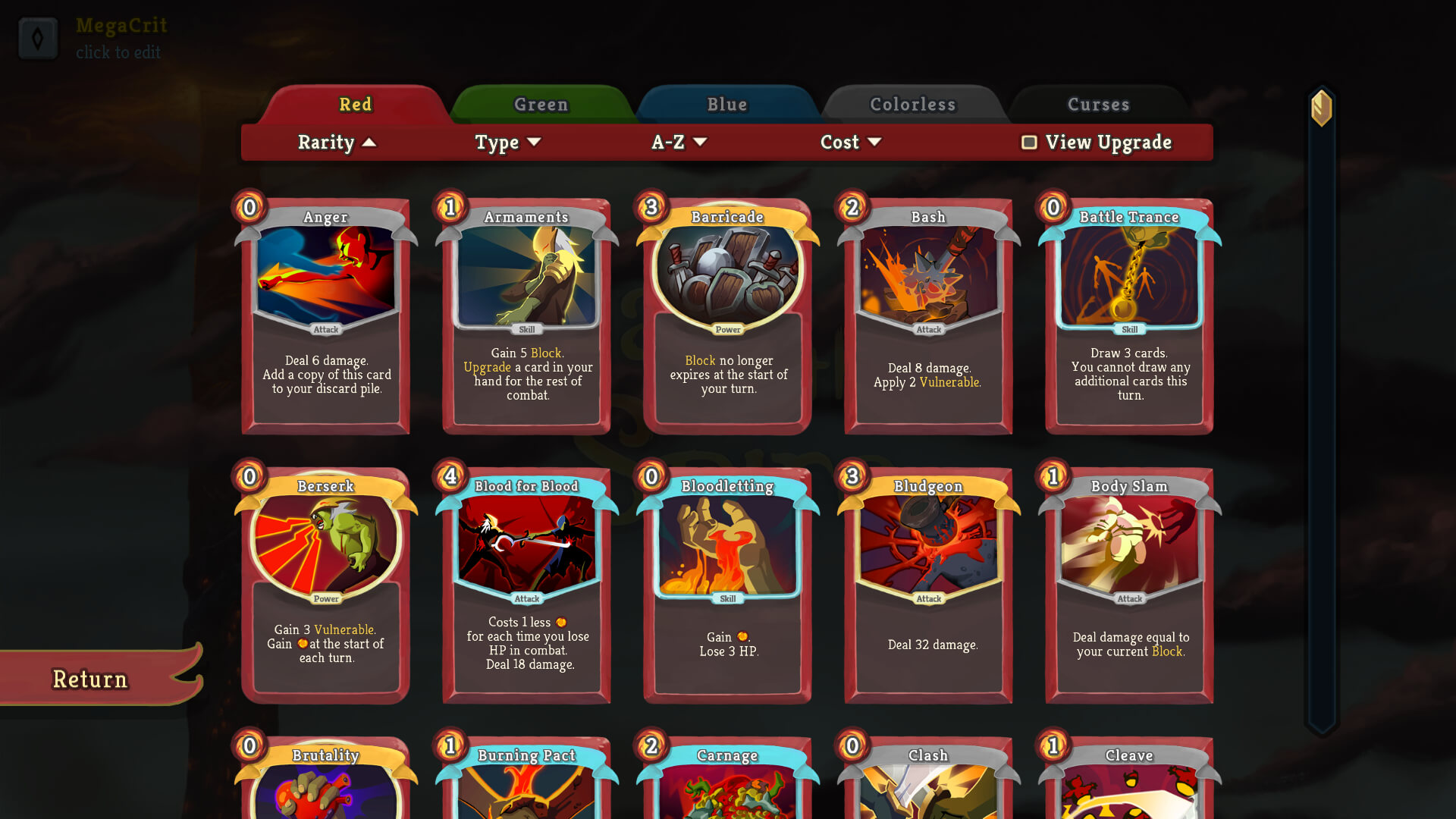
| Block | Barricade (Block no longer expires), Entrench (double your Block), Body Slam (damage equal to your Block), Juggernaut (5 damage whenever you gain Block), Impervious (30 Block), Flame Barrier, Metallicize | Shrug It Off and Flame Barrier. Barricade is a rare; without it, keep Body Slam and Entrench as side options |
Best early picks and cards to skip
Act 1 elites decide most early runs, so the first card rewards should add damage. Carnage (20 damage, Ethereal), Pommel Strike (9 damage, draw 1), Uppercut (13 damage, Weak and Vulnerable), Hemokinesis (15 damage for 2 HP) and Twin Strike are strong first picks; Shrug It Off (8 Block, draw 1) is the best common defence. Against groups, Thunderclap or Cleave helps.
Skip or delay these as a beginner:
- Searing Blow. It can be upgraded any number of times, but only pays off if you find it early and path through many Rest Sites. Otherwise it is a weak 2-cost attack.
- Clash. 14 damage for 0, but only playable when every card in your hand is an Attack.
- Wild Strike, Power Through, Reckless Charge. They shuffle Wounds or Dazed into your deck. Good with Evolve or Fire Breathing, a clog without them.
- Berserk. +1 Energy each turn, but you start with 2 Vulnerable on yourself.
Boss relics that suit the Ironclad
Mark of Pain (+1 Energy, 2 Wounds per combat) is much safer here than on other characters, because the Ironclad has many ways to Exhaust. Runic Cube (draw a card whenever you lose HP) suits self-damage decks with Hemokinesis, Bloodletting or Offering. Coffee Dripper is easier to live with because Burning Blood keeps healing you, and Black Blood is safe but usually the weakest choice. Full rankings are in the boss relic tier list.
Common Ironclad mistakes
- Treating Burning Blood as free healing. 6 HP after a fight does not undo a 30-damage turn. Block when enemies hit hard.
- Collecting Strength without a payoff. Inflame on a deck of single-hit Strikes is +2 damage per card. Strength needs multi-hit or high-count attacks.
- Playing Skills into Gremlin Nob. This Act 1 elite gains 2 Strength every time you play a Skill after its first turn. Attack instead.
- Swapping Burning Blood at Neow. It removes the Ironclad's safety net for a random boss relic.
Silent
Starting deck and relic
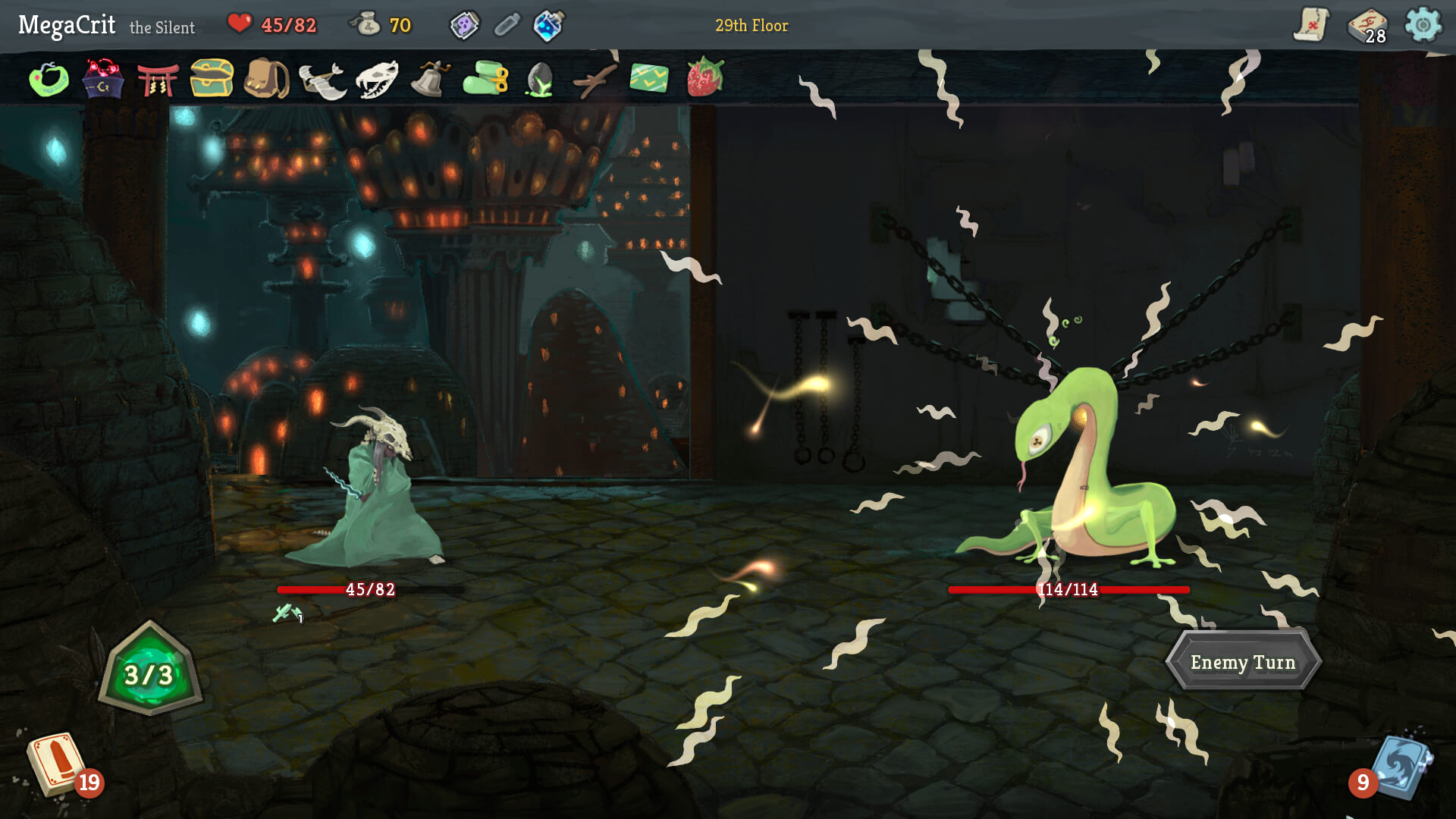
The Silent starts with the largest deck, 12 cards: five Strikes, five Defends, Neutralize (0 cost, 3 damage and 1 Weak) and Survivor (8 Block, discard 1). Ring of the Snake draws 2 extra cards at the start of each combat, so your first hand is 7 cards. She has the lowest HP (70) and no healing, which makes her the most fragile character early.
Archetypes
| Archetype | Key cards | What to look for in Act 1 |
|---|---|---|
| Poison | Noxious Fumes (2 Poison to all enemies every turn), Deadly Poison (5), Bouncing Flask (3 Poison three times), Catalyst (double an enemy's Poison), Corpse Explosion, Bane. Relics: Snecko Skull, The Specimen, Twisted Funnel | One good Poison source, but poison is slow, so keep taking front-loaded damage for the elites |
| Shiv | Blade Dance (3 Shivs), Cloak and Dagger (6 Block + 1 Shiv), Infinite Blades (1 Shiv per turn), Accuracy (+4 Shiv damage), After Image, A Thousand Cuts, Finisher. Relics: Shuriken, Kunai, Ornamental Fan, Wrist Blade | Blade Dance is solid early damage. The deck needs Accuracy or Strength to scale |
| Discard and draw | Acrobatics (draw 3, discard 1), Backflip, Prepared, Calculated Gamble, Tactician (Energy when discarded), Reflex (draw when discarded), Eviscerate (cheaper per discard). Relics: Tingsha, Tough Bandages | Acrobatics and Backflip are good in every Silent deck. This engine supports the other two |
Under all three sits a defensive layer: Footwork (+2 Dexterity), Leg Sweep (2 Weak, 11 Block), Piercing Wail (all enemies lose 6 Strength this turn) and Malaise. The Silent has no healing, so she survives by stacking Weak and Block, not by tanking.
Best early picks and cards to skip
The Silent's Act 1 is the weakest in the game: Strikes and a 0-cost Neutralize do not kill elites quickly. Prioritise damage: Dash (10 damage and 10 Block), Predator (15 damage, draw 2 next turn), Dagger Spray (4 damage to all enemies twice), Blade Dance, Poisoned Stab, and the rare Die Die Die (13 damage to all, Exhaust). Footwork, Backflip and Leg Sweep are the best defensive picks.
Skip or delay these as a beginner:
- Grand Finale. 50 damage to all enemies, but only playable when your draw pile is empty.
- Reflex and Tactician. Unplayable; they only work when discarded. Without regular discard effects they are dead draws.
- Accuracy without Shiv sources, and Bane without Poison (it only hits twice if the enemy is poisoned).
- Expertise. Draws up to 6 cards in hand, which the Silent often already has.
Boss relics that suit the Silent
Wrist Blade (+4 damage on 0-cost Attacks) is excellent in a Shiv deck and almost useless elsewhere. Hovering Kite (1 Energy on your first discard each turn) needs a discard deck. Ring of the Serpent replaces Ring of the Snake with 1 extra card every turn: better in long fights, worse on turn 1. Velvet Choker (6 cards per turn) is the Energy relic to avoid with Shivs. Details are in the relic tier list.
Common Silent mistakes
- Building a slow engine before you can beat Act 1 elites. Lagavulin and Gremlin Nob punish decks without front-loaded damage. A Poison deck with no attacks often dies before the Poison matters.
- Playing many Skills against Gremlin Nob. The Silent's deck is full of Skills, and each one gives the Nob 2 Strength.
- Running Shivs without scaling. A Shiv deals 4 damage. Without Accuracy, Strength or Shuriken it falls off by Act 2.
- Ignoring Weak. Weak cuts enemy attack damage by 25%. Neutralize, Leg Sweep and Sucker Punch are part of the Silent's defence.
Defect
Starting deck and relic
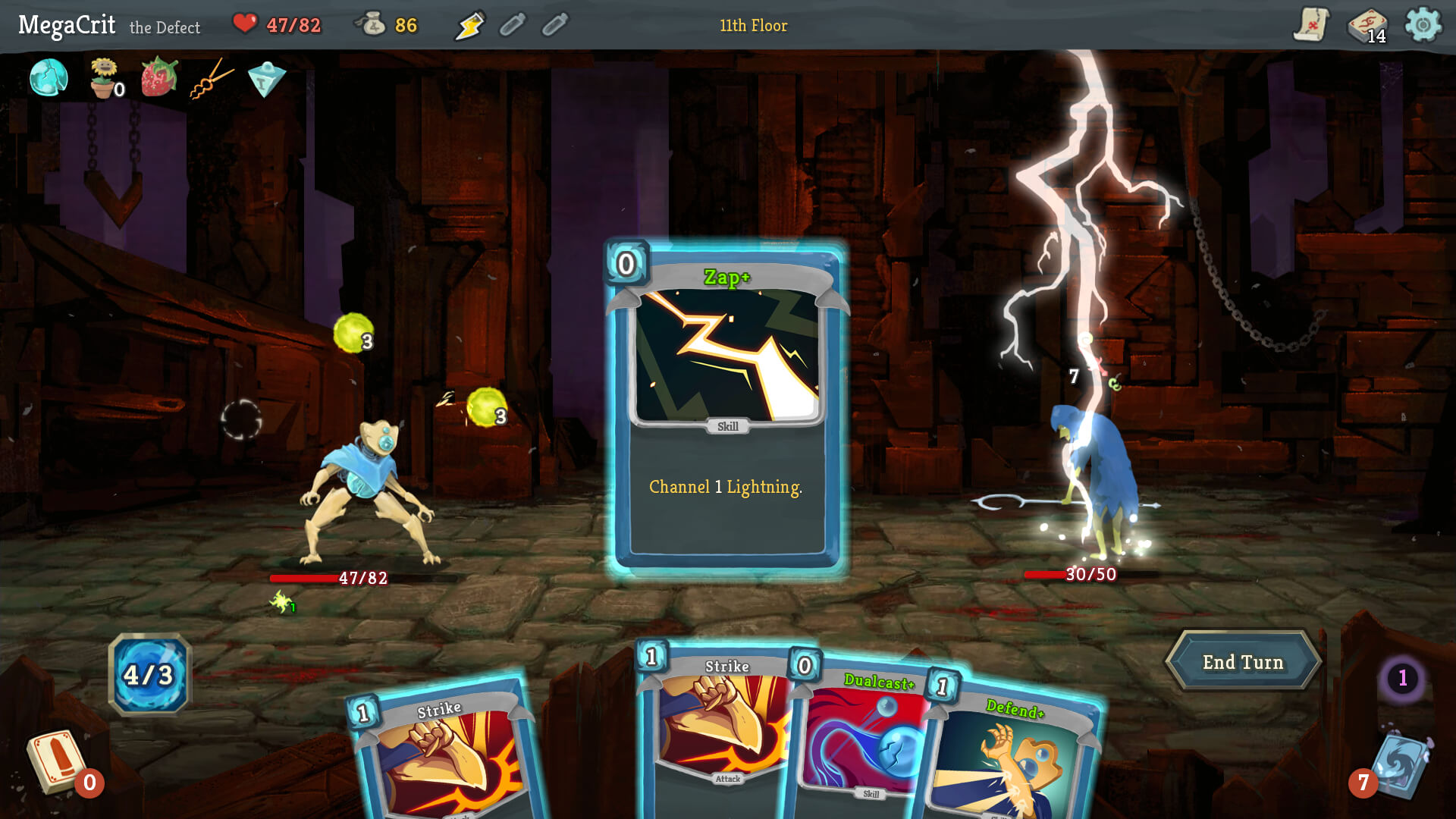
Four Strikes, four Defends, Zap (Channel 1 Lightning) and Dualcast (Evoke your next orb twice). The Defect starts with 3 orb slots. Lightning deals 3 damage to a random enemy at the end of each turn and 8 when Evoked; Frost gives 2 Block per turn and 5 when Evoked; Dark grows by 6 every turn and Evoking it hits the lowest-HP enemy; Plasma gives 1 Energy per turn and 2 when Evoked. Cracked Core Channels 1 Lightning at the start of each combat.
Two rules matter. Focus adds 1 per point to the passive and Evoke values of Lightning, Frost and Dark (not Plasma). And when every slot is full, Channelling a new orb Evokes the oldest (rightmost) one.
Archetypes
| Archetype | Key cards | What to look for in Act 1 |
|---|---|---|
| Focus and Frost | Defragment (+1 Focus), Biased Cognition (+4 Focus, lose 1 each turn), Glacier (7 Block + 2 Frost), Coolheaded, Cold Snap, Capacitor (+2 orb slots), Loop. Damage: Barrage (damage per orb). Relics: Data Disk, Frozen Core, Runic Capacitor | Coolheaded and Cold Snap first. Defragment is the card that turns Frost from a supplement into a wall |
| Lightning | Ball Lightning (7 damage + 1 Lightning), Electrodynamics (Lightning hits ALL enemies), Thunder Strike, Tempest, plus Focus | Ball Lightning is one of the best early commons. Electrodynamics is the Defect's main answer to groups |
| Power engine | Echo Form (first card each turn is played twice), Storm (Lightning per Power played), Heatsinks (draw per Power), Creative AI, Buffer, Amplify | Not an Act 1 plan. Take it later when your deck already survives |
Best early picks and cards to skip
The Defect's starting orbs are weak, so early damage comes from attacks that also Channel: Ball Lightning, Cold Snap (6 damage + 1 Frost), Sweeping Beam (6 to all, draw 1) and Doom and Gloom (10 to all + 1 Dark). Coolheaded, Charge Battery, Glacier and Defragment are strong picks once the first elite is handled.
Skip or delay these as a beginner:
- Meteor Strike. 5 Energy for 24 damage and 3 Plasma. Too expensive for most decks.
- Hyperbeam in a Focus deck. 26 damage to all, but you lose 3 Focus.
- Blizzard. Damage based on Frost Channelled this combat, which scales too slowly early.
- Force Field. Costs 4, reduced only by Powers played. Weak unless your deck plays many Powers.
Boss relics that suit the Defect
Nuclear Battery (Plasma at the start of combat: effectively +1 Energy every turn) and Frozen Core (Channel Frost if you end your turn with an empty slot) are strong in almost every Defect deck. Inserter (+1 orb slot every 2 turns) is slower and best in long fights. See the relic tier list for the general Energy relics.
Common Defect mistakes
- Taking Focus without orb generation. Defragment does nothing if you rarely Channel orbs.
- Evoking your best orb by accident. With full slots, every new orb pushes out the oldest. Count before you Channel.
- Drafting only good stuff. The Defect's individual cards are weaker than the other characters'. It needs a plan (usually Focus) by Act 2.
- Leaving slots empty. Empty slots are wasted value every turn. Capacitor is only worth it if you can fill the extra slots.
Watcher
Starting deck and relic
Four Strikes, four Defends, Eruption (2 Energy: 9 damage and enter Wrath) and Vigilance (2 Energy: 8 Block and enter Calm). Pure Water gives a Miracle (Retain, 0 cost, +1 Energy) every combat. Her starting deck is the strongest of the four, which lets her be pickier with card rewards.
The stances: Wrath doubles the attack damage you deal and take. Calm has no effect while you are in it, but leaving it gives 2 Energy. Divinity is entered by reaching 10 Mantra: it gives 3 Energy and triples attack damage, then ends at the start of your next turn.
Archetypes
| Archetype | Key cards | What to look for in Act 1 |
|---|---|---|
| Stance dance | Wrath entries: Eruption, Tantrum (3 damage three times, enter Wrath), Indignation. Calm entries: Inner Peace, Fear No Evil. Payoffs: Rushdown (draw 2 when entering Wrath), Mental Fortress (4 Block per stance change), Flurry of Blows, Empty Body, Empty Fist, Talk to the Hand | A cheap way back to Calm or out of Wrath (Empty Body, Empty Fist, Inner Peace, Fear No Evil). Entering and leaving Calm with 1-cost cards is Energy-neutral |
| Mantra and Divinity | Prostrate (2 Mantra + 4 Block), Devotion (2 Mantra every turn), Worship (5 Mantra), Brilliance. Relic: Damaru | Prostrate is the useful early one. The plan pays off in long boss fights |
| Retain | Establishment (Retained cards cost 1 less), Sands of Time, Windmill Strike, Perseverance, Protect, Meditate | Protect (12 Block, Retain) is a good early defensive card in any Watcher deck |
Best early picks and cards to skip
The Watcher already has strong damage in Eruption, so early picks should make stance changes safe: Empty Body (7 Block, exit stance), Empty Fist (9 damage, exit stance), Halt (extra Block in Wrath), Talk to the Hand, Wallop (Block equal to unblocked damage) and Tantrum. Cut Through Fate, Wheel Kick and Third Eye add draw and Scry, and Bowling Bash and Consecrate help against groups.
Skip or delay these as a beginner:
- Blasphemy. Enters Divinity, but you die at the start of next turn. Only play it when you are sure it ends the fight.
- Pray. 3 Mantra plus an Insight shuffled into your deck. It does little on the turn you play it.
- Conclude. 12 damage to all enemies, but it ends your turn, which is dangerous if you are in Wrath.
- Extra Wrath entries without exits. Every Wrath card needs a way back out before the enemy attacks.
Boss relics that suit the Watcher
Violet Lotus (+1 Energy whenever you leave Calm) turns the basic stance dance into an Energy engine. Holy Water (3 Miracles per combat instead of 1) gives a strong first turn. Because her deck stays small, any Energy boss relic with a harmless downside is also strong. See the relic tier list.
Common Watcher mistakes
- Ending a turn in Wrath when enemies are attacking. Their damage is doubled, and it is the mistake that punishes new Watcher players hardest.
- Entering Wrath with no exit in hand. Check for Empty Body, Empty Fist or a Calm card before playing Eruption.
- Ignoring Calm as an Energy bank. Ending a turn in Calm stores 2 Energy for the next turn's Wrath.
- Adding too many cards. Watcher decks work best small, so she can draw her stance cards every turn.
Which character should you play next?
The unlock order is fixed (Ironclad, Silent, Defect, Watcher), but once all four are open, use what you enjoyed to choose the next one.
| If you like… | Play | Why |
|---|---|---|
| Hitting hard and recovering between fights | Ironclad | The most HP, Burning Blood, and Strength scaling that is easy to read |
| Ironclad's Strength scaling and want more damage | Watcher | Wrath doubles attack damage, and her starting deck is already strong |
| Ironclad's Exhaust combos (Corruption, Dark Embrace) | Silent | Her discard and draw engine is the same kind of chain, with more pieces |
| Slow, safe fights and stacking defence | Defect | Focus and Frost builds can block almost everything once set up |
| Playing many cheap cards per turn | Silent | Shivs and 0-cost cards trigger Shuriken, Kunai and After Image many times |
| Planning several turns ahead | Defect | Orb order, slot count and Focus reward planning more than any other character |
| Short fights and big single turns | Watcher | Wrath and Divinity end fights in one or two turns |
| Less luck in damage targeting | Silent (Poison) | Most Poison cards hit the enemy you choose, while Lightning orbs hit a random enemy |
Related guides
Boss relic choices for every character are ranked in the relic tier list. Map routing, elites and card removal are covered in the beginner guide, and climbing difficulty in the Ascension guide. Our overall verdict on the game is in the review.
★Honest Take: the characters are balanced for experts, not for beginners
At high Ascension all four characters can win, and the "who is strongest" argument mostly comes down to the Watcher. For a new player the gap between them is much bigger than tier lists suggest. The Ironclad forgives mistakes; the Silent's first act is genuinely hard; the Defect looks weak until it has Focus; the Watcher looks easy and then loses a run to one turn ended in Wrath. The game does nothing to explain this, and the unlock system hides key cards such as Catalyst and Limit Break until you have played a few runs. Our advice: play the Ironclad until you beat the Act 3 boss, then pick the next character by the table above, not by which one is called strongest.