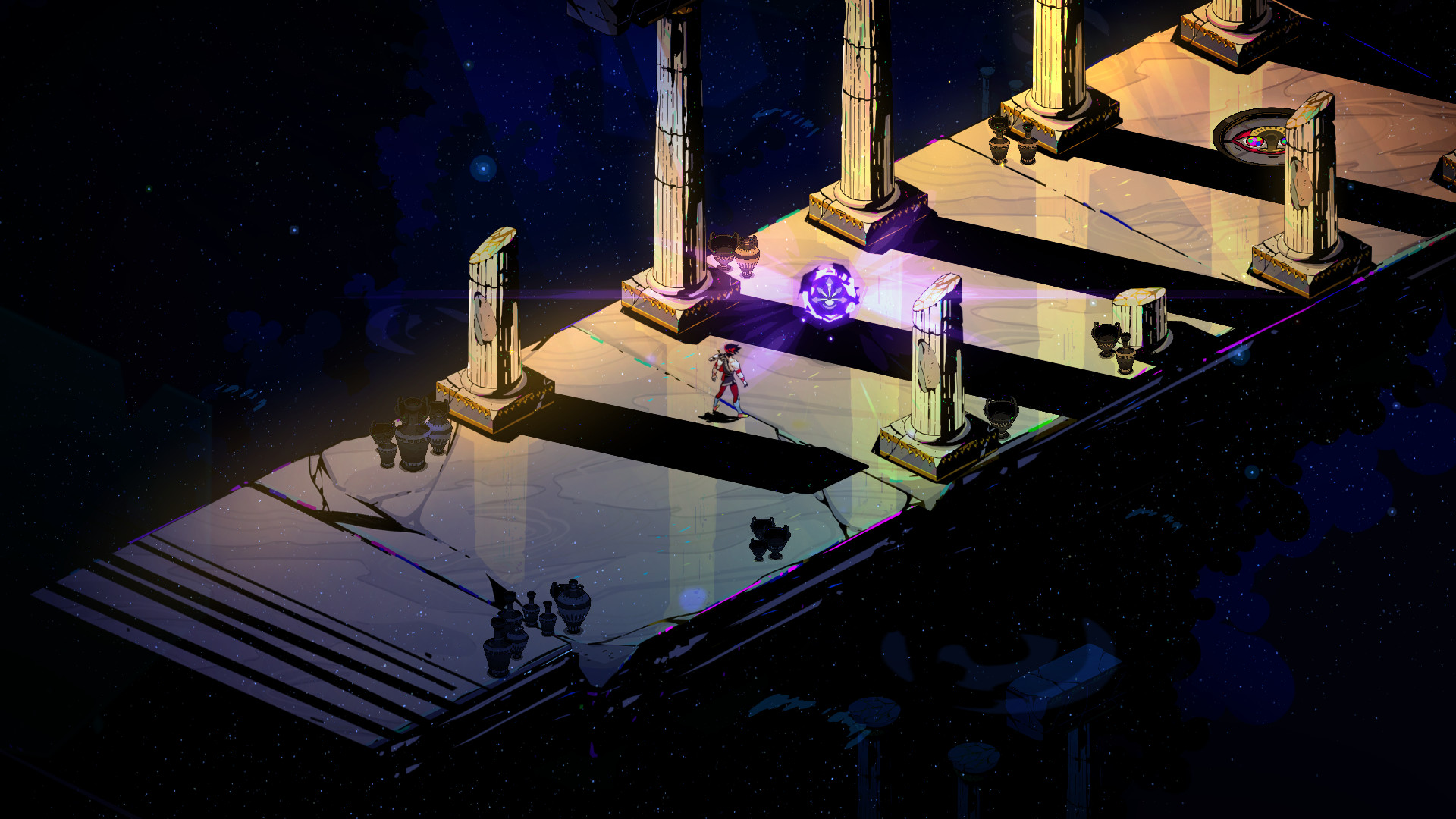

Hades is the fourth game from Supergiant Games (Bastion, Transistor, Pyre). It reached version 1.0 in September 2020 after almost two years of Early Access, holds a Metacritic score of 93 on PC, and won Game of the Year at the BAFTA Games Awards, as well as the first Hugo Award given to a video game. Its sequel, Hades II, reached its full release in September 2025. So the question today is not only "is Hades good" but "is it still the one to buy". This review answers that first.
Buy, wait or skip
| Your situation | Verdict | Why |
|---|---|---|
| You like action games and have never finished a roguelite | Buy | Permanent upgrades, God Mode and a story that rewards dying make it the easiest way into the genre |
| You plan to play Hades II as well | Buy this first | Hades II is a direct sequel; its story and characters build on this one |
| You want the biggest, most complex game in the series | Play Hades II instead | More weapons, routes and systems; the first game is simpler and shorter |
| You are price-sensitive | Buy, ideally on sale | It already sells at an indie price and is discounted often |
| You want co-op or online play | Skip | Single-player only, with no plans for multiplayer |
| Repeating the same route dozens of times sounds like work | Skip | The four regions never change order; variety comes from builds, not from the map |
| You prefer turn-based strategy to reflexes | Skip, or look at Slay the Spire | God Mode lowers the pressure, but every fight is real-time |
Short version: Hades is finished, cheap and still one of the best places to start with roguelites. Hades II does not make it obsolete; it continues its story.
What kind of game it is
You play Zagreus, son of Hades, trying to escape the Underworld to reach the surface. A run goes through four regions in a fixed order — Tartarus, Asphodel, Elysium and the Temple of Styx — each made of short combat chambers, and ends with a fight against Hades himself. Before each chamber, the door shows its reward: a boon from an Olympian god, a Daedalus Hammer weapon upgrade, gold, health, or a permanent resource.
Boons are the core of each run. Nine Olympians (Zeus, Poseidon, Athena, Aphrodite, Artemis, Ares, Dionysus, Demeter and Hermes) plus Chaos offer powers for your Attack, Special, Cast, Dash and Call. One run might freeze enemies with Demeter; the next chains lightning with Zeus. When you die, Zagreus returns to the House of Hades with the permanent currencies he collected, talks to the household, and spends Darkness at the Mirror of Night on lasting upgrades. Then he tries again.
Current state: what you get today
| Item | Status |
|---|---|
| Release | Full release since September 17, 2020 (Early Access from December 2018) |
| Platforms | Windows and macOS (Steam, Epic), Nintendo Switch, PlayStation 4/5, Xbox One and Series X|S. The iOS version on Netflix Games was removed in July 2025 |
| Updates | Finished. The last patch (February 2022) made it Steam Deck Verified |
| Monetisation | One-time purchase; no microtransactions and no paid DLC (only the soundtrack is sold separately) |
| Multiplayer | None; single-player only |
| Languages | English voices. Text in English, French, Italian, German, Spanish, Russian, Brazilian Portuguese, Korean, Polish, Simplified Chinese and Japanese |
| Saves | Cross-save between PC and Switch; not with PlayStation or Xbox |
| DRM | The PC versions are DRM-free |
Nothing is coming for the first game. Supergiant's work moved to Hades II, which is a separate purchase, not an update.
What it does well
Combat that rewards skill and builds
Six weapons (the Stygian Blade, Heart-Seeking Bow, Shield of Chaos, Eternal Spear, Twin Fists and Adamant Rail) each have four aspects, for 24 ways to play. The dash is short and gives brief invulnerability, enemies telegraph clearly, and fights are short enough that one mistake rarely ends a run on its own. Boons then reshape the weapon: Athena's Divine Dash deflects attacks, Aphrodite weakens foes, and a matching pair of gods unlocks Duo Boons that combine both. The boon build guide explains which pairs work, and the weapon aspect guide ranks all 24 aspects.
Dying moves the story forward
Supergiant's official FAQ promises around 30 fully voiced characters and "thousands of unique events and interactions". In practice, characters comment on how you died, what you used, who you met and what you said before, so a failed run usually ends with something new. This is what makes Hades different from most roguelites: you keep playing to see the next scene, not only to win.
A real ladder for beginners
The game is designed so that resources can make up for skill. Death Defiance (an extra life at the Mirror), healing fountains bought from the House Contractor and keepsakes earned with Nectar turn a run that died in Elysium into one that reaches Hades. The beginner guide lists what to buy first.
Art, music and voice acting
Jen Zee's character art, Darren Korb's soundtrack and the full English voice cast are consistently strong. The music and visuals are one reason the same rooms stay pleasant to revisit.
Where it falls short
The route never changes
Every run is Tartarus, Asphodel, Elysium, Styx. Rooms are shuffled and rewards vary, but the structure and bosses repeat. After the first escape, much of the variety comes from your build and from the Pact of Punishment, which adds Heat (difficulty) in exchange for rare currencies. Bosses also gain variants after a few wins. If you do not enjoy mastering the same fights, the route will feel routine well before the story is over.
Boon luck
A boon chamber usually offers three boons from one god, and you cannot choose which god appears next. Keepsakes help (an Olympian keepsake guarantees that god's next boon), and the Fated Persuasion talent at the Mirror adds rerolls later, but a run can still miss the piece a build needs.
The full story is a long road
The first escape is not the ending. The credits roll after 10 successful escapes, and the epilogue then needs specific conversations plus high affinity with six of the nine Olympians, which takes much more Nectar than a normal playthrough gives. Dialogue triggers are partly random, so a specific scene can take a while to appear. This is good news if you love the cast and a slog if you only wanted "the ending".
How the story works across runs
The narrative is built around repetition instead of in spite of it:
-
1
Early runs: learning the house
Each death brings conversations with Nyx, Achilles, Hypnos and others. You learn why Zagreus wants to leave, and start giving Nectar to earn keepsakes and build relationships.
-
2
The first escape
You reach the surface for the first time. Without spoiling what happens there, it raises more questions than it answers, and you return to the house to keep going.
-
3
Escapes 2 to 10
Each successful escape adds a new piece of the main story. After the 10th, the credits roll.
-
4
The epilogue
Relationship stories with the household and the Olympians lead into a final story event. It needs high affinity with most of the Olympians, so it rewards players who keep visiting everyone.
-
5
After the story
Heat, the remaining aspects and character side stories keep going. The Heat bounties stop at 20 Heat; beyond that, you play for the challenge.
Because the story only advances through runs, how fast you see it depends on how often you escape. That is where God Mode comes in.
God Mode and Hell Mode
God Mode can be switched on at any time from the menu. It gives 20% damage resistance, which grows by 2% each time a run ends in death, up to 80%. Switching it off removes the resistance but keeps the percentage for next time. It locks no achievements or story; only the run records are kept separately. Supergiant added it so players who are struggling, or who mainly want the story, can play their way.
Our view: if you are here for the characters, use it without guilt. If you want the satisfaction of beating Hades unaided, leave it off; the Mirror will get you there more slowly. The honest downside is that high resistance lets you tank hits instead of dashing, a habit that does not carry over to higher Heat.
At the other extreme, Hell Mode is chosen when you create a save and cannot be changed later. It starts you with five Heat of mandatory Pact conditions, including one exclusive to Hell Mode, and disables God Mode. It is for players who already know the game. The Mirror of Night and Heat guide covers Heat in detail.
Common complaints, and how true they are
| Complaint | Is it true? | What helps |
|---|---|---|
| It's too hard | Early runs are hard; most players die many times before the first escape | Mirror upgrades (Death Defiance first), healing keepsakes, the Shield or Bow, and God Mode |
| It gets repetitive | Yes, the four regions and bosses repeat | Rotate weapons and aspects, try new god pairs, add Heat; boss variants appear after a few wins |
| Builds depend on luck | Partly; you cannot choose which god appears | Olympian keepsakes guarantee a god; the Mirror's reroll talents help later |
| The ending takes forever | The credits need 10 escapes and the epilogue more | God Mode speeds up escapes; give Nectar to everyone early |
| It's too easy once upgraded | At 0 Heat with a full Mirror, often yes | The Pact of Punishment exists for exactly this; Heat also pays the rare currencies |
Hades compared with similar games
| Game | Core loop | How Hades differs |
|---|---|---|
| Hades II | Same studio's sequel: Melinoë fights the Titan of Time on two routes, Underworld and Surface | Hades is smaller and simpler, with a self-contained story; Hades II adds magick and Ω Moves, gathering and more weapons and systems |
| Dead Cells | 2D side-view action roguelite with branching biomes | Hades is isometric, far more story-driven and more forgiving thanks to God Mode; Dead Cells has more route choice and paid DLC expansions |
| Slay the Spire | Turn-based deckbuilder roguelike on a branching map | Hades is real-time and rewards reflexes; Slay the Spire rewards planning and has almost no story |
If you liked Dead Cells, Hades will feel slower to vary but much richer in characters. If Slay the Spire is your favourite, Hades offers the same "one more run" pull through boons instead of cards, but asks for real-time skill.
Hades or Hades II?
Hades II had its full release on September 25, 2025 for PC, Nintendo Switch and Switch 2, followed by PlayStation 5 and Xbox Series X|S on April 14, 2026. You play Melinoë, Zagreus' sister, with new weapons (the Nocturnal Arms), a magick resource that powers Ω Moves, a Cast that binds enemies in a circle, and two routes instead of one. It supports more text languages, including Traditional Chinese. Supergiant says no knowledge of the first game is needed.
Still, the two are best played in order. The first game is shorter, easier to learn and tells the story that the sequel builds on. If you only have time for one and do not care about that story, Hades II has more content; if you want the story from its beginning, it is this one.
Related guides
Starting out: Beginner Guide. Which boons to take and how to steer them: Best Boons and Builds. All 24 aspects and Titan Blood: Weapon Aspect Guide. Mirror talents and Heat after your first escape: Mirror of Night and Heat Guide.
★Honest Take — the roguelite that made dying worth it
Hades earns its 9.4 because it solved the genre's biggest problem for newcomers: losing feels like progress. You get stronger, the characters remember you, and the story moves on. The combat is precise enough to keep experienced players busy through Heat, and God Mode keeps everyone else in the story. The weaknesses are real but narrow: a fixed route, random boon offers, and an epilogue that asks more time than many players expect. Hades II is bigger, but it is a continuation, not a replacement. If you have not played Hades yet, start here.